
The Future of RTI
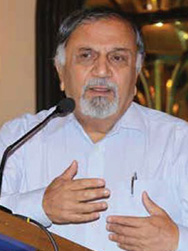
A true nationalist, Shailesh Gandhi has been a champion of transparency and honesty in the country. A tireless proponent of the Right to Information (RTI) Act, he has dedicated hours and days on spreading the importance of this Act and educating people on filling an appeal in a manner that it is sure to be answered. Amongst his other achievements as the Commissioner, Central Information Commission (CIC), are that his was the first paperless government office in India, and of having heard over 20,000 cases in his tenure, making it to 25 cases in a day!
“Fellow citizens of India, over a century ago, Lokmanya Tilak made a statement in Pune, which rings in my ears even today, ‘Swaraj ha maza janmasiddh adhikar aahe ani toh me minavnar (Swaraj is my birthright and I shall have it)’. On 15th August 1947 we got Swaraj. The question I’d like to pose is, are you happy with the governance in our nation? Swaraj mean ‘my rule’, so are you happy with your own rule?” with these very questions Shailesh began his enthralling speech.
“I would like to submit that on 15th August 1947, Swaraj never came! It’s all an illusion and a delusion, as what happened on 15th August was only a transfer of raj, from the whites to the browns, but the raj still remains. And it remains without us realizing it.”
Continuing further he adds, “Friends tell me, how is it possible, we are one of the world’s largest democracies? We he people of India made the constitution and we follow it… True! We call ourselves a democracy because we have a reasonably fair system of elections, by which we are able to choose leaders, change governments, and so on. However, elections and the constitution are necessary conditions for democracy, but do not fulfill the complete set of conditions required. The heart and essence of democracy is in the concept that each individual citizen is a sovereign in his/ her own right and they hand over a part of their sovereignty to the state, in return of which they get the rule of law. Sovereignty of the individual is at the base of democracies and of entire human rights concepts, which we’ve missed completely!”
“But one may ask, how can I have 125 crore sovereigns? Incidentally in Hindi, Marathi and in Gujarati, we call this Lok Shahi. Lok Shahi means ‘logon ki shehenshahi’, wherein you are made to feel like a Badshah or a Begum when you interact with the government, but that doesn’t happen. Normally when a citizen goes to a government office, he comes out feeling angry, humiliated and frustrated.” What can be done to bring back the respect or sovereignty for the individual? Is this possible any where in the world or is it just a play of words? “I’d like to quote an example to show you how respect for human beings is the basis for anything proper to happen. I’d like to take you back 125 years to South Africa. Mohandas Karamchand Gandhi got inside the train and although he had a first-class ticket was pushed out because he was a brown man. He then sent out a telegram complaining about what had happened to him, and in about 12-14 hours, a railway official came and put him on the next train. Think of the significance of this… Mohandas Karamchand Gandhi was not a citizen of South Africa. In fact, by South African law he was a second grade human, yet when he complained, the system responded in 12-14 hours even though there were no mobiles or Internet. However, if you file a complaint with the Indian Railways, it’s doubtful that you will even get a response in 12-14 years. This respect for an individual, for every human being, is the basis of democracies and civilization”, he affirms.
“Some people say, this is all very good for an affluent country, but not for a country like ours. I would like to point out that the first Right to Information or Freedom of Information law was passed in Sweden on 2nd December 1766. Sweden at that time was a backward country. Shailesh Gandhi Simplifies The RTI Application Process Who can file an RTI application? Any Indian citizen can file an RTI application. Who has to give the information? The law defines, what is called as a ‘public authority’. What is a public authority? All Government agencies, as we normally understand, and any agency, that is substantially financed, controlled or owned by the government. Who should I send the application? Think of who has that information. What is information pray? Information is something that exists on records, which must be given to you.
What is the process? Start by writing your information pray on a simple sheet of paper, put a 10 rupees court fee
stamp. If it is related to the central government, take an Indian Postal order of 10 rupees, attach
it and send it off, and you start a very powerful process. And India, on the other hand, was a ‘sone ki chidiya’. Over 12-15% of the world trade was controlled by India. Therefore, my point is that it’s not capitalism, it’s not science; it’s not technology, but democracy, that releases the energy of the people in a nation, in a positive manner which leads to progress.”
“Today, the RTI Act has spread very well. It receives over one crore applications annually from across the nation; be it from villages, cities, or towns, as everybody is using it. However, we are also seeing a huge resistance in the proliferation of this law. A lot of attacks are being made on RTI by almost everybody in power, because it is inconvenient. For those who are corrupt, it’s obvious that they don’t want to be transparent. But for those who are honest, there’s arrogance that while I’m doing my work sincerely, then why is it that people want to know about my trip, or what I did, and so on and so forth. Therefore, now we have a small crisis, if I may call it”, laments Shailesh.
“And the reason why I’m telling you this is because; it is only individuals who have ever made changes to democracies and societies. Let me give you a powerful use of Right to Information.”
“This is a story of a young man, Tukaram, 22 years of age, who came from a small village in Maharashtra to Mumbai in 2006 to find a job. He started living with his uncle in a jopadpatti (slum). During that time, an RTI workshop was conducted in his basti. So he sat through the workshop, and understood the ease with which an application can be made.”
“He then got a job and needed proof of existence, i.e., a Ration Card. So he applied for one, and as he was leaving, the peon told him at the door, ‘aapko Ration Card chahiye toh chai paani lagega’. So he said, ‘theek hai piladunga’. The peon said, ‘chai pilaneki baat nahin, you have to pay 2000 rupees. This young boy without batting an eyelid said, ‘I shall not give any bribe’, and went away.”
“After two and a half months of waiting, he made an RTI application to the Public Information Officer at the Rationing office. Since he knew that he would only be able to get information, that which is on record, he requested to know what action was taken by the officer on his ration card application, and also a list of people who applied for Ration Cards from his area, dates on which they applied and when they received their Cards.”
“You can imagine if an answer were given to this, the corruption would have been obvious. Even if the bosses were corrupt, they could not have shielded something like this. So the next day, the same peon came to his house and said, ‘saab ne bulaya hai’. He went to the office; there he was not only given his Ration Card, but was also offered a cup of tea and water. He did not give chai paani, but he got chai paani instead. That my friends, is the power of RTI!” exclaims Shailesh.
“Another powerful law that I’d like to talk about is Maharashtra’s Act 21 of 2006, which I call as the confidential law because most people don’t know about it. As per this Act no decision on any file can take more than 45 days if a matter has to be decided within the department, and no more than 90 days where other departments have to be consulted. If however, an application / complaint / representation has received no response for over 90 days, and if the citizen brings it to the notice of the Secretary of the department, the Secretary is obliged to take disciplinary action against the concerned officer. Like RTI, if this law too is widely and appropriately used, it has the potential to change governance in Maharashtra.”
“Also, as per the RTI Act, if all government documents are digitized then there would be no documents missing or being burnt in a fire or eaten by rats. With this alone, 30% of India’s corruption will come down. However, no one talks about it. Crores of rupees are spent in the name of digitization, but nothing serious is being done.“
“Therefore, instead of cribbing, see if you can identify the various issues that affect you and address them in a way whereby you can change the government by design, and make them stronger, better and get them to deliver for each one of us. Can we do that? …The responsibility is yours!”