
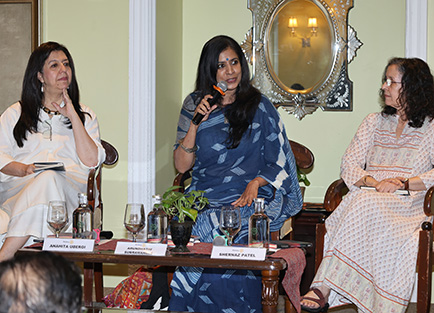
The Gallery of Upside-Down Women: A Conversation on Voice, Mysticism and Poetry Arundhathi Subramaniam, Shernaz Patel and Anahita Uberoi
Arundhathi Subramaniam: Thank you so much, and thank you for having us here. I should tell you something about what to expect before we actually plunge into this reading. The Gallery of Upside-Down Women is a book of poems I wrote, published last year by Penguin. It is a book that marks the culmination of a very long journey.
So, to set the stage, I am going to give you a glimpse of that journey, because I am aware of one thing. I am aware that many of us nurse a certain fear, or sometimes a certain resistance, to poetry. I am not sure how many of those people are in the audience, perhaps none. But I know, personally, having had my share of unimaginative school teachers who asked the question, what is a poem trying to say? And that is a question that would fill me with dread, because I never had an answer to that. I knew I loved a poem, but I had no clue what it was saying most of the time.
It took me a very long time, and much of my lifetime, really, to realise that a poet is never trying to say something. A poet is saying it. And it is as simple as that. So I want to use that as an entry point into what we are going to be talking about today.
I have been a seeker, perhaps even more fundamentally than a poet. And at different times in my life, I have been deeply nourished, even rescued, by the voices of many, many mystic poets, whether it is Hafiz, whether it is St. John of the Cross, whether it is Basho. In this subcontinent: Kabir, Tukaram, Nammalvar, so many of them.
But a question that remained for me was: where are the women? Do they exist? And are they worth listening to? And where on earth are they? I know that most of us know of a sprinkling of women across spiritual traditions. Some of us may know Simone Weil, some of us may know Rabia in the Sufi tradition. And of course, in this subcontinent, we know Meerabai. Who does not know Meerabai, right? We all know Meerabai. In the north, in the south, we all know Andal.
But this is just a handful. Where on earth were the other women? What were they doing?
That was a question that fuelled an enterprise that lasted a decade in my life. So, it gave rise, really, to an anthology called Wild Women, which is a compilation of 56 extraordinary women poets who exist in this subcontinent.
And about them, I just want to say I made two discoveries. One, that even the women we thought we knew, Meerabai, Andal, Akka Mahadevi, for instance, these women have been flattened into calendar art. They have been turned into antiseptic plaster saints. So, we see them eternally swooning in states of beatitude at the feet of their deities. That is how they are presented by religious narratives. What we do not hear is the danger in their voices.
And then I discovered there are legions of other women from all over this country, in innumerable languages, who have just remained unmapped. So I realised that whether you are sanctified by religious narratives or whether you are sidelined by rationalist narratives, either way, you are lost.
So this entire project has been about retrieving a sisterhood that I wish I had known about. I should have known of these women growing up, and I did not. And that, to me, is one of the great tragedies of my life. And I believe it could have been a collective tragedy, because there are not many of us who know these voices.
What do I mean by these voices? I mean the voice, for instance, of a 14th-century Dalit woman mystic poet of this very region, Soyarabai, who asks the question: If menstrual blood makes me impure, tell me who was not born of that blood? Why did I never hear of Soyarabai?
Why did I never hear of the 18th-century Tamil woman mystic, Avudai Akkal, who says, if saliva is a matter of ritual orthodoxy, she asks in one poem, she says, if saliva makes someone impure, then the very Vedas that emanate from the mouths of Brahmins are impure.
These voices, voices of sass, voices of temerity, why did I never hear them? Why did I never know of a 17th-century Kashmiri woman mystic, Roop Bhavani, who says: I have not bowed. I never will. The one who listens stands resplendent within me. That is worship. That is what I do.
Why did I never hear her? The same Rupa Bhavani asks us: How will you recognise an enlightened woman? And her answer to that is: Will she be wearing ochre? Do you think she will be wearing ochre? Do you think she will have her hair tonsured? And Rupa Bhavani says: The ever-alert plays and dances just like others do. She decks herself; good clothes she wears. On the path of Shiva, she becomes Shiva himself.
No longer about a bowing and scraping relationship with the divine, but a woman who will settle for nothing less than embodying the divine.
And finally, before we plunge into our upside-down women, to give you just a flavour of the kind of dangerous woman I am talking about, here is the 13th-century Marathi woman mystic, Janabai, who has such a back-slapping relationship with her god, Vitthala. It is familiar. It is a relationship between buddies. When Janabai is tired, she asks Vitthala to do the dishes. When she is even more exhausted, she asks Vithoba to wash her hair.
And sometimes she writes a poem like this one:
Arundhathi Subramaniam recites:
God, my darling, do me a favour and kill my mother-in-law.
I will be lonely when she is gone,
but you will be a good God, will you not?
And kill my father-in-law.
I will be glad when he is gone,
but you will be a good God, will you not?
And kill my sister-in-law.
I will be free when she is gone.
I will pick up my begging bowl and be on my way.
And then it is just the two of us, you and I.
That is the kind of woman I am talking about.
So, having spent so much time putting together this anthology, which I hope some of you will pick up, it is called Wild Women, it was inevitable, having spent time in such disgraceful company, that they would leak into my own poetry. And that is how The Gallery of Upside-Down Women happened.
So, I am going to read you a poem about one of the women mystics whom I believe deserves to be much, much better known. A lot of the poems in this book are just me allowing these women to speak through me. They are what we call dramatic monologues, where you allow yourself to speak in other voices, and you allow other voices to speak through you.
And so, I cannot have better company than two actors and two friends, the only actors I would entrust my poems with. Thank you both for being here.
So, I am going to start with the first poem, and then we will move on to Shernaz and Anahita. But part of the reason for telling you about these women is that I want you to know about them.
So here is a woman who deserves to be better known. She is a 12th-century Kannada woman mystic called Sule Sankavva. And many people, even in Karnataka, do not know about her. She wrote ecstatic poems to Shiva, and she was a prostitute. Both are true. She acknowledges both.
And the wonderful thing about Sule Sankavva is that she gives us a definition of God that I think we could all welcome into our own lexicons. And this is her definition. She calls her God Nirlajjeshwara, the shameless God. This is not a God she has to purify herself to reach. This is a God who will get his hands grimy trying to reach her.
And she makes absolutely no apology. There is no trace of shame or guilt about her profession. Both are acknowledged: her love of God and her profession.
So I had to write a poem to her, which ended up being a poem in which I adopt her voice. And the only thing I will say about this poem before reading it is the fact that I have Sule Sankavva mention a whole lot of other women mystics. You may not know their names, and it does not matter. I mention them because women need to be named. They have been forgotten. They deserve to be acknowledged.
So I mention a whole lot of them here.
Arundhathi Subramaniam recites:
God’s Forgotten Nickname — Sule Sankavva
Who says harlots do not have choices?
We cannot choose our clients, and believe me, I have seen them all.
Fried, boiled, scrambled, poached, sunny side up, runny side down.
But we can choose our gods.
I chose mine because he came without a name,
and on some nights, without a body.
I chose him because he waited his turn,
did not ask me to hurry or clean up,
did not complain about the line of shuffling men at my door.
When colleagues badger me for details, I turn sassy.
I say, Mahadevi’s God unhoused her,
Janabai’s deloused her,
Andal’s aroused her,
Avvaiyar’s doused her.
Some like them fried, some like them boiled,
some like them immaculate.
I like my gods
soiled.
But they are not impressed.
He must have a USP, they claim,
a sun sign, an address,
for God’s sake, a name.
I grow quiet.
He has a garland of fancy titles, I say,
but they do not quite work for me.
Maybe he is the world’s greatest lover,
but how does that count
when planets shrivel and char
in the flaming cemetery of his gaze?
And maybe he birthed the three worlds
beneath the delirious hurricane of his feet.
But how does that even matter
if he is too bloody innocent
to read the lurch and plummet
of a contrarian heart,
the fine print of my breath?
And yet, he is mine.
He is mine, friends, for a simple reason.
For he rushes to my side
when I utter his darkest,
most intimate,
most forgotten nickname.
The one coveted by every god there is.
My God.
Without shame.
Thank you. We are going to move on to another 6th-century Indian woman mystic from the southernmost part of India. We do not know much about her. We know that she was also a devotee of Shiva. And we know, oddly enough, that this woman gave up youth and beauty and chose to adopt an utterly grotesque, demonic form. And we know, and this is how the book derives its title, that she chose to walk upside down.
Who on earth was this woman? Is this for real? Is Karaikkal Ammaiyar for real? Are we to take the story literally? We do not know. We know that there are still sculptural reliefs in Cambodia, in Angkor Wat, that acknowledge Karaikkal Ammaiyar. We know that Karaikkal Ammaiyar left behind a bequest of tremendously scorching poetry, and somewhere that idea of upside-downness, and what it means to each one of us, lingers.
Shernaz Patel recites:
That Girl from Karaikkal
Her husband, Paramadattan, speaks.
She was not exactly the girl you took home to Mum,
that agate-eyed child-woman of Karaikkal.
There was something about the way she hardly ever blinked,
something about the lightning quiver of sinew in her arm.
But I took her home anyway, and I was not disappointed.
I mean, she did the right things at first, stirred the rasam,
laughed at my jokes,
wrote pretty songs about the family gods,
wove jasmine into her evening braid.
But then I began to smell the ash in her hair,
heard her grind her teeth in her sleep,
caught a whiff of something like flesh in her kitchen.
And once, when she peeled off her sari,
I could have sworn I glimpsed the hideous shock of bone.
The day she gave me a mango, reeking of foreignness,
of orchards far beyond the postcode of this planet,
the kind of mango that would drip yellowly,
maniacally down your chin,
the kind no good woman would be seen dead eating,
I knew it was time I did the right thing by her.
I touched her feet,
anointed her a goddess,
got myself another wife.
They tell me about her sometimes,
the fisherwoman by the beach,
the parrot seller from Kashi,
the trader from the wind-scoured whiteness of Tibet.
They say she has walked from this coastal town,
with its gold and tamarind sun,
all the way to a Himalayan winter on sinewy,
blue-veined hands,
legs splayed obscenely in the wind.
They say she sings songs to outcast gods,
stirs tsunamis into her rasam,
shares mangoes with the ghouls, laughs in charnel grounds by night.
And when folk from distant lands come to seek her blessing,
she offers them the same counsel:
No need to flee to the forest, seeker.
Stay right here in the madcap town.
Do exactly what you have always done.
Just do it upside down.
We have Sule Sankavva and Karaikkal Ammaiyar, two dramatic women. But I was also interested in the quiet woman.
Two thousand five hundred years ago, we had that extraordinary anthology that is still with us today, thanks to the efforts of compilation undertaken by the Buddhist tradition. So, at the time of the Buddha, the many nuns in the Sangha compiled their poems in a remarkable anthology called the Therigatha, which some of you may know.
And perhaps one of the quietest women in the Therigatha is Patacara. Patacara had a tumultuous life, lost her children, lost her husband, and everything that really would be a recipe for PTSD many times over. She joined the Sangha, met the Buddha, and yearned to be enlightened.
And one day, after years of waiting, we are told that she went into her cell, she washed her feet, watched the water flow from high to low, went into her cell, pulled up the candle wick, and was enlightened. As quiet, as undramatic, as matter-of-fact as that.
I wanted a tribute to that quiet woman.
Arundhathi Subramaniam recites:
Patacara Awakens
It seems to happen for others like a thunderclap,
not for me.
I had had my thunderclaps earlier,
you see.
A family wiped out by lightning and snakebite and hawk and riptide.
A badly written script, you would say,
but that is how scripts were written in my time.
It happened on an unremarkable day.
I watched a nun play with a squirrel near the old stone sink.
I wanted to tell her creatures that furry and cute were not to be trusted,
were more perishable than most.
But it was the first time she had looked happy in months,
so I held my tongue.
Over lunch, a preening novice told me the Immaculate One appeared to her,
aureoled in dream dust, and instructed her to burst the smoky bubble
of her karma by the next full moon.
I felt a stab of something then, like envy. I mean, I was not arrogant or lazy,
so why should I be denied such a visitation,
cheated of such a boon?
Would the Master never grant me my very own full moon?
And so I got down to work, sweeping a tornado of leaves in the yard,
until their hypnotic sibilance, sal, simal, shisham, sal, simal, shisham,
began to shush the slipstreams in my heart.
At sundown, I washed my feet,
watched the water flow past the ridge of my ankles,
the gradient of my toes,
and settle into warm Gangetic alluvium,
from which more trees would grow,
more grieving mothers,
more nuns dreaming of the full moon.
Then the last currents of thought vanished into a vastness,
like a great yawn of terai suspended in a wobble of sun.
Entering my cell, I performed the first act of my lifetime like I authored it.
I forgot about dreams of the Master,
and I forgot about moons, full, gibbous, crescent.
I forgot every doctrine about the flickering, the empty, the evanescent.
I pulled up the candle wick and gate-crashed into the present.
Let me assure you that I do not just write about women who are long dead and gone. So I am going to move on to a fun poem, which involves a woman, an upside-down woman, though she would not see herself that way, a contemporary woman.
It is also a poem that is an ode to sambar. I do not know how many of you enjoy your sambar. I hope there are some of you in this room who do. Sambar is the mainstay of my life, though I do not have it as often as I believe I ought.
Arundhathi Subramaniam recites:
Consecration
No one needs to explain consecration to my mother.
She is not interested in preparing a meal fit for the gods,
though she knows well how one god is appeased by dumplings of melted jaggery
and another with black sesame.
What does one say of the high priestess
who knows how to gild water and spice air into tamarind rivers,
loamy and Gangetic, silted with lentils,
where drumsticks float like heavy-lidded crocodiles
under a red chilli sun?
What does one say of her who knows when to intervene
and when to allow matters to cook in their own juices?
Who knows when to pound, when to desiccate,
when to sauté, when to macerate?
When to alchemise, transubstantiate,
when to simmer, when to refrigerate, when to act,
and when to wait?
What do you say of a woman
who can condense the sacred
into sambar on your plate?
And there are not just women in the pages of this book. To prove that, we have made sure we have included one man. No, there are many others. You will find them if you were to pick up the book, which is available. But this particular poem is a tribute to a tailor.
I also write about tailors, amongst many other things. It is a tribute to a tailor. I like to believe that if the world ends, and of course we hope it will not, but if it does, it will not end because of a bunch of self-important men in the corridors of power. It will end perhaps because of that humble tailor down one street.
Anahita Uberoi recites:
The Tailor
I knew a tailor beneath a peepal tree,
flanked by a dog that was always asleep.
He walked 20 miles to reach his tree,
never looked up from his Singer sewing machine,
never took holidays, even when the roads flooded and the skies blazed,
and when the buses stopped and then the trains,
when shutters came down and doors slammed,
and the plague raged,
he sewed masks.
Except that one day his heart decided to lock down.
And then a denim sky was rent apart.
Buttons bursting, hemlines snagging, zips flying, elastic snapping.
He left behind an unspooling sky,
a sleeping dog, a whirring machine that knew all about songs
outliving their singers.
And he left behind a planet unravelling,
unravelling all the time into a more perforated,
ready-to-wear original,
closer to what another man under a peepal tree seemed to know 2,500 years ago.
All because he had been survivor enough to don his share of black holes,
seamster enough to know that an awakening is often an unseaming,
Indian enough to have seen the world end many times over.
We have been trying to figure out what to read, and we are going to wind down shortly because we do want to have a conversation with you as well. But I am tempted to ask Shernaz to read a poem from an earlier collection. It is a moment that I think we would all recognise.
I do not know about you, but for me, growing up was about seeing parents largely as the backdrop to my life. I never really thought of them as individuals in their own right. But I think there comes a moment in one’s childhood, at some point in each one of our lives, when one swivels and suddenly discovers that backdrop is actually a flesh-and-blood person. That is a shock of recognition. And this is a poem about that shock.
Shernaz Patel recites:
When Landscape Becomes Woman
I was eight when I looked through a keyhole
and saw my mother in the drawing room
in her hibiscus silk sari,
her fingers slender around a glass of iced cola.
And I grew suddenly shy
for never having seen her before.
I knew her well, of course.
Serene undulation of blue malmal,
wrist serrated by a thin gold bangle,
gentle convexity of mole on upper right arm,
and her high-arched feet,
better than I knew myself.
And I knew her voice,
like running water, ice cubes, and cola.
But through the keyhole
at the grown-up party,
she was no longer geography.
She seemed to know how to incline her neck
just so, to sip her swirly drink,
and she understood the language
of baritone voices and lacquered nails
and words like emergency.
I could have watched her all night.
And that is how I discovered
that keyholes always reveal more than doorways,
that a chink in a wall is all you need
to tumble into a parallel universe,
that mothers are women.
We wanted a mix of tones, so thank you for bringing that tenderness into the reading.
I am going to conclude this reading with a joyous poem, a fun poem. And we have one more in store for you if we have time at the end of our conversation. But here is a fun poem which is, yes, it is about women, but if you are not a woman and you enjoy your chai, then this poem is for you. Caffeine in any form, really.
Maybe one should stand for this. It is an anthem.
Arundhathi Subramaniam recites:
When Two Women Drink Chai Together
All is well in the world
when two women drink chai together.
Time holds its breath,
star anise glitters,
ginger gives up the ghost,
lemongrass grows rogue,
cinnamon is less sinned against than sinning.
Bodhidharma awakens
when two women drink chai together.
Aeolian harps trill,
kettle drums roll,
mind meets heart,
part becomes whole.
Apothecaries smile and sommeliers sing,
Lao Tzu intones the Dao De Jing,
Nilgiri meets Darjeeling
when two women drink chai together.
Froth of jade, jewel dew, ancient cauldron,
friendship brew.
One’s a hermit, ten is a jamboree.
The perfect number is always three.
A cackling duo and a pot of tea,
two women drinking chai together.
There will be time to love our men,
but not when caffeine meets oestrogen.
The defence budget and the state of AI
must stand aside as earth meets sky.
Ours is not to question why
teaspoons tango and hippos fly
when two women drink chai together.
There will be a time when both God and beast
are included in our cosmic feast,
and one day it will not be out of line
to quaff a martini or a bottle of wine.
But right now, friend, it has been too long,
oolong, oolong… Oh! Bloody long,
since two women drank chai… together.
Thank you.
We will do one mad poem for you, a fun poem for you.
Okay, this one is addressed to women again. It is an anthem for women. But it could also be addressed to men if you identify with this essential condition, which is, what does it mean to be going downhill? What does it mean to be a person of a certain age going downhill and enjoying it?
Arundhathi Subramaniam, Shernaz Patel and Anahita Uberoi recite together:
A Song for Catabolic Women.
We are bound for the ocean and a largesse of sky.
We are not looking for the truth or living a lie.
We are coming apart. We are going downhill.
The fury is almost done. We have had our fill.
We are passionate, ironic, angelic, demonic,
clairvoyant, rational, wildly Indian, anti-national.
We are not trying to make peace.
We are not itching for a fight.
We do not need your shade,
and we do not need your light.
We know charisma is not contagious,
and most rules are egregious.
We are catabolic women.
We have known the refuge of human arms,
the comfort of bathroom floors.
We have stormed out of rooms,
thrown open the doors.
We have figured the tricks
to turn rage into celebration.
We know why the oldest god
dances at every cremation.
We have kissed in the rose garden.
We have been the belles of the ball.
We have hidden under bedcovers,
and we have stood tall.
We are not interested in camouflage or self-revelation,
not looking for a bargain or an invitation.
We are capable of stillness
even as we gallivant,
capable of wisdom
even as we rant.
Look into our eyes, you will see,
we are almost through.
We can be kind,
but we are not really thinking of you.
We do not remember names
and we do not do Sudoku.
We are losing EQ and IQ,
forgetting to say please and thank you.
We are catabolic women.
We have never ticked the right boxes,
never filled out the form.
Our dharma is tepid,
our politics lukewarm.
We have had enough of earnestness and indignation,
but still keep the faith in conversation.
We are wily Easterners,
enough to argue nirvana and bhakti,
talk yin and yang,
Shiva and Shakti.
When we are denied a visa,
we fall back on astral travel,
and when samsara gets intense,
we simply unravel.
We are unbuilding now,
unperpetuating, unfortifying, disintegrating.
We are caterwauling.
Catastrophic, shambolic,
cataclysmic, catabolic women.
ROTARIANS ASK
- Hi, Arundhathi. I have been hearing you for many, many years at Xavier’s. So happy to see you here on stage. I enjoyed this lovely collection of poems, and I was wondering if you have translated these, or how they came about. I mean, how does this work?
This is entirely a collection of my poems. So entirely. The book that I mentioned at the start, Wild Women, is a collection of translations that I commissioned as an editor and as an anthologist. So I would say to you, it would be wonderful if you picked up Wild Women, because it is really a collector’s item. It contains so many women mystic poets whom many of us do not know about. But I will also say that The Gallery of Upside-Down Women is a book of poems of my own, which is a tribute to some of these women. But it is about upside-downness of all kinds.
- You said the women were not recognised. Is it because they could not come out and share their poems like men did? Or is it because of our culture, that women had to remain at home and pray in front of God?
Thank you. It is a wonderful question. There are many different women, of course, different contexts, chronological, historical, and regional. So there are different reasons. But I would say it is a mix of all these.
One, of course, is that women have always written and women have always sung. And this is not very different even in the West. We really do not know of women poets for many centuries, and then suddenly they begin to emerge. Does that mean they never wrote? Does that mean they never made poems, never sang, never danced? They did all of that. They were just not considered worthy of documentation and archiving. That is really the primary answer.
The other is, of course, that many of these women were unknown in their lifetimes. Some of them were acknowledged regionally, but on a pan-Indian level, no one knows them. I wanted to choose women who had made every kind of life choice. The solitary woman, the mendicant, the monk, the sex worker, the courtesan, the householder, women who had husbands who were also their spiritual partners. There were so many.
And they are part of our folklore sometimes, but they have never been taken seriously as poets in their own right.