
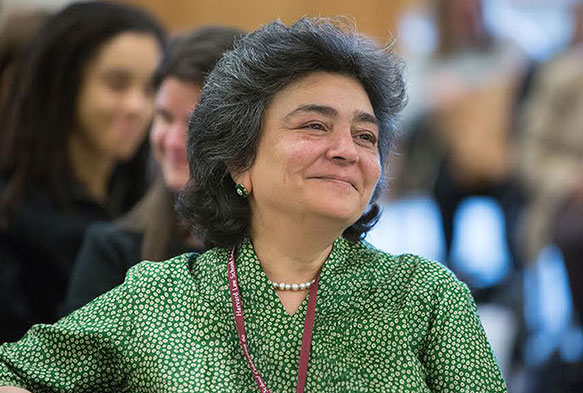
Zia Mody, Co-founder and Managing Partner Of AZB & Partners, On The Benefits Of A Progressive And Pro-Active Supreme Court
It is a pleasure to be here. I can see my CV doesn’t have all the other attributes that Avaan mentioned. I think it boils down to my mother who is also listening today, who was determined that her daughter had to do everything to make her eminently marriageable.
We are followers of the Bahai faith. One of our fundamental tenets is that men and women are equal, it is a matter of religion, but my brother always teased me that god has said that you are equal, since when did he say you are more than equal? So, we grew up in an environment where we were allowed to shine, thrive and we had only one passion – excellence and to do the right thing.
As Avaan has said, I have not studied a day of Indian law in my life. When I came back to India it was a terribly insecure Zia who wondered how she was going to practice Indian Law. So, what I tell you in the next 30 minutes, please understand that I have learnt this along the way, not as a student but as a part of being Junior Counsel in court, part of arguing and then just being fascinated by our Supreme Court.
If you look at what the Supreme Court (SC) has done, in a nut shell, time and again it has saved our democracy and I don’t think many of us as citizens realise exactly what we owe to our SC. So, just by the way of history, it was founded two days after Republic Day in the 50s – January 28th, 1950. We have currently 34 judges. We have some great judges and I will talk about what they have done to change the lives of the citizenry in many ways. Unfortunately, they retire too early at the age of 65 and we lose our some of our best judges just because the clock has ticked the timer. So, I wanted to talk about how the SC has changed the rule of law, judicial review and what exactly they have done which we don’t realise as ordinary citizens, it was achieved over so many decades. The first thing was really in terms of preserving and protecting the Indian Constitution.
Many of you may have heard, certainly all the lawyers may have heard that absolutely unshakeable case of Kesavananda Bharati. That was the judgement of the SC which came before Emergency and what it did basically was to disallow Parliament from changing the basic structure of the constitution. As you know we have three branches – Legislative, Executive and Judiciary; this is the tripod of our democracy and what Parliament was trying to do at that time was to allow and arrogate to itself the power to change our Constitution in any which way or form that we wish to – broadly speaking.
This came before a bench of 13 judges in 1973 in the case of Kesavananda Bharati where, by a very slim majority of seven for and six against, the SC held that there is one thing that you cannot touch and the one thing that you cannot change and that is the basic structure of the Constitution of India. It is an 800-page judgement, it is the longest judgement written. It has 4.2 lakh words; it has judges writing their different judgments. But basically, it said, that as the SC, we have the power to review any law or any amendment and strike down any such amendment which affects our basic Constitution – the core value, the basic structure of the Constitution. And what does that mean? What is the basic structure of the Constitution? The SC held that what has been granted by the way of Fundamental Rights: Right to Equality, Right to Freedom, Right to Life and privacy and basically all Fundamental Rights, these are inviolable and have to be preserved for future generations. Anything that derogates from that is liable to be struck down. That is what they did.
It cost some SC judges their careers, it was delivered on the last day of Justice Sikri’s retirement. There were three judges who were up in line to become the next SC judges of India – Justice Shelat, Justice Grover and Justice Hegde. Mrs Gandhi was so upset that these three judges had gone against what her Parliament wanted that she basically superseded them and instead appointed a Justice AN Ray as the SC Chief Justice. The three senior judges obviously resigned in protest and Mrs Gandhi and the government in power were hoping that with the Chief Justice of their choice, things might take a different course. Very interestingly enough, in 1975, Chief Justice AN Ray ordered that the judgement in Kesavananda Bharati case should be reviewed by a bench of 13 judges and for all of us law students and law practitioners, we basically regard, as the saviour of democracy, Mr Nani Palkhivala who argued this case and convinced a set of judges and a bench which, by all accounts, was spell-bound and with his almost hypnotic advocacy forced to uphold the basic structure. And when the review came not much was said about it. Because when the review started Mr Palkhivala argued for two days and mysteriously after that the judges just disbanded and abandoned the review. Then, therefore, Kesavananda stood the test of time. Now, has this been tested time and again? It definitely has.
If Kesavananda Bharati happened in 1973, we had our Emergency from 1975 to 1977, a shameful playout in history but there it was. During the play of Emergency, the SC did not always cover itself in glory. In 1976, the Jabalpur Judgement, they upheld the government’s legislation to allow anybody during Emergency to be detained. There was only one judge who dissented, Justice Khanna, and the story goes that before he delivered the judgement, he told his sister that the judgement I am delivering today will cost me my SC appointment and so it was. He was never made Chief Justice of India. Then there were other judgements where after the Emergency the SC, in a way, regained its mojo and one after the other there were wonderful judgements upholding the Indian citizens’ fundamental rights. So, this is one part where democracy was preserved.
The next piece which will interest you is how Parliament and the executive have always tried to influence the composition of the SC and there has always been a wonderful tussle where, thank god, the SC has always won when it decides who gets appointed to the SC. All of you have read how Trump and Clinton appoint their Republicans and Democrats respectively and, in our case, we have what is called as a collegium. The collegium is five of the most senior members of the SC and they ultimately decide who becomes a member of the SC as a judge or not. Many a times the government has tried to say they must be part of the process and they must have a final say and these are called the judges’ cases. There have been four judges’ cases and every time, maybe some more diluted than others, but ultimately every time the bottom line has been that the SC is supreme in who it appoints to its bench as a judge. I always say that despite all that criticism, whether it is too much power, my position has always been – I would rather put my life in the hands in the minds of SC Judges than in the hands of an executive whose motives are naturally, not in a negative way, to gain more power.
So, the next part is therefore the protection of the collegium and the protection of the composition of the SC. It is so important and critical and that is why it has been attacked on at least four occasions by several governments and thank god it has survived.
The next thing all of you have read is how active the SC can be from time to time and this has been in the ’80s and early ’90s through a lot of Public Interest Litigation. The SC could literally take a postcard and convert it into a PIL and legislate. Under Article 141 of our Constitution, any Judgement laid down by the SC is binding and overrules, over-writes everything else and every law and is binding on both Centre and the State. So, this is the Brahmastra of the SC – Article 141.
One of the very interesting cases in which it has been exercised, is, when it came to prevention of sexual harassment of women, India did not have, which was so basic, as to prevent women from being harassed at the work place. And finally, a man that will endure in my memory with much affection till the time I die, Chief Justice Verma, in 1997 he said, “We really should have a law. We have been asking the Government to frame this law, they are not framing this law so, guess what? I am going to do it!” and he basically relied on India being a signatory to the Convention on the elimination of discrimination against women and used that to say that India has signed up to prevent harassment in the work-place. He used that convention, laid down guidelines and it became known as that famous Vishaka Judgment, and it became law under Article 141 until finally after the Nirbhaya case, the Government finally decided in 2013 to pass a statute. So, Chief Justice Verma and the SC laid down this protection from 1997 to 2013. This shows you the power and the ability of the SC and a progressive and active SC to change the lives of millions and millions of people. When it comes to women, a couple of really seminal judgements, Vishaka was obviously one which had a huge impact.
The next one was the old Shah Bano Begum judgment where the SC upheld the right of a Muslim woman to alimony and said that getting Rs. 125 per month under the Indian Penal Code was not sufficient. However, that was changed when the Rajiv Gandhi Government legislated the statute which negated the Shah Banu judgment but, in 2017, along came another judgment called Shayara Bano which finally held that the triple-talaq was not Constitutionally valid and the reason is that it demonstrated a manifest arbitrariness. So, once again, the SC using the doctrines of the Constitution upheld the law of personal empowerment and personal protection of the Indian woman.
There have been many judgments which have helped and protected the fairer sex. We have a judgment in 2019 which decriminalised adultery and made it a ground for divorce. You have a judgment in 2020 that said that women can work in the Army on par with men in 10 streams of the Army which they were not allowed earlier because they were women and, in this manner, if you look at the way the Supreme Court has progressively step-by-step enhanced the quality of men and women which is in any case an Article 14 requirement under our Constitution. By using its powers under Article 141, it has laid down progressive judgments and progressive legislations.
We then come to what else the SC has done. You look at the Right to Privacy. Today, in the digital and social media space, everything is known about you to everybody. You can’t really control what is about yourself, you don’t have the right to be forgotten and everything you were and which you thought was personal could be out there. Finally, in 2017, the SC read into the Right to Life as a right to privacy and it is interesting that this judgment was delivered by one of the greatest jurists in the Court, Justice D.Y. Chandrachud who, I think, examined that the older judgment of his father, Y.V. Chandrachud, who was the Chief Justice which did not agree to right to privacy being part of Right to Life and nuanced it and gave it a new meaning and infused it as a part of our Fundamental Right as a Citizen of India.
So, I see the SC as a living, breathing institution in line with the changing requirements of society and, doing what it can in its limited way, does really not have unfettered power in that sense. It is also constrained by its own limitations under the Constitution. But to strike out wherever it can and make a difference. If you have heard the judgments that the SC has given about the custodial deaths, about requiring states to make sure that people who are in custody do not die unnoticed or unnamed or ignored. They have also given judgments where many of our under-trial prisoners have actually been waiting for the trial for their so-called offence and have been in jail longer than the maximum sentence that they would have received had they gone to trial and been proved guilty. So, we have a lot of problems as a country but you can always expect our SC to come, face and do whatever it can. The problem, of course, in many of these cases is implementation because the implementation is required to be done by various states and the Central governments, that is not always effective.
Even in the area of environment, I remember one of my favourite judges who used to be the Green Judge, Justice Kuldip Singh, passed seminal judgements to protect the environment decades ago when it was not so topical or considered as an obvious requirement and there the foundation of our environment protection and litigation was laid down in those early days by Justice Kuldip Singh.
If you look at even Union Carbide and the judgements that led to Union Carbide, those were the MC Mehta judgements, in several PILs, which basically said that if you allow something toxic to escape from your factory and go into the environment or to your neighbour’s property, that is when your liability becomes fairly extensive. These were judgements that Justice PN Bhagwati, I think, had deliberately given knowing that Carbide would come up before the SC because Carbide had already happened. It was taking its way through various courts for litigation but the PIL that MC Mehta filed, he seized on and gave judgements that had to be followed when it came to Union Carbide.
The next thing is, of course, technology. How did the SC take steps to protect technology and weave into its freedom of speech? You post so many things on the platform and then suddenly the Government says that the platform owners need to go to jail because they have posted “abusive” or “offensive” content. So, the SC said that this section of the Information Technology Act, Section 66A; we are going to strike down because an intermediary is simply giving you a platform on which you can post. The SC said that the only liability of the intermediary is if there is a Court Order or the intermediary has its own policy of takedown of offensive material and thus intermediary cannot be subjected to this harassment because this itself is a curb on freedom of speech. Our current Chief Justice, Justice N.V. Ramana also issued a judgement in 2020 about the Government shutting off internet in Kashmir and what he said is that the Government has the right to block but it has to be subject to the doctrine of proportionality. You can’t just shut down, in today’s day and age, an entire region from being able to access the outside world through social media and internet and what he said is that disproportionate blocking has a chilling effect on the Freedom of Speech. So, again, the SC has said that thus far but no further. So, the SC also has to balance itself. It cannot overreach where the Government says who is ruling the country, you or me? But the SC is clear, I think, that they believe that sometimes the government is doing a very poor job and that it doesn’t have an option but to protect the citizens of the country by doing what it needs to do.
If you look at what the SC has been doing in times of Covid, they were actually monitoring how much gas has to be allocated to which state, what the Centre was doing, whether there was under-allocation of gas in states which were not controlled by the Centre. Is this really the job of our SC? But it felt that there was no choice but to step in and stop the fatalities, to stop the spread because it felt that the Government had basically failed in its duty to protect the citizen.
So, that comes to what is always the most fascinating part of what the SC does, the Constitutional Law and we have what we call – the Golden Triangle. It is three articles of our Constitution –
Article 14; which lays down that the State cannot deny to any person equality before the law or the equal protection of the laws in India and also prohibits gender discrimination, treating people differently, arbitrariness in legislation or decision making.
Article 19; fundamental rights, always subject to reasonable restrictions. Freedom of speech and expression, Freedom to assemble peacefully, Freedom to form associations or unions, Freedom to travel freely, Freedom to reside in any part of the territory of India and Freedom to practice any profession or carry any occupation, trade or business.
Article 21; no person shall be deprived of his life or personal liberty except according to the procedure established by law. Into this Right to Life has been breathed by the SC the Right to Privacy, Right to Livelihood, Right to Education. This is your activist SC.
What does the SC do apart from protecting life and liberty in the commercial space? How does SC assist good business, good practices, come in the ease of business etc.? One area in the commercial space is in arbitration and in the recent judgements over the years, the SC has tried to reduce the work load of the courts if the party has chosen to go to arbitration.
Today, there are about 58,500 cases pending in the SC and, out of those, around 37,500 cases have been pending for more than a year. So, SC doesn’t want more added to its plate. What they are saying is that if you have a contract which says that you have to go and arbitrate your matters then you should not be coming to us all the time to interfere in what you have chosen which is a parallel path of decision-making and so, in the recent years, it is called party autonomy. Parties have the autonomy to decide how their commercial dispute will be decided and if they choose arbitration then the SC says don’t bother me all the time, there are going to be limited exceptions as to when you can arrive in my court. But other than that, you have gone and chosen this path so, whatever the decision is, you should, by and large, be able to live with it.
The next thing that has happened, and here we owe everything to Justice Nariman who retired in August. For decades India had the problem of sick companies but rich promoters. So, you never saw the banks getting their money and you never saw the promoters stepping up and taking ownership and accountability. This changed with the passing of the Insolvency and Bankruptcy Code by the Government, but that code would have met the similar fate of getting knocked down in unnecessary litigations if it was not for the SC and Justice Nariman really led and held it up on the SC bench with deciding cases on what we call the IBC and basically, he said a couple of things. One is, you promoters have mismanaged the company, it’s gone into insolvency, you now have no say, management stand suspended, you cannot interfere in the running of the company, you have lost your company.
Secondly, if you have been behaving in a way in which you siphoned off money or you are responsible for the insolvency, you cannot bid under Section 29A of the IBC and try and buy back the company on the cheap because you led it to this state. So, you are a wrong-doer and you are excluded from the right to repossess your company. If you have structural formulas and structural diagrams by which you want to come again through the back door, Justice Nariman said, not working. You won’t be allowed.
Then he said that this cannot go on forever, every IBC case has to have a time limit because I remember as a young junior counsel if I have to argue a matter, if I was for a person to get money, I would tell them it is going to take 10 years – if you need one rupee, take 50 paisa and go home. If I was for the defendant who has to pay, I would say don’t pay anything, pay 50 paisa because you don’t have to pay for 10 years. So, it was what we called a defendant’s court. And the defendant had the advantage simply because of the delay. This, Justice Nariman did not allow when it came to the IBC matters and so, the SC saw, for the first time, promoters were actually worried about losing their company, promoters willing to bring back personal funds and try and rejuvenate their company and promoters actually seeing golden jewels of their group companies being taken away by third parties who came in and bid for them and while these promoters were actually prohibited and disqualified for buying back these companies. So, there has been huge mentality change on how the promoters look at debt which is unpaid. They are willing to engage with banks, they want to do settlements, they are willing to bring in their personal money because the SC had made it very clear that you can’t keep being naughty boys anymore. So, this, in the commercial space, has been a significant impact and has helped banks recover more money than they could ever have dreamed of, loans written off for years and years are now coming back and making the bank supported profitable. So, this is yet another development by the SC in the commercial space.
Lastly, the SC held in case of Selvi that you cannot be forced to give a lie-detector test or subject yourself to drugs which you have to undergo so as to say whether you are saying the truth or not and therefore India introduced, in its own way, what the US calls, the right to not to self-incriminate yourself. So, if you look at what all India has done through the SC, and I was actually preparing for this talk, I could not help but take a deep breath and marvel as to really how lucky we are that we have such a court that it protected itself, that our judges stood firm and were not subject to political crushing or political influence for most of the time. Have there been stories of bad judges and bad apples in the SC? There have been but you can’t judge a few and cast the SC with a black paint on it. As a lawyer of many years, and I am a young 65 years, I believe that really what we have to be grateful for is the supremacy and ability of the SC to come to our rescue every time we are in trouble.
Rotarians ask
There is news that Parsi women are discriminated against for marrying out of the community. Is it going to come up before SC?
I have a friend called Percy Bilimoria, he is arguing this case, and on Friday, the SC took notice in the plea filed of the protection of Parsi women. He is going to be arguing the case. So, he is planning to argue for the benefit of Parsi women.
I heard a talk by Dr. Zareer Masani in which she talks of Nehru introducing the first amendment which created a kind of second Constitution. Could you talk a little bit about it?
No, I am not aware of it. But, from the beginning, if you look at Dr. Ambedkar and the draft Constitution, the Government has tried to get some supremacy from what the Constitution was adopted and Nehru was no exception and there were also tussles between Nehru and the first Chief Justice of India, Justice Kania. So, the head-butting started quite early after we became a Republic.
Is judicial activism now reaching levels of judicial out-reach?
Possible in some cases and sometimes the SC realises that and pulls back. It is always so personal, who are the two-three judges sitting there, what are their convictions, we had Justice Arun Mishra, before his retirement, go ballistic at banks and make them put money in the court to pay off homeowners and they had absolutely nothing to do with it as lenders. So, some are more cautious, some are more conservative but by and large if you ask me the balance is met. You have to always ask yourself a question, I suppose. Would I rather have this or would I rather not have this? Does it come with a good and a little bit of bad or does it come with a lot of bad and a little bit of good?
Talking about judicial out-reach, the SC has recently made the independent directors personally liable to the dues of the company and they have also ordered the attachments of personal assets of the independent directors. Has anyone of you chosen to appeal? This is a case of complete out-reach and none of you are bothered to appeal the judgement because it affects every single independent director. It is crucial to corporate growth.
I agree that there is a chilling effect on the good directors. As a lawyer and an individual, I have never been on a single board of an Indian company. And the reason is, I just don’t need the aggravation, exactly because of the repercussions that you have outlined and so, what I have always been telling the regulators is that you are losing such a good cache of honest people who have helped in the proper governance of the companies.
I think it is a problem of judiciary not stepping up enough and not judicial out-reach. The freezing of assets is done by agencies like SEBI but all in all why would you bother to be an independent director if this is what would happen to you and that is what I have always felt that people listen but they don’t know what to do about it. So, I feel this has to be a legislative proactive reform frankly because the judges can’t decide.
Let’s say that an independent director was involved in a decision to siphon off funds, because you are an independent director, you don’t become a virgin automatically. So, the SC is not going to get into was she good or was he good? The SC will probably want Parliament to frame a broad set of rules. Now the Ministry of Corporate Affairs recognising this problem has, in fact, passed circulars that independent directors will not be hounded or troubled. So, it is better than two-three years ago. Do I personally think that it should be even better? 100%. Do I think that not being better you are going to suffer in corporate governance? 100%. Do I think women will be even more reluctant than men? 100%. So, it needs to be fixed.
In recent times I personally feel that the SC hasn’t covered itself in glory and some obvious ones like the Habeas Corpus cases or anything around Article 370 – Kashmir, relative silence, anything to do with politically sensitive stuff in recent times, would you agree?
I do agree. Even the way Ayodhya was resolved. I think, if you ask me, it is a tough job to be a Supreme Court. First, you are subject to comment in every single newspaper, you can’t comment back. If you ask me what was one reason that I thought that becoming a judge is not worth the other good things you could do? It was a constant attack and you had to stay in your ivory tower, and you could not come out of it to fight back. So, it is a balancing act, very often. Sometimes the SC cedes to political will and again it depends on what you let go of. It is like a marriage; you give up on little ones and fight for the big ones.
TO WATCH THE REST OF ZIA’S THOUGHTPROVOKING TALK, CLICK HERE