
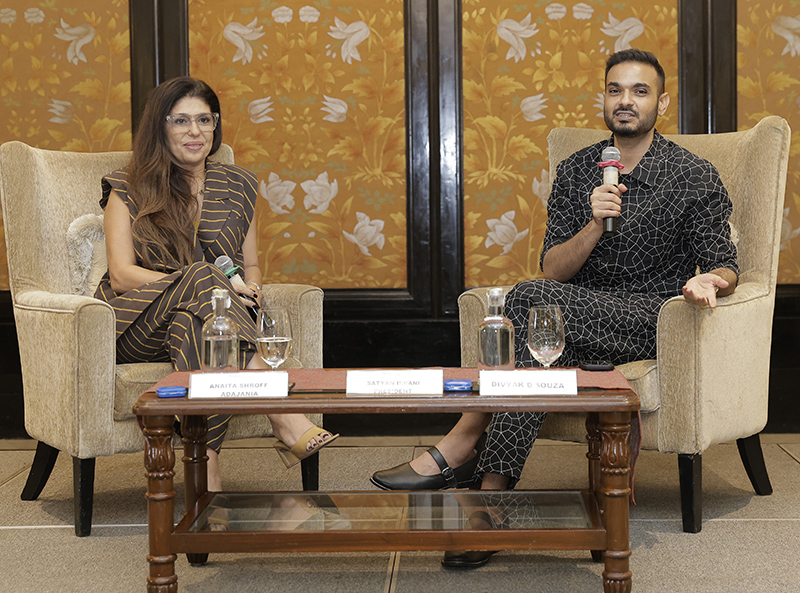
In conversation: Indian fashion stylists and costume designers Anaita Shroff Adajania and Divyak D’Souza
In conversation: Indian fashion stylists and costume designers Anaita Shroff Adajania and Divyak D’Souza
Divyak: Firstly, thank you so much for having the both of us here. Anaita and I, of course, know each other professionally. You all have heard everything about Anaita. If I had to just sum it up like a Gen-Z kid, she is the mother of style. Anaita has set the template, and the rest of us have just followed. I’ve been in the business for 16 years, but I’m still a baby, you know, on this stage too.
Anaita: Me too!
Divyak: Absolutely. But you know, like we were joking, if the two of us were left to our own devices, we would be gossiping about rubbish all day long. But for the sake of structure and to make this possibly interesting for you guys, we thought we could talk about styling as a profession: what it’s about today, what somebody who wants to become a stylist should do, and just the general idea of the business of glamour, as we are calling it.
So, hi, Anaita. Firstly, I think, for a lot of people in the room, it might be good to spell out the difference between a fashion designer and a fashion stylist. Since you pretty much invented fashion styling as a job in India, how did you land there? And, what are the differences?
Anaita: Hello and hi, everyone.
Okay, so I think when I started out many, many years ago, I always knew that I wanted to make people look better and feel better, but I didn’t know how because I felt I didn’t have the expertise to be a designer. I still don’t feel I have that.
So, technically, the difference is that a designer is someone who should know how to cut pieces, size them sensibly, and also have a vision for their brand that changes season to season. For me, I pretty much live in the moment. If I’m styling someone tomorrow, I do what’s best for them. I honestly couldn’t care less about trends or any of that.
What we do as stylists is source from any designer, any store, any accessory maker — sometimes even my friend’s closet — to create a look. Whereas a designer has to rely purely on their own aesthetic. For me, I think the world is my shopping mall, my Pinterest board. In fact, all of you are an inspiration to me. You never know but you may see someone like you in a film soon. And you may or may not even know it. I’m constantly absorbing things. So that’s the difference — designers create collections that are sold in stores. I sell nothing but my talent.
Divyak: Okay. From the time you first started and how styling worked then to what you see today as a profession, there are just so many different styles and avenues of styling. For the room to understand — when you hear the term “stylist,” you’re usually thinking of a celebrity or a famous person on a red carpet. You think of a stylist in that connotation. But that’s probably just one vertical of styling. There are so many different avenues — there’s advertising, editorial which is magazine styling, television, and more.
To be able to do all of that, how does a young person today get into the business? Do you think it’s important for them to go to some kind of school and get training? Is apprenticeship with a professional more important? What do you advise someone who wants to get into it?
Anaita: So for me, I studied political science — hello, classmates! And honestly, I think it helps me deal with difficult people. That’s about it. I’ve never studied fashion. My work is purely instinctive. Having said that, if I were to hire someone, I would prefer it if they had a fashion backdrop because it just helps. It helps when I say, “Take it to the ’80s,” and they know what I’m talking about. Those of us who lived in the ’80s don’t find that difficult, but kids born after that do. They don’t even know what you’re talking about.
Divyak: They think the ’90s is retro, you know?
Anaita: Exactly. And for me, in my career, I feel like the 2000s haven’t even happened yet! I feel like we went from the ’90s to 2025 — I don’t know what happened. But yeah, I feel it’s very important to work with someone whose work you like. But it’s not easy; I literally walk into a room, and people say, “We’d like to work with you.” But I don’t have a school. I’m just me. I don’t need so much help; I’m self-sufficient. That’s the best way to learn.
Styling as a profession didn’t exist when I started, and I kind of discovered it, not necessarily in an easy way. I remember a very famous photographer, Farrokh Chothia. At that time, I was the fashion editor at Elle, and we used to do a lot of editorial together. He saw that I brought something to the table that the advertising agencies didn’t. In advertising, they would just say, “Lal t-shirt le ke aao!” Your ads all look the same! They had no personality. He brought me in, and I could see that the agencies weren’t so keen at first. They were like, “Why do we have to pay her? What is she going to do?” But I’m grateful that he pushed for it, and slowly and steadily, advertising became a huge revenue source for me as a stylist.
What then happened was that I had lots of assistants, my assistants became stylists, and now their assistants are becoming stylists. But I feel that everyone thinks it’s an easy run, and it’s not. You really need to work with people. In fact, when I get a résumé that says, “I’ve worked with X, Y, and Z,” I’m like out. It means you had no focus. Why have you worked with four people in two years? Give one person two years; absorb, learn the system. Also, I think a lot of people think what we do is glamorous. That is the biggest misconception ever.
I mean, I dressed up for y’all. Half an hour ago, I was in track pants, a t-shirt, and rubber chappals. That’s pretty much my normal look. We run around a lot. A stylist’s job is more production-based. You have to run to different places — the markets, the suburbs —whether it’s raining or not, whether your driver shows up or not. You still have to do it. We go deep into the suburbs for fittings. You reach there for a 2 pm fitting, and they go, “Actually, I want to do it at 4.” And I’m like — now what the hell do I do for two hours?
In the beginning, it was like that. Now, things have improved, and people respect your time. You also learn with time to only work with people who appreciate what you bring to the table. I’m sure you’ve faced this too, Divyak — where you go to a star, and they say, “No, but I think I want to wear this.” And I’m like, then don’t call me! Please think for yourself and buy it. I’m lucky to have built that rapport with most of my clients — and maybe a reputation that if you’re getting me, please listen. Otherwise, I’m going to be mean.
Divyak: Totally. Taking from what you said, a lot of people mistake our profession for being flippant, and not necessarily very cerebral. They think, oh, it’s all creative, you’re just thinking of beautiful clothes and putting together beautiful outfits. Sure, that might be what everyone else sees —the final image on Instagram or on a billboard. But what goes into that image creation is a lot of administrative work.
As Anaita said, there are multiple designers and stores we have to liaise with. We have to source clothing, jewellery, and expensive luxury items. Then we have to do multiple rounds of fittings…
Anaita: We are like a glamorous coolie most of the time.
Divyak: Pretty much. It’s a lot of… you know, I was just joking about it the other day — I said, as I’m getting older, I’m beginning to worry if my back can withstand this job. Because we do a lot of work on our feet, we’re lifting heavy things all day. And honestly, even at Anaita’s level, she’s still doing it. You know what I mean? It’s not something you can get away with. It’s part of the job.
Having said that, and talking about all of these traits that one needs to be a stylist, what do you think it takes to succeed? To make it a successful business? To make enough money to pay Bombay rents. Let’s say you want to live a certain lifestyle, do you think it’s a sustainable profession? Do you think people should opt for it? And if they do, how do they make it lucrative? How do they make money?
Anaita: So, I mean, I think styling is an extremely lucrative profession, and most people who style for a living work freelance. So that’s a bit tricky, right? Because if you’re waiting for someone to call you, it’s tricky. One month, maybe someone doesn’t call you. But having said that, there is a lot of, what I call, set-piece work. You could, for example, work with a big online retailer and say, “Look, I’ll shoot for you two days every month.” This is for people who are starting out, and it ensures you have those little regular streams of income.
But I think the most important thing is to be a sponge — to absorb, to do any work that comes your way. Do not feel, “Oh, this is below me, I won’t do this.” And this is why, actually, I personally — Divyak was introduced as a celebrity stylist, so this is not a dig at him — but I personally don’t like the term because I’m a stylist. I will style anyone. I will style this chair if I have to. Pay me on time, and I’ll be there. I’ll even dance for you if you want. No, just kidding.
Having said that, We will style anyone. My work — there’s a lot that is in the public eye, which is the stuff we put up on our social media, or when a celebrity posts a picture. But I have many corporate clients and many non-working women who are my clients, who never want people to know they are styled. And that’s when I feel I’ve done the best job ever — because I’ve taken their personality and given them a look. Whether it’s their hair, makeup… I mean, again, styling is literally from the top of your head to the tip of your toes. Hair, makeup, clothes, innerwear — the right innerwear can change your look completely — everything.
So, I think styling exists at multiple levels. And also, assisting someone — styling assistants get paid brilliantly. So I feel there’s enough work. Maybe there are too many stylists and too many aspiring celebrity stylists, but if your goal is to actually make a difference and work on the profession like we do, then I think there’s enough work.
And also, you have to have good taste. I mean, that’s irreplaceable, right? Although, there is a market for people with bad taste as well.
Divyak: Speaking of Bollywood and Indian fashion — more than in any other country, I think in India, our fashion industry is quite heavily reliant on Bollywood. Even today, we still see celebrities walking runways in fashion shows. We still see most of our fashion brands and jewellery brands keeping an actor as their brand ambassador, hiring a celebrity face. So, having been someone who’s worked with the biggest stars in the movie industry, how connected do you feel today compared to when you started? How connected do you think Bollywood and fashion still are? What’s your take on that?
Anaita: I think when I was a bit younger and not very exposed to Bollywood at all, my only exposure was film magazines. For some reason, my mum read the magazines but never watched the films. I think it was her love for the gossip in them, perhaps. And that definitely passed on to me.
At least I knew actors, I could identify them. I was always totally enamoured by Zeenat Aman and Parveen Babi. I thought they were sexy and hot. In fact, years later, when I shot a cover for Vogue with Cindy Crawford, they were my inspiration for that. I put Cindy in this gold sequin gown with a low neck and added some beautiful jewellery just to bring in the India connection. And it was that moment — it was the moment of those films. Or maybe I glanced at it on some Chhaya Geet in someone’s house or something. But when I came into the industry, I was — and still am — an outsider. I barely watch films. I’m actually more of an international reality TV junkie.
So at that stage, my exposure was limited, but I saw that the women in films, especially the vamps, attracted me more. And I think it also coincides with my absolute love for drag fashion. I think the two somehow, sometimes, cross paths.
Now, actresses travel abroad. So, they would probably walk into an Armani and buy a suit. And now, suddenly, one may see Karisma Kapoor in these power shoulders, you know, playing a role. I think in those days; costumes were more incidental in commercial films. Now, the marriage between Bollywood and fashion is very, very close. It’s totally interdependent.
The fashion industry looks to the stars to showcase themselves on the runways or in ad campaigns. And the stars also need good clothes to wear, so it works both ways. They look great, they are appreciated, and the brand gets mileage. I also feel this is really, really helpful to young brands because as soon as somebody well-known wears their clothes, they’re no longer an unknown brand. Now they’re known. So, it’s a win-win situation.
Fortunately, now that stylists have become costume designers, even films look a little more appropriate. Just correct. And character building is more important. So, I think, yeah, it’s come a long way.
Divyak: Yeah. I think also, taking further what Anaita said, I agree with her completely. When I’m described as a celebrity stylist, it kind of gives me the ick, if I’m being very honest. Because I feel it kind of relegates what you do to just dressing up famous people. And sure, that is part of what I do. Every other month, there is a famous person I dress for a red carpet or maybe help them shop for clothes they want to wear every day. That’s one job. It’s one pay-cheque.
But I have 12 months in a year to pay my bills. So, there’s a lot of other stuff that we end up doing. But there is a lot of Bollywood influence in the fashion industry, no matter where you go. Whether I’m styling an ad campaign, it’s probably with an actor. Whether I’m doing a movie, there’s going to be famous people. So we come in contact with celebrities, but we do fashion. I think that’s the best way to put it.
Okay, now that we’ve spoken about Bollywood, I wanted to understand: Do you think, with Indian designers now getting global recognition — there are brands like Rahul Mishra showing at Paris Couture Week, Gaurav Gupta being worn by celebrities like Adele and Beyoncé — we see a lot of our designers making their mark globally, right? Do you think Indian stylists (A) have the potential and (B) the opportunities to play on a global stage as opposed to just Bollywood? How do you see that panning out?
Anaita: For someone who worked for an international brand for almost 13 years, I felt the commonality greatly. In fact, very often, I thought we were better. So, I think the opportunities are there. It’s just that I feel a lot of us are scared to move out of our comfort zone. Like, I know when I was very young, I wanted to move to New York. And at that time, my then boyfriend who is my husband now, was like, “How can you leave me?” And I was like, “How can I leave you?” And I stayed here. But I’m sure if I had gone, I would have been fine. I think I would have been doing the same thing — maybe I would have done better. I am very grateful I didn’t go. But just adding the backstory to why I didn’t go. It is more daunting, right? It’s more daunting for people to go abroad. We’re so used to our ways here. We’re so spoiled in the way we live in India, and I’m so grateful for that.
Divyak: Great tailors for cheap — that’s the biggest advantage of our country.
Anaita: Yeah. You know, when we shoot abroad, if we say, “Make sure there’s a tailor on set,” they’re like, “The whole day? They can come for half an hour.” I’m like, “Are you kidding? Like, we’ll have three, you know.” So yeah, labour — and expertise. Labour here is amazing. But sorry, I lost track. I was thinking about my beautiful husband.
Yeah. And I think — look at our models, right? So many of our Indian models are huge on the international runway, and I think it’s only going to grow more and more. Even our Indian celebrities have bagged international brand campaigns, and that’s where Bollywood and fashion come together. I’ve been so lucky to style so many of those international campaigns. We are the only Indians there; everybody else is firang. So yeah, the world is our stage. And I think right now, everybody feels that India is it. Our talent is shining. You know, it’s difficult to compete with the heritage we have in terms of craft and also how designers are using it to tell stories. I think storytelling is so important. I think we’re just gonna get better and better and take over the world sooner or later.
Divyak: Amen to that.
OK, so, you know, since we’re in a room with people who are not from the fashion industry, we hear a lot of chatter within our circles about sustainable fashion, about shopping more mindfully, not over-consuming. How would you break that down for somebody who has, say, a regular job and, you know, they want to look good, they want to buy new clothes? How do you feel people should plan their wardrobes? As a professional stylist, what do you suggest?
Anaita: So my #1 tip, the advice I give all my non-performing clients (we all perform, just not on stage) is to shop in your own closet. Very often, we have so many things in our cupboard that we’ve never worn or we’ve thought they’re outdated. Firstly, forget trends. Just be you. Wear what makes you feel happy, what makes you feel comfortable.
I’ll give you an example. This suit that I’m wearing came with a yellow net blouse inside, and it looked so nice on the model. I thought, “Great, I’m going to wear it.” I put it on today and was like, “God, I look like mango has spilled all over me.” So, you know, you have to edit yourself. I think that’s what’s really important.
So, shop in your own closet. Take out things you haven’t worn before, and if you aren’t going to ever wear them — like, if you’re never, for example, going to go back to the size they were, bigger or smaller — give them away. Share! Share your wardrobe with friends.
You know, when I worked with Vogue, we had a kitty. Like, if someone had a lehenga they weren’t going to wear again, another person travelling would take it and wear it. Your friends haven’t seen it — so now, it’s a fresh outfit for someone else. We have to learn to consume less. It’s very difficult — I fight it too, I promise you.
And I think also, it’s important, like we were talking about celebrities, it would be so nice if celebrities made our craft their CSR. Like, what if one actor took over Benaras, one actor decided, “I’m only going to do Kantha embroidery” — and without making it sound like it’s a chore or an NGO-led thing, just made it glamorous and beautiful? So, you know, maybe that’s something important to put out there.
Divyak: Yeah, I think Indian textile heritage and our craftsmanship — like we said, tailors are cheap here, but they are also very skilled. So, I think tapping into that — make your own clothes, buy local textiles, work with local craftsmen — is a great way to also pump money back into our market and our people. It’s kind of going back to Swadeshi as a movement.
- Another very big, bad world that’s kind of entered and changed the game of our job has been social media. With Instagram, Snapchat, Twitter, YouTube — there is this whole digitisation of styling, and influencers have come in. And you, I think, have seamlessly navigated both worlds.
Anaita: I’m an accidental influencer. The lockdown created this in me, and it just happened.
Divyak: And it’s a very happy accident — just growing. Yeah. And I think that’s what I personally love about your Instagram. It’s very real, very in the moment. Anaita is one of the only stylists I know who will take pictures at shows or events, and within five minutes, she’s sat in the car, and her post is up — while everyone else, all the young new interns, are sitting and editing pictures and ChatGPT captioning them. Anaita has done it, dusted it, and moved on to her next appointment, you know?
Anaita: I mean, thanks for the compliment, but I haven’t yet posted Fashion Week — which happened last week.
Divyak: But honestly, it’s a lot of pressure. You know, with youngsters today, they pretty much build their identity on Instagram — what they look like, what they’re wearing, how people are reacting to them. Their sense of self comes from Instagram validation. I don’t know if we can talk someone out of that — it’s a whole generational shift.
So, how do you see that panning into the work of a stylist now, for young kids? You know, this whole social media culture?
Anaita: I guess for me, as a more experienced stylist — rather than saying “older” — I love social media. Earlier, there were just a couple of people sitting in certain seats, hired to review things, saying, “Oh, this collection was terrible.” It was always a personal opinion.
Whereas with social media, it makes fashion more democratic. Everybody has a say — and sometimes, you don’t want to hear what everybody has to say, but they can say it. The same way, if you want to say something, you’re free to say it. There’s no right and wrong — it’s how you feel. And also, fashion should evoke emotion, right? If it doesn’t evoke emotion, it hasn’t done its job. You should look at someone and say, “Oh wow, I feel happy to see you,” or “Oh my God, I could help you,” you know? So, I feel social media does that.
It has also allowed me, as a stylist, to be in touch with countless brands, models, makeup artists, and photographers — something that normally, in my life, wouldn’t have happened. How many meetings would I have had to do? I’d only be in meetings for a month if I had to meet as many people as I do in a week through social media.
So, it allows that. But yes, the downside is that people tend to see their worth only through their likes or comments. Unfortunately, that is the nature of the beast. As a parent, I feel it’s my job to educate my kids that this is not who they are — this is not their entire being. But at the end of the day, there will be fall-out.
That said, I would say for me, it’s more of a win-win in our industry because everybody’s at an equal level.
Divyak: And so, it’s a visual industry, right? You can put your work out there, and people see your style.
Anaita: Exactly. Yeah, absolutely. Yeah, and as a visual person, for me, it’s like a natural fit. When Instagram came out, I felt like someone had answered my prayers — no words, only visuals. Wow, how lucky I am! So yeah, it’s a perfect fit for some, and maybe that’s why.
But you know, earlier when I was saying I’m an accidental influencer, it literally just happened. I had just quit my job, and fortunately — or unfortunately — three or four days later, we went into lockdown. So I was on an eight-month holiday, in my home in Alibaug, with my phone, my friends, and my children. I kind of discovered that it was a great communicative tool. We were doing a lot of those live sessions — what were they called? Insta Lives, Q&As — literally just engaging with people.
I went for a two-day trip and ended up staying for eight months. No clothes, nothing — just a swimsuit, two T-shirts, and wild hair. And you realised that people were okay listening to you just the way you were. You didn’t always have to be perfectly coiffed. You could just be yourself. At the same time, you could have both sides.
I think I’ve lived quite a mixed life — I dress up for events, but otherwise, I couldn’t care less. And I’m happy for people to see me in both those ways. I think that’s how we all live our lives, right? There’s a time when we need to look good — that’s our social media face — and then there’s the everyday version of us. Like when you’re catching a boat to go to Alibaug, crossing the road looking your worst, throwing on big sunglasses, and feeling cool.
What I’m trying to say is that social media is a great place to find ideas and people. Even Pinterest, for that matter, I use it a lot to create mood boards. It’s also a great communication tool to express who you are. You can ask for opinions, like, “Hey, should I wear this or this?” It’s for everyone, not just for people in fashion. And it’s not just fashion — it’s travel, food, everything. So yeah, I love it.
Divyak: Yeah, I pretty much agree with everything Anaita said. What really stands out to me is that so many kids today want to be influencers. They grow up seeing it as a legitimate career choice, like, “Oh, I just have to post reels, and brands will pay me money.” While that does work for some, and there are a few young influencers making insane amounts of money, they are few and far between. I always tell young people that Instagram influencing should be incidental. You need to first develop a skill — whether it’s fashion, cooking, or dancing. Work on a skill or an art form and then use Instagram to present it to the world. It’s just another canvas to showcase your work. But don’t make “being famous on Instagram” your goal. That’s a slippery slope. Work on building a real skill first.
Anaita: Actually, don’t do anything just to be famous. If you’re good at what you do, fame will come naturally.
Divyak: Totally. I always quote Kareena Kapoor on this: “Mujhe rewards chahiye awards nahi.” She says, “I just want to do good work, make good money, and recognition will happen on its own.” You don’t have to lobby hard for that.
Anaita: True. It’s like this new craze of podcasts. Once a day, I get a message saying, “I’d love to have you on my podcast!” And I’m like, “But why would I want to be there?” And unless there’s a real reason, the conversation ends. The moment I ask about budgets, they say, “Oh, we’ve never paid anyone.” Goodbye! Have a good day!
Divyak: Yeah, I think we need another session just to discuss how to deal with stingy clients and producers. That’s a whole other subject.
Anaita: And another thing — we were talking earlier about being a stylist. People often think what we do is frivolous — just fashion, clothes, jewellery, and fun. But I run a company. We have to manage accounts, be financially sound, and read contracts. That’s the worst part of the job! There’s also research, mood boards — it’s a mix of creative and business skills. It’s not just fun and games. It’s rewarding, yes. You feel amazing when you make someone look and feel good. But it’s also hard work. Take this morning, for example. Maitali, who works with me, can confirm this. We have a big beauty campaign shoot on Saturday and Sunday. The girl in charge of my team called me this morning and said, “Oh, I have 102-degree fever.” And I was like, “Damn. Now I have to go to the Taj, talk to these people — how am I going to fit everything into my day?” But we make things happen. I don’t think you understood that stress because you didn’t even sigh! (laughs) It was very stressful! I’m flying to Hyderabad tomorrow morning. I won’t be here. And the fittings are the day after. Imagine it’s like your wedding, and you don’t have your clothes ready!
Divyak: Fashion emergencies happen every day for us. And honestly, that’s also a test of temperament. When I see a young person who is calm, knows how to multitask, and doesn’t panic when things go wrong, I know they have what it takes. Being able to handle chaos is an important trait. Every job we do is full of opinions. Take an actor, for example. The actor has an opinion on what they want to wear. The director of the commercial has an opinion on how they want the actor to look. And then there’s the actor’s manager. And sometimes even their maid has an opinion! And the dogs too.
Everyone thinks they can have a say because we all wear clothes. But what actually works on camera, under specific lighting, and after post-production — that’s what we are trained to understand. You have to learn how to balance all these opinions while managing egos and keeping your cool. That’s a big part of the job, beyond just being creative. You’re managing people, dealing with sick assistants, and juggling last-minute changes.
And you know, we don’t often sit down and reflect on everything we do. But when we do, we realise — wow, we handle so much!
Anaita: Fortunately, because we have experience on our side, we can push back when needed. Last night, I got a call saying, “You have to be in Hyderabad at 10 am tomorrow.” And I said, “If I have to be in Hyderabad at 10 am, that means I have to leave tonight. You don’t own my night. I own my night. So please change the meeting to 1 pm because I’ll be taking a morning flight.”
At the back of my head, I was thinking, “Did I push too hard? Should I have just agreed?” But sometimes, you have to set boundaries because, at the end of the day, no one else is looking out for us. If we look after ourselves and our lives — yeah, it’s a learning process. I’m sure in the earlier days, I was like, “Sure, I’ll wake up at 4:00, I’ll take a flight, I’ll be there.” Probably, the actor would come three hours late. But now, we’re like, “This way, this way.” That comes with experience.
Divyak: This is such an important point, actually, because I feel like I have personally watched Anaita over the years. I was a young little intern when she was Fashion Director at Vogue, and I think, you know, Anaita, I have to give this to you — you’ve set a lot of professional templates. Even for simple things like charging a client for a meeting.
You’re giving an entire day of your time, which you could have spent on a film shoot somewhere, making money, but instead, you’re going to them to hear what they have to say. Charge them for that. Simple things like that — procedural stuff in a disorganised industry.
It’s important for people like us, as we’re moving forward in the industry, to set these templates for future generations because, in India, everybody loves to cut corners. Everybody loves to bargain. Every producer starts the call with, Bahut achha shoot hai, par kam budget hai. The first thing they say is about the budget.
And when you’re young and eager to do something — to have your work out there and be able to say, Maine kaam kiya hai — you’ll be okay to take that hit. Yeah, you’ll get walked all over. But at some point, you cross 30, real life hits you, and you’re like, “Okay, I can’t be doing free work anymore.” So yeah, I do think — thank you — for a lot of the templates you’ve set.
Anaita: My pleasure. I learned along the way because no one taught me.
ROTARIANS ASK
Thank you! This has been an amazing afternoon — such candour and lovely anecdotes. I had a fun question and a serious one. I hope that we all love gossip as much as you do, so if you can share with us — who do you love styling the most, and who do you dislike styling the most? You can take names, or if you don’t want to, just give us clues.
And the serious question that follows — what kind of research do you actually do to style people? Do you really travel all over India to collect styles?
Anaita: Okay, I’ll start with the tougher question. If I’m styling someone, it means I like working with them. But I think we can both agree that Kareena Kapoor is someone we love working with because the atmosphere is always lively. She’s very respectful of what we bring to the table. In fact, recently, at the Lakmé Gala dinner, she went off-script and said, “Designers are great, but when will you thank our stylists, our makeup artists?” And that felt really good. She is the queen. And it’s always fun — the lunches are yum, and we finish on time. So yeah, I love working with her.
That being said, I love working with many people. Who do I dislike styling the most? Myself! I absolutely hate it. I know it’s part of my job, and I’ve shot myself in the foot by dressing up for events. I could have been someone who just wore a black suit everywhere and still been accepted in fashion, but it’s just not me.
Second question, for me, my research is pretty in-depth. But the kind of films I do that require research are more contemporary. I do a lot of research with my friends. For example, in Cocktail, Saif’s character was loosely based on my husband and another friend combined. I took that friend’s watch for the character and gave him a new one in exchange. Sometimes on set, I’ll take a hairdresser’s backpack because it looks worn and authentic. I do a lot of research. Once my research is done, it’s locked in my brain; I don’t keep changing it for a project.
Luckily, the films I’ve done are based in places like Delhi, Bombay, London, and New York, which we already know. I don’t need to travel there for research. I’m not a stylist who does rural films. It’s not my forte. There are people much better at that, and I wouldn’t even attempt it. Research is very important for me. And with social media, Pinterest has changed the way we do research. It’s so easy now. We don’t have to go and sit in a library or visit a jari purana wala and buy 1,500 old magazines to cut and paste into mood boards. But when I started, that’s exactly how I did it. I physically cut magazines, stuck them on big chart papers, and people made fun of me. They’d say, “Oh, she just does art and craft.” And I’d be like, Honey, my art and craft brought me here. I’m good.
With so many online styling tools available today and AI-driven personal fashion assistants, do you think the need for personal stylists is reducing — other than maybe for Bollywood or elite clients?
Divyak: AI is definitely giving people new ideas. Brands like Adidas are now putting entire shoot campaigns together with AI. From a business standpoint, that means one less model getting paid, one less hair and makeup artist, one less photographer, stylist — people like us who were hired and paid for that job are being replaced by machines.
I think AI will have its applications, and it will become popular, but you can’t remove the human touch from art. Styling is commercial art — it’s art to sell a product, but it’s still art. You’re dealing with colours, silhouettes, textures, and storytelling. AI is only telling stories we’ve fed in. To generate something truly new, you’ll always need a human touch. So, I can’t predict where it will all land, but I don’t think AI can replace the human touch.
Anaita: To add to that — remember those old apps where you could upload your face, and they’d put different hairstyles on you? It was never your actual hair. You were never going to look like that. That’s what AI is doing — it’s giving you a formula, but what we do is very personalised. AI can’t see that little hip issue you’re self-conscious about or the exact way you like your hair to fall. I have no fear of AI replacing us. In fact, I see myself using AI to help in other ways.
Recently, H&M did a campaign where they paid real girls but created AI-generated imagery from them. So the talent was still being used — just the methodology had changed. Sure, AI will be there on websites saying, “Hey, I’m your AI stylist! I think you should wear a red shirt today.” But it’s saying the same thing to 500 people. We wouldn’t do that.
So let’s see what happens. I’m hoping in my lifetime, nothing drastic will change.
Apart from Bollywood, what percentage of your clients are male?
Anaita: Oh, I love having men around me, so quite a lot. For non-actors, I’d say it’s 60% women, 40% men. In actors, it depends on the day. Actually, I am one of the few stylists that doesn’t restrict myself to men or women. There are a lot of stylists who only style men or only style women. So yeah, it works. I mean, like for example, in a week I would be on a film for two days with like, say, two men. Some days, the other way around.
How does the process work? Does the director or assistant director brief you?
Anaita: It varies, but I prefer to read my own scripts. Directors prefer to give narrations. Then, we create mood boards, make presentations, tweak if needed, then shop or make clothes. After that, fittings, look tests, and finally — the shoot!
If you don’t mind me, I’m not asking how much you’re making. I’m asking — what is the kind of general charge for, like, suppose somebody’s going to an event that day? What is the kind of charge?
Anaita: OK. I would say you could hire someone — I’m taking a guess here — I think you could hire someone for like 30 to 40,000 per look. Yeah, you would find people.
How would you describe your personal style in three words — for both of y’all?
Anaita: OK, three words: unpredictable, repetitive, encouraging. And if you want me to explain that word, I will. I wear a lot of young talent, and I think it’s to encourage the growth of the industry. Also, I love what they do. I’m not a charity.
Divyak: You know, I was never that kid who grew up aspiring to be in fashion, reading Vogue under the sheets. I very accidentally stumbled into the job. So, I love it, but it’s a job. So again, like I said, I also find it very tedious to dress myself and think about — what are my looks going to be, and how am I going to look? I do that for others, and I get paid. For myself, I have no interest, you know? So I like to be very functional. I think that’s one word I would use — functional. And, minimalistic, and relaxed. Like, I need to be able to — I have three appointments in today’s calendar, for example — this talk, a shoot in my book studio, a fashion show later in the evening. I need something that I can live and breathe in, move in, you know, and not be fussed about through the day.
So yeah — functionality, minimalism — these are the main.
Anaita: I think also it’s important to add — a lot of us don’t leave the house looking like this and definitely don’t go back looking like this. So I’ll have two options of shoes, two options of bags, depending on where all we have to go.
So, you know, that’s just how we roll.