
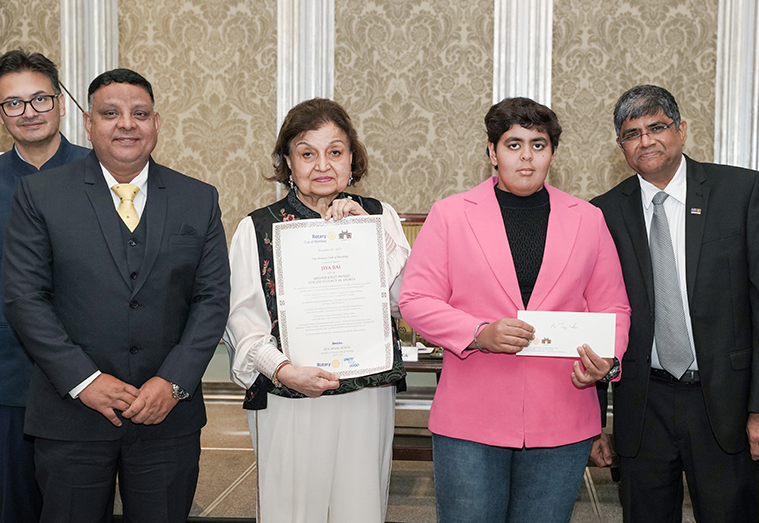
Rotary Club of Bombay Arvind Jolly Award for Excellence in Sports to Ms. Jiya Rai
Chief Rai in conversation with Rtn. Ptn. Anisha Jolly
Rtn. Ptn. Anisha Jolly: Congratulations, Jiya. Fellow Rotarians, our esteemed guests, and the triumphant Rai family, I’d like to offer each one of you a very warm welcome this afternoon on behalf of the Jollys. I know this is an award ceremony and everybody has many commitments in the afternoon, especially in December, but you’ve all taken out this time for us. We are truly grateful for that.
My husband, Arjun, who is here, and I are truly honoured and grateful to the Rotary Club of Mumbai for giving us the opportunity to honour a swimmer of this calibre. Why Arjun and I, you may ask? Simply because I have been a sea swimmer myself, Arjun is a sprinter in the pool, and our daughter is an international swimmer. So we relate to Jiya’s journey and to the efforts parents invest to help a child achieve excellence.
Before I begin, I’d like to mention that this will be a spontaneous discussion between Chief Rai and us.
Captain, when did you realise that Jiya was meant for swimming? When did you know she was on the spectrum, and why did you choose swimming as her path?
Chief Rai: Thank you, Anisha and Arjun, for inviting us to this wonderful afternoon. As a father, we feel very honoured to share the stage with you, and we thank the Rotary Club for organising this function and awarding Jiya the Arvind Jolly Prestigious Award.
Jiya was diagnosed with autism at 2½ years old. After diagnosis, it was hard to digest, as no parent wants to hear that their child has an autism spectrum disorder. But truth is truth, and acceptance is the first step to overcoming the challenges ahead.
At that age, her behaviour was often not accepted by society. We began facing challenges as parents, often having to justify our child’s behaviour. But we noticed Jiya loved water. She would spend half an hour to an hour bathing, always ready to touch water, and she had a method to test it — floating toys, gauging safety. We didn’t know it then.
Taking her to a swimming pool was a turning point. She was happy, and we felt comfort knowing no one would criticise us for her autism. Swimming became a safe space.
The defining moment came in 2014, when Jiya was six. Until then, she was not respected by society and was often called a “special child,” while we were “special parents.” At a school event that year, she won a gold medal and received applause from her classmates. That was the first instance we felt respect was possible. From that moment, we decided to pursue a longer journey for her, aiming for Olympics or the English Channel. By 2016, we began actively seeing that dream.
Rtn. Ptn. Anisha Jolly: So her competitive journey began at six, overcoming criticism with recognition.
Chief Rai: Yes. In water, every child plays the same way, so she was no longer labelled a “special child.” It was as if a divine signal told us to pursue swimming further.
Jiya has swum in many oceans — the English Channel, California, Sri Lanka, Arabian Sea. Which was the most challenging and why?
Chief Rai: Every swimming event was tough for Jiya in terms of approval. The English Channel is the most challenging due to temperature variations of 10–16°C, strong and unpredictable currents, and jellyfish. The solo swimming success rate is around 50%, but for para-swimmers, it is only 2%. In 150 years of the channel’s history, no one on the autism spectrum, male or female, had completed it successfully.
Before she could attempt it, applications were often rejected due to age or autism, including her first national event, the Porbandar Open Water Championship on 5 January 2019. Despite initial rejection, we continued to watch the game as we didn’t have tickets to go back home. While watching, one person came up to me and said that my daughter is a brilliant swimmer, I sighed and said that the organisation sees disabilities than talent. He was intrigued and asked me what had happened, I told him so and so. Then he called his team and saw if she can be given a waiver and she did, through the Swimming Federation of India (SFI), and Jiya was allowed to compete.
During the race, we saw many swimmers, well received, awarded. Her first national race was a five-kilometre open water swim. She led from the front, and the commentary announced: “Cap number 741, leading from the front, Jiya Rai from Mumbai.” She finished first, breaking records each year. By 2021, her five-kilometre time was 1 hour 20 minutes, down from 1 hour 28 minutes.
So for us, “No” is a lucky word. Every “no” in her life became a stepping stone to success.
So the English Channel was the ultimate challenge. How did she manage it?
The main challenges are extreme tides, water temperatures below 10°C, and long hours without food. Even a normal swimmer risks cardiac arrest in such conditions. Yet Jiya persevered.
We made sure to mentally prepare Jiya for extreme races, like the English Channel, is also a challenge. We teach her the concept of time, the race duration, and ensure she understands the plan — from sunrise to nightfall. Jiya has learned to gauge time like the Stone Age sun clock — an incredible testament to her perseverance.
Sponsorship is another challenge in India; few are willing to support disabled swimmers. We are fortunate to have support from Mr. Cyrus Bagwadia, who is with us today.