
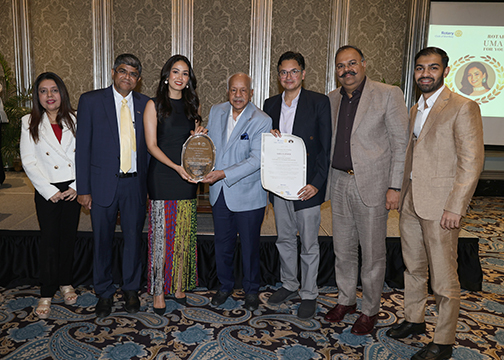
Rotary Club of Bombay Uma Jain Award for Young Woman Achiever to Mira Kapoor in Conversation with Rtn. Priya Tanna
Rtn. Priya Tanna:
Hello, Mira.
Mira Kapoor:
I’ve forgotten my cue cards. Priya, I have a couple of questions for you.
Rtn. Priya Tanna:
That’s not how this works; it’s all about you right now. Our banter can continue outside of this. It’s going to be really hard for me to be very serious because I’ve known Mira for a very long time as a friend, and now we’re both pretending to be grown-ups.
Mira Kapoor:
I’ll give you all a little story about Priya and me. Yes, I think that would be more fun.
So I’m in Bombay. I’ve just got married. I was all of 21, and I didn’t know anybody. Of course, everyone knew Vogue and everyone knew Priya Tanna. The first invite I ever received for any event was for the Vogue Beauty Awards in 2016. At that time, my daughter was about three or four months old, so this was around two years after I came here.
I was just thinking, why is someone calling me? I still hadn’t got used to Bombay and the lights and the attention. Someone said, “I think you should really go.” I said, “But there is no need for me to go. I’m not part of this circle.”
Priya called me and said, “Look, I really think you should come.” I took this leap of faith, and when I met her, I almost felt like someone was looking out for me. Of course, I was like, wow, this is the editor of Vogue India. But she gave me so much confidence. She gave me so much love. She’s continued to support me over the years.
I have to say that, more than a mentor and a friend, she has really looked out for me over the last 11 years I’ve been in Bombay.
Rtn. Priya Tanna:
You are the award winner, and this is all about you. It’s really not about me. She’s embarrassed me enough, so let’s carry on.
My question to you is, I’m going straight for the jugular, Mira, you became a public figure way before you became an entrepreneur. How much did the visibility of being Mira Shahid Kapoor’s wife, help? And did it also, as I expect, bring a whole new set of expectations with it?
To be honest, if it was just Mira Kapoor starting out without the Shahid factor, how different would things have been?
Mira Kapoor:
I’d like to say that there was a duality to my existence for the first couple of years. What you mentioned, if there was Mira and no famous husband, no Shahid, I would still be the same.
I think what changed was recalibrating how I am when I step out of the door. In my close circle, my family, my friends, I’ve actually stayed the same.
What changed for me, and what I had to navigate a little, was that suddenly I had thousands of people looking at me and judging me and commenting on me. But what really gave me respite was the fact that I could retreat very quickly and go back to my world, which was something I was comfortable with.
I do feel that the recognition, success, and love that Shahid had, I will always be grateful for that because the windfall I had and the ease I had going forward, that credit goes entirely to him. When we got married, he had already worked for 13 years. So of course, it made things a lot easier.
The challenges that came were those that you have to navigate. If your path becomes easier, I think you also have to accept everything else that comes with it.
Rtn. Priya Tanna:
True. The beauty and skincare market is brutally crowded. Every single day your algorithm shows you a new indie beauty brand, as they call it. Then you compete with K-beauty and all the other brands.
Why did the world need another beauty brand? Why did the world need Akind?
Mira Kapoor: Very good question, Priya. I think you should do this for a living.. Haha..
I had the same question. Should we do this? Because if we need to get into this crowded market, we need to differentiate ourselves very clearly from the outset.
This was a collaborative effort with Reliance, where we realised that, first, it is very crowded. Let’s simplify it. Second, everyone is looking at concerns. No one is looking at the fundamentals of skin, which is the skin barrier.
We want to fix pigmentation, acne, ageing, lines, dehydration. Why is that happening in the first place? It is happening because your skin barrier, which is the upper layer of your skin that keeps everything good inside and keeps everything bad out, in simple terms, is not regulated.
When that skin barrier is distressed, everything shows up. So let’s look at the foundation.
That aligned with my philosophy of life and health extremely well, which is going to the root cause of everything. So it’s not a beauty brand. It is a skin-focused brand that looks at building the fundamentals of skin so these issues do not happen or do not get exacerbated.
You can arrest ageing and concerns before they become issues requiring a nine or ten-step skincare routine.
Rtn. Priya Tanna:
It’s more prevention than cure. You’re really going to the before.
Mira Kapoor:
It’s actually about rejuvenation of the skin and its integrity. Brands are not honouring the integrity of the skin. They’re saying, okay, we have acne, let’s use salicylic acid. We have pigmentation, let’s use vitamin C. Ageing, let’s do retinol.
These things are very strong actives.
Rtn. Priya Tanna:
I have a funny Mira story as well. When I first saw her, like everybody else, I saw her on Koffee with Karan. What struck me was that not only is this girl drop-dead gorgeous, but she’s actually sassy. She has an opinion. She’s not a wallflower.
Then when I got to know her, I made the innocent mistake of asking her to recommend a good vitamin C serum to me. I did not understand the number of questions she asked me after that.
I will never again ask her about skincare because she went into, “You don’t use the pipette, you use this. What’s the concentration?”
That’s when I realised she’s not just looking the part, she’s actually walking the path herself.
I don’t really know anybody in my life who is born into the privilege that she is, but chooses to take the path of proper gadha majuri, if that’s the phrase I can use.
What you’re seeing today is different. What I see in her is the most tireless, relentless worker. I think that, for me, is what makes it so inspiring to follow her journey.
My next question to you is about the wellness space and Dhun. I often worry that wellness is not just mainstream, it has also become a trend word. Everybody uses the word wellness so easily. Longevity, wellness, all of that.
You could easily have been the face of a wellness brand. You could have chosen to endorse one. What led you to feel the need to become the founder of one? Where did you see a gap in the market where Dhun Wellness stepped in?
Mira Kapoor:
To answer your first question, why didn’t I just endorse another wellness brand or organisation? Because somewhere I felt there was a gap.
The gap was urban wellness.
The other part of this answer is that I realised everyone focuses on just one modality. But the real gem of true wellness, and the treasure that we have, lies in integrating modalities.
Ayurveda, acupuncture, longevity, biohacking, supplementation, nutrition. All of these things need to work together, just like the body is not merely a sum of its parts. You have to treat it as a unified whole.
Similarly, we should take the best of all modalities available to us. I felt there needed to be a place where we could integrate different philosophies that can work for us.
We should adapt to the needs of the modern consumer. All of us are privileged enough to have a fair amount of money at our disposal. But what is it that we all have in equal measure? It’s time.
So how do we optimise for time? How do we value our time and our health in a way that allows us to do the right thing for our body without compromising on time?
For me, that compromise was this: I don’t want to take seven days away from my children. I cannot do that.
For somebody else here, it could be: I can’t take seven days away from work. I have too many things to do. How can I leave my ageing parents?
How can we give you your time back without forcing you to choose between health and life?
Your health and wellness goals need to become part of your life.
That is why I felt we needed to create an urban wellness business where you can come in, address all your goals across modalities, and still go back to your life.
When you go away for seven days, it’s an ideal circumstance. Think of it like a petri dish. It’s a controlled environment. You’re getting food on time. You don’t have to make decisions.
What happens when you come back? Now you are in control of those decisions, and suddenly the wheels fall off.
So how can we help you change your life in the very circumstances you live in every day?
I can send you away for seven days, and I’m quite sure you’ll come back looking fantastic.
But then what happens?
I use this analogy very frequently. You can’t go to the gym for seven days in a year and expect yourself to be fit. Why do we go three times a week?
Rtn. Priya Tanna:
It becomes something you can integrate into your lifestyle whilst being in the city as a part of your day, right?
The interesting news is that Mira has just raised some serious money, and I’m quite impressed. Dhun Wellness is now opening its second outpost in Delhi.
So I have an investment-related question. What mattered to you when you were thinking about raising money? Was it vision? Was it traction? Was it pure economics?
What was the need, and why was now the right time? You raised $4 million from Fireside, right?
Mira Kapoor:
We raised $4 million from a set of family offices.
I don’t want to sound pretentious and give you an answer that I’ve probably rehearsed, because I have taken the last one-and-a-half years to learn what a business is. I’d like to say that now I’ve come to feel a little more confident about it.
I think a lot of you have spent enough time in the business world to know EBITDA and PBT and all of these things. Two years ago, I didn’t know any of it. So I made sure I understood exactly what it all means so nobody could take me for a ride.
My fundamental philosophy in life is to align with the right people and the right energy. I’ve done that with my life partner. I’ve done that with brands that I have invested in. I believe in the founder and back the founder.
I think we took the same approach when it came to raising funds. Family offices helmed by families that share the same values as me.
That is not to say that I don’t want to be accountable. In fact, a lot of them say, “Please don’t send us such extensive quarterly reports. We don’t need to know. We know you’re doing the right thing.”
But I hold myself to a sense of responsibility that if they have believed in me, I owe them an honest answer. I need to tell them this is how the business is doing, this is where your money has been put, and this is how we plan to grow.
The need definitely arose from the fact that we wanted to expand. We saw very early success metrics and knew that this was not a one-stop shop.
If I wanted to create a one-stop shop, I wouldn’t be doing the gadha majuri that you’ve seen me do. I want to see Dhun Wellness across the country and across the world because I feel urban wellness is a gap that deserves to be filled.
Secondly, I feel Ayurveda, as a science, has not been fully tapped. It is so close to my heart because of the cultural significance it has. That is what drives me.
Whether it was the Havells family office, SRF or DLF, they all believed in the vision that we have, that urban wellness is the future.
It also came with a sense of responsibility, but equally freedom. The fact that they believed in me is the reason why I send them quarterly reports that they find exhaustive.
So yes, to answer simply, it was for expansion.
Now we know that we can expand, but we’re also diversifying, which means creating a new vertical focused on longevity.
We all know longevity is the new buzzword. We’re doing it the Dhun way. We’re still integrating it with holistic practices. We’re developing proprietary IVs. This is not what you get at a salon or any place where they are plugging in different things without even checking whether you need them.
We’re partnering with Dr. Dang’s for blood tests and biomarkers and integrating this into an ecosystem so that the moment you come in, you don’t have to do anything. We do everything for you.
We don’t let you feel the stress and burden of over-information.
Rtn. Priya Tanna:
And will these have standalone clinics? Will there be Dhun Longevity, or is it integrated into Dhun in Bombay and in Delhi?
Mira Kapoor:
Dhun in Mumbai is Dhun Wellness. In Delhi, it’s four floors, 20,000 square feet, and an entire floor is dedicated to Dhun Longevity.
Once we have two different verticals, based on the market’s appetite and where we feel each one will work, because the CapEx involved is very different for wellness and longevity, and so are the compliances, we can decide whether it should be wellness only, longevity only, or fully integrated.
I never want to do anything that does not meet quality standards.
Rtn. Priya Tanna:
What do you think is the one question every founder must ask an investor that is often overlooked? Or what was the single most important question you needed to ask your investors?
Mira Kapoor:
I actually didn’t ask them any questions, and they didn’t ask me any either. I got very lucky in that way.
In fact, they all reached out to me and said, “Can we be a part of this?”
I tend to ask a lot of questions as someone who is learning. Tell me, how was your journey? How did you navigate this?
I love asking questions about HR because no business can function without people.
The questions I tend to ask are more about business philosophy, their journey, and how they navigate difficult situations.
I’m not afraid to ask dumb questions. I think it’s very important to ask dumb questions.
Rtn. Priya Tanna:
How ready is India for longevity and wellness?
The reason I’m asking is because we tried to put together a longevity festival, and whilst the consumer seemed ready, a lot of the brands were backing out, saying they don’t think India is ready yet. It’s just a word.
But then you see the metrics of burnout, the numbers behind stress levels and lifestyle diseases, and all of that is happening.
Because you are focused on metro wellness, my question to you is this: does that somewhere clash with human ambition? Does it compel you to slow down?
How does wellness within a city fit into your manic lifestyle?
Mira Kapoor:
I think precisely the fact that our lives in the city are so manic is the reason why we need a beat of rest.
We call it a beat of rest at Dhun. In fact, our logo is the musical notation for one beat of rest. In an entire musical piece, you will see that notation, and that is one beat of rest.
I think what has happened, especially in the world of longevity and biohacking, is that we are relying on external data to tell us how we feel.
We wake up in the morning and want to check a Whoop. How many of you are wearing an Apple Watch or a Whoop that you check every morning?
Sometimes we forget to ask ourselves: How am I feeling? Am I feeling rested? Am I feeling full? Am I feeling tired? Am I feeling energetic?
Can I really go to the gym, or am I going because some study or meme on Instagram has said you must do strength training three times a week, zone two cardio four times a week, track your macros, your micros, the amount of sleep, the strain, and all of that?
I think we’ve forgotten to stay in touch with ourselves.
When brands feel the market is not ready, it may be because they’re trying to sell a product. They’re not asking for connection.
A mattress is now longevity. A pillow is longevity. A blanket is longevity. I can’t sell longevity. I have to live it.
Because longevity is not about living longer. It is about living longer, better. That is the difference between health span and lifespan.
Inauthenticity is going to be caught out right from the beginning.
I can sell you water with charcoal and say this is going to make you better, but is it really? Or is it a stack of habits practised every single day? When you have intervention, it has to be calibrated and personalised to you.
A blanket cannot be sold to everyone in this room because our sleep patterns are different, and our reasons for poor sleep are different.
That is why you need personalised longevity. Brands cannot go beyond a certain point.
Rtn. Priya Tanna:
I feel like I’ve asked you a question and, like the serum conversation, you’re just going on. It has clearly got you really excited. Ask her any question on wellness. This is how she will answer. It’s almost never-ending. It’s amazing how much she lives, breathes, eats and drinks this.
What has been the hardest part of starting not one but two enterprises?
Mira Kapoor:
Mum guilt. It’s real. It’s so real.
How do you get more time in the day? How do you make sure your children feel they are a priority, your team feels they are a priority, and your family feels they are a priority, while you never feel like you are a priority for yourself?
Last year, the number of times I had burnout spikes made me realise I’m not going to let that happen this year. I had to reorient my day and the entire year.
But the mum guilt has been the toughest part of this entrepreneurial journey.
I answered in 30 seconds.
Rtn. Priya Tanna:
Better. This is definitely better than the earlier answer.
My other question is, what learnings are you taking from Mumbai?
So I’m breaking this into two parts. Dhun is what, One? That’s it? My God, it feels longer.
How are you defining the metric of success? Are you thinking about number of customers? Repeat customers? Are you looking at it purely from a business point of view? I’d love to know, for you, how are you defining success today? Dhun feels like a success story to me.
My second question is one I’m sure you’ve been asked before. Wellness almost seems to come at a price. Why is it not more accessible? Why are we not able to go and just have an easier treatment or check into one of those cryo centres and whatever other words you use?
So yes, those are the two questions. I should have kept that under 30 seconds as well.
Mira Kapoor:
The answer to the first question, Priya, is in three parts.
The first is, is Dhun synonymous with wellness and urban wellness? I would like to say it is, because when people talk about wellness, they talk about Dhun. I’d like to say imitation is the best form of flattery. Every time someone tells me that so-and-so started this, you also try, “Oh, I love that,” or that someone else is also opening this and opening that, I think that is success.
Customer retention, absolutely, that is a success metric. What is their lifetime value? How many times are they coming back to us?
And third, the metric of attrition. Like I said, people are most important to me. How happy is my team? How much do they want to stay with us? How many of them leave, and why? Is this an organisation they are proud to be a part of?
These are the three metrics of success for me. It has to go beyond me.
Rtn. Priya Tanna:
How was year one? How do you look back at year one, and what do you think?
Mira Kapoor:
Year one, in terms of numbers, surpassed what everybody expected.
In terms of the team, we had to hire much sooner than we thought because that was the demand. We’ve now reached a place where we feel we have fewer rooms. Do we need a bigger space?
I think those are good problems to have. They instil a lot of confidence in the business.
In terms of the team, these are challenges that you navigate every day. But when you do that yearly chat with the team, the feedback they give makes me feel very proud. They tell me, “We love working here.” I think year one has been fantastic, and that’s why we’re accelerating the speed at which we’re opening more centres.
Rtn. Priya Tanna:
And the other part of the question I asked was, why isn’t wellness accessible?
Mira Kapoor:
Let’s look at wellness from your point of view. If you benchmark us to places like Viva Mayr, SHA Wellness Clinic or Lanserhof, you’d think coming to Dhun is paying pennies.
But if you go to a salon and ask for a full-body massage, you’d think Dhun is expensive. So it’s very relative.
I did not want to compromise on the quality of the space, even the size of the room. If you’re coming in to relax, you shouldn’t feel like you’re in a pigeonhole.
If that means I have to reduce one room and my capacity utilisation changes, so be it, because you’re paying for the experience.
The oils are blended to your constitution. You don’t get these oils in the market. The entire layout of the space has been designed so that your tempo reduces every time you step in.
The people we’ve hired, while experienced for five or six years, still go through three months of training to learn the Dhun way.
All of these things add value.
If we’re looking at price versus value, we’ll never win the argument. But what I’m trying to say is this: why do we like staying at the The Taj Mahal Palace? Why do we like going to the The Oberoi Mumbai?
Can we quantify service? We cannot. We can only feel it.
I think that is the value proposition.
Rtn. Priya Tanna:
Okay. One superstar husband, two businesses, two children, and endless amounts of mum guilt. I think everybody in the room wants to know, what is Mira Kapoor’s wellness ritual?
Mira Kapoor:
Good sleep.
I used to wake up every morning deciding whether I should sleep one more hour or go and work out. I realised everyone says you have to work out at least three times a week. There have to be more people like me making this choice every day.
So I actually sent out a survey, and I sent it to you as well. It was about urban women and sleep debt. I sent it out to about 200 women who responded, and 60% of them said if there were no consequences, they would choose sleep over a workout.
Yes. It was eye-opening.
A third of them had full-time help and still felt they had sleep debt. Many would come back home after work, with help available, and still feel that the responsibilities of homemaking remained.
Rtn. Priya Tanna:
So how does that apply to you? How do you deal with this?
Mira Kapoor:
Many times, I just switch it off.
Because if I keep making myself feel like I’m falling short and not ticking all the boxes, I will drown in guilt.
If on some days the house is not looking great, or the food is simple, maybe just ghia and dal and something boring, it’s okay.
If I didn’t pay attention to the menu, or didn’t make sure there were fresh flowers in the house, or there’s a crack on the wall and I haven’t got it painted, forget it. It’s okay.
I’d rather spend those two hours with my kids.
I think we need to prioritise, and we do not need to be perfect. We’re not the wives like The Stepford Wives anymore.
Before you ask further, I also have a question. Since we are both in a similar world of digital content, aspiration, inspiration and authenticity, and I think you have spearheaded a lot of cultural conversations, but also shaped culture from your time at Vogue. All of us have read her magazines and thought, my God.
I want to know, where do you see the future of authenticity, inspiration and aspiration? What does that look like? Because everyone is questioning people on their phones now.
Rtn. Priya Tanna:
I think it’s a very simple answer for me, and quite aligned with what you do. I discovered this pretty late in life because I spent so much of my 30s and 40s working incessantly without breathing or pausing.
I think more and more people who want to be authentic and truly be who they are, the journey has to start inward. We need to be more in touch with ourselves, and we’re losing that.
Not because we want to, but because we don’t have choices. You wake up, and the next thing you know, you’re going to sleep, and everything in between feels out of your control. For me, mindfulness and manifestation are not just some vague, abstract ideas. They are about deliberately pausing and finding connection from outside in.
Does that answer your question?
Mira Kapoor:
What happens to people who are always outside and always on a screen, consuming personalities?
Rtn. Priya Tanna:
Everything in life comes down to choices. It’s the choices we make.
The most important choice we can make, and I’ve been listening to this amazing podcast by Rob Dial called The Mindset Mentor, is simply to be.
Find five minutes in a day, ten minutes, fifteen minutes, where you can just be. Without anyone, without anything. Just you.
You have to empty your thoughts. You can only fill something when it is empty.
We don’t allow our minds to become empty. For me, I do that very purposefully, and that has helped me stay as sane as I am right now.
RAPID WITH MIRA
Rtn. Priya Tanna: Mira, the wellness industry is full of trends. What are three things you believe will still be here 20 years from today? And sleep cannot be one of them.
Mira Kapoor:
I think Ayurveda, definitely. I would say good habits and good food, but you’re not letting me say the basics. The basics are what transcend time.
So I would say staying in touch with yourself. Checking in with yourself before seeking validation from the outside world. That is here to stay for the next 20 years, and that will determine whether you remain sane.
Ayurveda, definitely. And by that I don’t mean medication or pills. I mean the philosophy, personalised constitutional analysis.
The third is more mindful time with family.
As time goes by, we’ve become more nuclear, but even within that nuclear setup, we’ve become more distant. What should stay for the next 20 years is how our parents kept us together.
Rtn. Priya Tanna:
I love that.
Mira, is there one trend that everybody is obsessing over but you think is completely overrated?
Mira Kapoor:
There are many, but I would say relying solely on wearables.
I think it’s great to refer to them, but relying entirely on a wearable to tell you whether you should sleep, move ahead with your day, or panic about your strain, that needs to go.
Rtn. Priya Tanna:
And what is one thing that is incredibly boring but actually works?
Mira Kapoor:
Sleep. Just go to sleep on time. I learnt this from Shahid. He sleeps at 9:30 regardless.
Rtn. Priya Tanna:
No way. 9:30?
Mira Kapoor:
9:30. If he’s working, 9:30. There could be a party outside. He will be in his room sleeping.
Rtn. Priya Tanna:
Has your definition of health changed in your 30s?
Mira Kapoor:
Of course it has. I think when you get closer to 40 and 50, where metabolic processes slow down, you want to stay ahead of it.
In your 20s, you’re already ahead of it. We could eat anything, and it wouldn’t matter.
Now, at least for me, this feels like the inflexion point where I’ve started thinking more carefully about what I eat, how much I sleep, how I work out, and how I want to delay issues I’m genetically predisposed to.
My definition has changed to being a little less reckless and a little more measured.
Rtn. Priya Tanna:
What keeps you awake at night as a founder?
Mira Kapoor:
If I’m being honest, HR.
Every problem that anyone has with anyone else becomes my problem. I want to make sure they are smiling the next day.
That’s what keeps me awake.
Rtn. Priya Tanna:
What’s the one piece of advice Shahid has given you that genuinely changed your approach to work?
Mira Kapoor:
Keep going. Don’t make excuses.
Rtn. Priya Tanna:
A founder you admire and why?
Mira Kapoor:
Kiran Mazumdar-Shaw. She’s incredibly inspiring. The fact that she worked in a beer factory and went on to build biotech is remarkable.
It’s about seeing opportunity and truly seizing it.
Rtn. Priya Tanna:
Thank you, Mira.
I feel like I knew everything about this girl, but every time I meet her, she surprises and amazes me in ways I didn’t know were possible.
ROTARIANS ASK
We’ve heard so much about your business today, but nothing about you as a person. Tell us something. How does Shahid romance you on your birthday? I believe there’s a piano involved.
Mira Kapoor:
I play the piano. That’s for me.
I think every time we get time with each other, especially when either of us is working, it becomes special. It doesn’t need to be my birthday.