
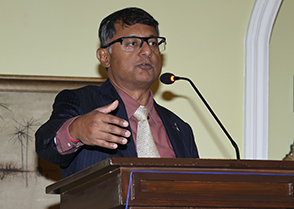
Dr. Debarag Banerjee, Chief AI & Data Officer, L&T Finance Ltd., will address the Club on ‘The Digital & AI Journey of Larsen & Toubro’
Dr. Debarag Banerjee: Hello. Thank you for inviting me, and I am happy to be here.
Just to add to my background, I started my journey in India itself. Back in the early 90s, I wrote my first AI paper here at IIT Kharagpur when I was a student. Most of the rest of my career, however, I spent in the Valley, where I finished my PhD and worked in larger companies, as well as founded two startups and took them to successful exits.
What brought me back to India was, first, when Jio was preparing itself and we went through the launch. I realised that this is a country reinventing itself on the backbone of internet infrastructure and really taking mobile commerce to a different level, and now also in e-governance, which opens up significant opportunities for more advanced banking and financial services.
L&T Finance is in the business of lending to millions of customers in India. Just to touch upon a few of our lines of business, as I understand, many of you are small business owners. We offer SME loans, two-wheeler loans, home loans, and so on in the urban segment. Similarly, we have almost a half-and-half split between urban and rural India, where we are one of the most successful microfinance lenders. We are one of the top tractor lenders in India. By the way, a little trivia: if you go by the actual number of tractors, India is the biggest tractor market in the world.
Recently, we acquired a few other businesses like gold loans and so on. The reason I am touching upon this is because, as I understand, some of your initiatives are not confined only to Mumbai, but you are doing very laudable work in rural corners of the country as well.
Now, let me first give you a little idea about LLMs. LLM stands for Large Language Models. The most popular one that almost all of you have come across is ChatGPT, right? But there are many more models, and they have evolved over time.
If you think about that evolution, on the Y-axis, the vertical space of this chart represents how smart a model is. The size of those circles represents how computationally large the models are and how they evolved over time.
You can see that as things progressed, the topmost position has been swinging back and forth. It has not always been OpenAI and Sam Altman. There have been players coming and going. Some of the open-source models, where technically you do not have to pay royalties to anyone to use them, are also catching up. But there is still a gap.
We are still using a closed-source model, in our case Gemini from Google. One of the things we do is structure our applications in a flexible way so that we can switch from one model to another, from one cloud provider like Google to another like Azure or Amazon, or even our own private cloud, whenever necessary.
Now, why do we use LLMs? Why do we use generative AI?
If you look at the state-of-the-art performance of AI models, over time they are approaching, and in many cases exceeding, the capability of an average human in performing many kinds of work.
AI models today are increasingly being benchmarked against human capability across a variety of tasks. These include image recognition, such as identifying objects within a scene, writing code independently, understanding English instructions, reasoning, and several other cognitive tasks.
Over time, AI performance across these areas has improved significantly. One by one, we are seeing artificial intelligence match and, in many cases, exceed the capability of an average human in specific tasks. Expert-level capability may take longer, but the progress is clear.
The reason we are using these models is not just to make processes cheaper, but to perform certain tasks better and more efficiently.
Many of you may have heard, if you follow discussions in the AI industry, that the amount of infrastructure being built for AI runs into trillions of dollars. To generate returns on that scale of investment, there are concerns around token costs, compute costs, and infrastructure expenses. Some believe this could eventually become unsustainable.
However, what we are seeing is that the cost of running these models continues to decline year after year. If you compare the early days of ChatGPT to current costs, they have already fallen by a factor of nearly 1,000.
If history is any guide, AI is going to become both cheaper and easier to use over time.
At the same time, models are also becoming smarter. So the direction in which the industry is moving is clear: models are becoming more capable while simultaneously becoming more cost-effective.
At present, there is still a small gap before most models reach the level of intelligence and practical utility we ideally want. Among the current leaders are models such as Gemini, which we use, along with strong models emerging from China and leading contenders from OpenAI.
That is broadly how we evaluate and decide which models to use.
Your particular uses of AI may end up in a different part of this curve. But over time, the clear progression is that more and more models are going to show up in the green, useful, intelligent area.
Now, while generative AI like ChatGPT and Claude makes the news, AI is much broader than that.
In a nutshell, AI can be thought of as any computer system that makes decisions or produces outputs close to what a human would produce.
Earlier, these were largely human-in-the-loop systems. Then machine learning changed everything. You feed the computer all the decisions that were previously taken, and it learns and figures out the rules by itself. That opened up many uses of AI in everything from credit underwriting to product recommendations on Amazon.
Over time, these models became more sophisticated, somewhat mimicking how the brain works, although not entirely. The latest generations that emerged from that are called transformers, which can figure out outcomes from natural language questions, generate images, and much more.
Now, while that is entertaining, where does the usefulness come in? That is the innermost box, agentic AI.
We are now beginning to figure out how to use predictive models and generative models together, and build software applications around them easily without requiring large teams of engineers writing code. This allows AI to do useful work in enterprises.
Now, coming to our business of lending.
At its core, lending is a relatively simple business. You lend at a certain rate of interest using money borrowed at a lower interest rate. Along the way, some customers default, resulting in credit losses. Some customers require repeated follow-ups, increasing collection costs. Then there is the cost of running the business, which is operating expenses. What remains is your return on assets.
We built a system called Cyclops and later augmented it with something called Helios. These are AI systems that help bring down our credit costs.
As the portfolio grows, we use something called Nostradamus, which tries to predict how millions of loans are going to evolve over time and what collection actions we should take. That helps reduce collection costs.
Finally, agentic AI, where AI works alongside humans faster and more accurately, helps bring down operating costs. This reduces the cost curve further and ultimately results in greater profit and higher return on assets.
Another way to look at this is through the dimension of growth.
Cyclops enables smart differentiation between good and bad borrowers and helps optimise loan amount, pricing, and segment identification.
More precisely, what you want to find are people who will become prime borrowers but have not yet reached that point. That is where intelligence comes in, and that fuels growth.
AI is at the very core of how we are reimagining lending at L&T Finance in a digitally connected world.
Now, I talked about Cyclops. What is it?
This is probably a very familiar scene in the streets of Mumbai or any Indian city. You see young people on motorbikes doing their daily jobs, whether delivering e-commerce packages or something else.
These bikes cost about a lakh or more. That sounds like a lot. But when you think about how much they earn, the EMI of a standard loan to buy one of these bikes can amount to nearly half of their monthly earnings.
That opens up a Pandora’s box of challenges for traditional lending. They may not have enough assets on their books, enough proof of income, or enough stability of income.
While India has improved significantly in documentation and e-documentation, a substantial part of the population still finds obtaining the right documentation challenging.
So how do we solve this? How do we provide credit access where it is needed?
Our answer was Cyclops. To give you an idea of how Cyclops works, imagine a person walks into a two-wheeler dealership to get a bike loan.
Let us pick a particular persona. Suppose we go with the first person.
First, they apply for the loan. That gives us certain characteristics. Then the application is submitted. With consent through the digital application process, we look up several additional characteristics about them. For example, we identify whether this is a salaried individual, their credit score, and so on.
As a human, you may say this person qualifies for around 90% loan-to-value.
Now we run Cyclops and see what it would do. Cyclops looks at many parameters in the credit bureau data. With consent, it also analyses banking transactions to understand cash flow. It looks at payment scores and a wide range of other factors.
It then generates an ensemble score indicating the level of risk involved in giving this loan. Based on that, it automatically generates an offer.
In this case, Cyclops actually gives this person 100% LTV with zero down payment.
How does it become that confident?
Because from all those characteristics, it determines that the probability of default is low enough for the return on assets to remain strong and the business to stay sustainable.
This is an example of how analysing many different types of data gives us the insight to provide credit where the borrower genuinely has the right characteristics.
This does not apply only to bike loans. As I mentioned, we have six other lines of business. Farming is one of them.
In farm lending, when a farmer wants a loan for a tractor, that is a very different environment. Factors such as rainfall in a particular region, soil characteristics, geographical access to markets, and the affluence of the local marketplace all matter.
As it turns out, even with these very different variables, we can still take data from the right sources, whether satellite imagery, open-source geographical intelligence, or the applicant’s own records and credit bureau data, and apply the same principle.
We bring together multiple sources of data using machine learning models, a form of AI, to arrive at decisions.
Now, not all data looks like data.
Sometimes it looks like pictures. Here is an example of how AI helps there. Let us say a farmer wants a top-up loan on their used tractor. Depending on the condition of the tractor, the valuation changes significantly. Our ability to lend higher or lower depends on that.
Instead of going through a very complicated process of evaluating each tractor with a human on the ground, if we simply upload pictures of the tractor, AI models today can differentiate between a tractor in poor condition, with very worn-out tyres and visible damage, and one which, despite having the same years of use, still looks very serviceable.
Based on that, we can differentiate how much equity that tractor still retains in order to provide the right amount of loan to the right person.
In the age of AI, data does not have to be a number on a spreadsheet. It can be a picture and still be a valuable source of data.
Another example is when we look at very dense Indian cities like Mumbai. There are areas that are highly affluent right next to areas that are not doing as well. This is the borderline between Dharavi, towards the upper left of this picture, and Sion, on the other side of the road.
Those of us living in Mumbai understand the difference between the two. But imagine this problem at a nationwide scale. Based only on a home address or location from which someone applies for a loan, how do we determine whether the affluence of that neighbourhood is high or low?
For that, we created something called GeoGrid. This, for example, covers all of Mumbai. Similarly, it covers 50 of India’s major cities across Tier 1, Tier 2, and Tier 3 locations.
It gives a score based on satellite imagery of the area to determine whether it appears to be an organised, well-developed neighbourhood or a more rundown area with disorganised layouts, narrow streets, and similar characteristics.
As it turns out, when we map these geographical characteristics against the actual behaviour of borrowers from those locations, we see a substantial and statistically significant differentiation based purely on the characteristics of housing in those areas.
Again, this is an example of the kind of data that probably would not have been possible to use effectively without AI.
Now, when we talk about AI, we often think, here is a model, it produces something cool, job done. But that is not the case.
Especially in complex, regulated industries like financial services and lending, multiple functions must work together. Business functions, credit teams, regulations, legal oversight, data security, and others all need to play their role in moving from a traditional operating model to an AI-first model.
I often refer to this with a phrase inspired by the book It Takes a Village. We say, “It takes a village to raise AI.”
We live and breathe this every day.
One of the systems we have developed addresses what happens after loans are disbursed and we have a portfolio. How do we understand the characteristics of every borrower and determine whether they are likely to become good candidates for follow-up loans, or whether they may run into trouble and require closer attention?
For that, we created and launched a system called Nostradamus.
It follows the life of every user at scale using many different data sources.
Suppose somebody is progressing steadily in life. There will be signals and events that indicate they are improving financially, and those signals help us predict that this person is likely to keep improving. That means we may want to offer them better loan products.
On the other hand, someone who looked very similar at the time of application may later face difficulties. They may lose their job, begin missing payments, and so on.
That raises warning signals and helps us determine what actions we should take for that particular cohort.
Similarly, data within Nostradamus can be queried by any credit manager. In much the same way someone would use ChatGPT and ask a question, they can query the system and get answers.
There are many such use cases, some of which I will skip for the sake of time.
One thought I would like to leave you with is this saying: if you want to go fast, go alone. If you want to go far, go together.
With all the innovations we are driving at L&T Finance, we believe we should take the industry along with us.
From 2024, when I came in, we started an annual tradition of hosting a conference called RAISE.
It is a conference where we bring in speakers not only from India but from around the world, thought leaders and innovators in AI, especially those focused on AI in financial services.
At present, it is India’s biggest applied AI conference for financial services.
We hosted it in 2024 and 2025, and we will host it again this year, in 2026, here in Mumbai on 16th December.
I am not sure whether the website is open for registration yet, but if you are interested in learning about the latest developments in AI for financial services, this is something worth considering.
Thank you very much.
ROTARIANS ASK
Q1. I have a couple of questions. You can answer either or both. The first is this: the use cases and benefits are well understood. Based on your experience implementing this at Myntra, L&T, or the previous travel firm, what are some of the pitfalls or challenges you have seen in reality where implementation did not work or did not achieve its full potential?
The second is that any technology is only as good as its effectiveness and efficiency, both in terms of accuracy and cost.
You have access to it. HDFC Bank has access to it. Bajaj Finance has access to it.
So ultimately, it comes down to who deploys it better. That links back to my first question. Not everybody gets it right.
What are your key learnings?
Dr. Debarag Banerjee: A few things.
First, pitfalls. This is something I often say, tongue-in-cheek: amateurs talk AI, professionals talk data. What does that mean?
At the end of the day, AI runs on your data. So if you want to benefit from AI, first and foremost, you need clean, governed, secure, well-documented data.
We invested heavily in getting that right before opening the floodgates to all the AI agents, hundreds of them, that we are building and deploying.
That is pitfall number one. Do not leave home without good data.
Pitfall number two is this. AI lowers the threshold for building something to the point where almost anyone can prompt their way into creating a system that does something.
But that is very different from creating something that does something genuinely useful or something genuinely better.
What AI enables is that people who understand their business, understand the problem statement, and understand what they are trying to achieve can use it as an accelerator.
It becomes a game changer, a force multiplier. On the other hand, it also means that if you do not truly understand what you want to achieve, it becomes easier for bad or untested ideas to make it through.
In a way, this is still a good thing overall because the friction to move from a good idea to market becomes lower. That means the ability to create value from an idea is multiplied.
But it also means you need to vet ideas much earlier, right at the idea stage, because the time for a bad idea to reach the market is also shorter. That would be pitfall number two.
Your other question was about relative use of AI.
As I said, for the ecosystem to truly develop, you need a large user base, strong demand, and enough investment in GPU capacity and infrastructure so that all of us can access the latest and best models.
Ideally, this should happen within the framework of data protection laws, which also requires infrastructure to be available in India.
So I do not mind the rest of the industry adopting AI and building their own systems in their own ways. They may do some very impressive things, and I welcome that.
Like I said, it is less about the core technology and more about how you apply it.
We have our own philosophy, and another differentiator is the speed at which we deploy. Because development cycles are much shorter now, we are far more agile in turning good ideas into reality.
Take Cyclops as an example. From the point when we decided to build it to the point where the first loan was disbursed using Cyclops, it took a total of five months.
That is almost unheard of in billion-dollar businesses.
Q2. Why is it called artificial intelligence? Should it not be called assisted information? How did the term “artificial” come about?
Dr. Debarag Banerjee: I believe people call it artificial because it refers to computers performing tasks that would otherwise be done by human minds.
I do agree with your characterisation that what we have today is mostly assistive.
It is not as though computers are independently waking up, writing their own code, and becoming increasingly intelligent beings like in science fiction films.
At the end of the day, these are software systems created by humans to follow rules.