
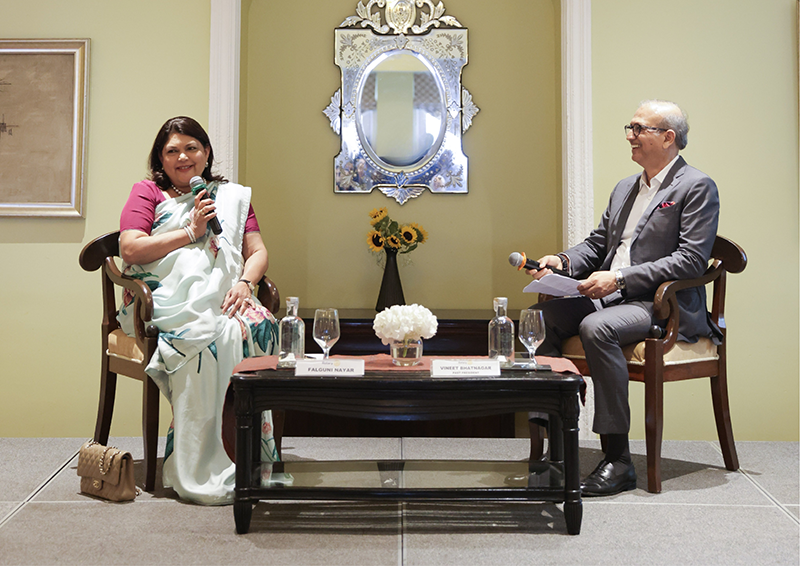
Ms. Falguni Nayar in conversation with PP Vineet Bhatnagar on ‘From Vision to Legacy: Building Nykaa and Shaping Consumer India’
PP Vineet Bhatnagar: So, I actually did a fireside chat with Falguni about seven years ago when she came to Cathedral School. It was a similar afternoon when I first spoke with her, and she brought out a few things which are quite fundamental to an Indian professional executive’s career and all-round development.
We have all heard of the expression of breaking the glass ceiling, which you did when you were the head of investment banking at Kotak Bank, and a very highly successful one at that. But when I look at you, I see another side, which is breaking the mould, because you broke the mould of walking away from a very successful career and launched yourself at the age of 50 to start Nykaa, right? So my question to you is, what is it that you had to unlearn from a very structured corporate environment to survive the chaotic early days of Nykaa?
Ms. Falguni Nayar: So, I think it’s very different, the start-up world and the early days of the start-up world, from what I was used to, the corporate world, where, from where I sat, I was always meeting the CEOs and CFOs of big companies, great offices in Nariman Point, corner office. And one got a lot of respect, of course, because of who you are in the corporate world. And I’m not even talking about the financial benefits.
And when I started Nykaa, I didn’t know how far it would go. I didn’t know the three core things: I didn’t know retail. I didn’t know beauty. I didn’t know technology. I don’t know what I was thinking. I knew the internet. I was inspired by the internet and what it could do. And I knew that the beauty industry in India was underdeveloped. And I believed that Indian women needed to be able to experience beauty the way the rest of the world was. I had seen it in the US, I had seen it in Asia, and I was inspired to make that happen in India.
So, with that, I started out on my journey. My early days looked like I literally knew one technology person because my entire ecosystem was finance people. So I met that one technology person, and through him, I met many more. So, figuring out what tech stack to buy, what next steps to take, was all very new.
And I was very particular that I didn’t want to be in a comfortable office. So I chose to start the company out of my dad’s old office, which was his manufacturing unit in Lower Parel. It’s in that, you know, all those mill areas, there were these spaces. So I started there. And it was a very simple office. I think it went with what the business needed. If you’re sitting in comfortable offices, maybe you don’t want to move forward. If you’re sitting in an uncomfortable office, you do get the desire to move forward and get out of those offices. So, yeah, that’s what it was.
PP Vineet Bhatnagar: Excellent. To say that your industry segment is fiercely competitive is going to be an understatement. There are competitors in your space who have deep pockets. How do you decide to continue to double down on value when the market is asking you to do a price fall?
Ms. Falguni Nayar: I think it comes from certain personal beliefs. And one of the personal beliefs was that I’d rather sell the right colour of lipstick to my consumers than the wrong colour of lipstick at 70% off.
So there are two things in e-commerce: One is that they go into this clearance, which is what is used a lot in fashion, where they go to the brands and say that, no, we need 60% discount, so give us, what is it, 60% discount. And they typically pick up products which are like one or two seasons old, two seasons-plus old.
Whereas Nykaa takes pride in the fact that you want to sell the latest trends, you want to sell the latest launches, and we are ready. Obviously, the brand is not ready to offer it at discounts. So obviously, we are ready to offer it at whatever the best price the brand wants to offer. So we want our consumers to get the best possible price the brand wants, but we don’t do discounting as an entry point.
I actually did a lot of research to see: is the entire e-commerce industry only built on price, or is it built on other things? And to my surprise, e-commerce consumers value, of course, assortment. It is an endless aisle, so they value the assortment. They also value the convenience of home delivery and being able to do it when they want rather than slot it against a certain time.
And then there could be the third point, which could be either price. And in our case, we took it down the lane of getting them the best trends, so we are very trend-led. So get the best trends, the newest brands, and be the consumer-focused platform which looks at what we should stock based on what consumers would love to buy.
So we never even prioritise what we show to our consumer based on, ‘Oh, this brand is giving us a lot of margin, we should push that.’ So it’s not a push website, it’s a consumer-pull website, and that’s what gives the consumer a lot of delight.
And one other thing we did differently was that we educated them because I believe that beauty needed a lot of education. So from the early days, like, we had the old days, there was a banner and the second banner was a content banner. And everybody told me, why would you distract your customers into reading something? I mean, a lot of engineers used to measure their success by how quickly the customer checks out. And Nykaa never emphasised that.
So from day one till today, our unique customers visit us 50 times a year. That’s when they buy only four, on an average, four to five times a year. Of course, there are customers who buy 20 times a year, but on an average, a customer buys four to five times a year. But they visit us 50 times a year. So they find a site useful enough to come and learn, to come and evaluate, and then finally, when they are convinced about something, they buy.
So I think that was another thing we did very differently.
PP Vineet Bhatnagar: Right. Excellent. So in this journey of Nykaa, which I guess is about 15 years old, at what exact point or inflection point did you realise that you need to manage the culture of the firm as against managing the operations of the firm? And as you mentioned, you started from a gala, so you must have soiled your hands right from day one. Was it painful to hand over the operational responsibilities to those who came in after you?
Ms. Falguni Nayar: Yeah, I mean, look, not that when I had to dispatch products, not that I did it well, because I was not good at it, but at least personal attention on everything in the early days to now, just impossible to do that, right?
So I think from being a very detailed, roll-up-your-sleeves-related, execution-oriented person, I have now become almost like someone who manages the business with, like you said, culture, what we call as Nykaa playbook, where it’s almost like how we as individuals have a value system. It’s like, what is the value system of Nykaa as a company?
We are a large company now with beauty, fashion, Superstore, GCC, so many parts of business, House of Brands — I think each part of the business has to have a similar value system and similar playbook as Nykaa.
And then, finally, manage it through numbers. So, a lot of data, a lot of information to see whether things are going as per the plan. So that’s what it had to change to.
PP Vineet Bhatnagar: Your twins, Anchit and Advaita, are also a part of the business. They manage key business verticals within Nykaa. We all know that family businesses are the bedrock of Indian entrepreneurship, but mixing family dynamics with boardroom governance is famously tough, right? So, I just want to ask you as to how do you draw the line between being a mother and the CEO when the debate is about high-stakes strategic disagreements?
Ms. Falguni Nayar: Yeah, so I think a couple of things. Firstly, I think recently my son used this phrase and I liked it. He says, ‘We are not a family business, but we are family who’s in business together.’ So I think I would put it that our business was not like a family business that anyone could inherit. I think if we like working together, then yes, we have come together and we are working together. So that’s how we look at it.
The second is, yeah, what you say is very important. One is, you say, okay, let us all manage different businesses and we manage our area of business without interference from each other, because each one has their own style and each one has their own way of doing things.
And it’s not just about three of us, because our management team goes beyond three of us into other leaders also who may have different styles of management, other business leaders, other functional leaders. You can see pros and cons and strengths and weaknesses of each one’s style. We allow a lot of differences in style as far as the core value systems are the same.
But we also realise the importance of being on the same page, and not just for three of us, but also for my senior management team, which consists of 15 people. And then beyond that, the team of top 100 managers who matter.
So we went through this particular exercise where we are on the same page now in terms of the near-term outcomes and the long-term vision for the firm, the near-term outcomes of the firm and how we will measure them. It’s a very formal process. Like, a lot of this tends to be a very formal process at the core.
And through that, you know, there is almost a similar language, similar aspirations, similar expectations and understanding of strengths and areas of further development. And based on that, we’re finding it a much easier journey to make rather than feeling the push and pull of the entire personal. Somebody may see, I tend to be a true visionary who doesn’t see anything to be a problem. Like, I’m just like walking far ahead of the rest of the organisation, who’s trying to manage everything else that needs to be done.
So I think with this, we all tend to then be on the same page and with a similar vision towards how we are progressing.
PP Vineet Bhatnagar: So, similar page, same page is creating a unanimity.
Ms. Falguni Nayar: It’s not unanimity, but it’s a very good understanding of, for any business, how much to pursue growth, for a listed company, that’s the biggest thing. How do you balance between long-term growth and short-term profitability pressures? So that’s the biggest question any company has to answer.
And increasingly, the world of leadership is changing from being that one unilateral leader to multiple leaders who come together to give outcomes on the organisation. So I think just simple questions like that, balance between long-term and short-term, then what are the areas of new expansion, new customer offerings that we would like to add.
Like when we went into fashion, even few of my investors felt fashion was not the right thing to do. So, should we do fashion? Should we not do fashion? Now we are saying we want to make a big focus on wellness. And what does it take to offer wellness? Because wellness at a wider level could include health, it could include everything, right? It could include services, it could include good-for-you foods, it can include, like, obviously, supplements. So what is our definition?
So it’s not about consensus, but about the contours of how we are progressing. And then very often none of us have time to go into every little detail. None of us, in the sense that most of the top managers don’t, and the entire organisation is taking it through. So finally, like someone who’s designing the app and they give relative priority to this versus that, I think today the pace at which Nykaa is growing and expanding, I don’t think all of those decisions are coming to some central tick mark. If I were to tick mark every decision.
PP Vineet Bhatnagar: Sure, I appreciate that. You talked about being a listed company. I mean, for many business owners, being a listed company is one of the goals. It’s a matter of pride. But you have been on the other side as an investment banker and you know that, as a listed company, there are always pressures which come every quarter.
So my question to you is, have you seen yourself actually making compromises in terms of achieving short-term goals or short-term satisfaction for investors, which you would have not made if you would have continued to be a private company as Nykaa?
Ms. Falguni Nayar: So I think I’ll just use some of the phrases which are very much related to listed companies. So one is QSQT, which is quarter se quarter tak. The second is, you know, if you deliver to the investors, they want more. So it is never, it’s never enough.
And then finally it comes down to trying to please only the near-term outcomes because they reflect in the stock price and then not doing what is right for the organisation. And more recently, Infosys was also kind of held responsible for not investing enough in the AI business. So one has to be ready for the future that will unfold and one has to make those investments towards the future.
So I think it’s a very difficult balance to maintain. I would say that there are a couple of things. One is very often the organisation is functioning all right, but the near-term numbers don’t reflect that, and then the market carries a certain impression about that.
So, basically, I mean, being a leader of a company is not a popularity contest. It may happen that you may become popular, but finally, I feel one has responsibility towards all the stakeholders, to maintain a healthy company that moves forward. And basically, a lot of companies want to do well in the long run and survive for the long run and prosper in the long run.
So if you’re going to be measured in the long term, then that has to be the driving force. I would say definitely that before being listed, I was not so focused on short-term numbers and I was building only for the long term. I think the listing teaches you that it’s not something you can do. So I think you become better at trying to balance. I call it almost like a treadmill. Once you get listed, it’s like a treadmill. You just have to be at it. And every little wrong turn also gets noticed and gets accentuated. So one has to be far more careful with the decision-making.
I felt a similar responsibility once I took external money compared to the early two to three years when I was building it with my own money. I think once you take external money also, you suddenly become more accountable. So, in a broader sense, I’ve enjoyed the discipline of being accountable to a larger number of people.
PP Vineet Bhatnagar: Good. So you must be witnessing this, that consumer habits are changing fast and faster. And really, consumers have moved from e-commerce to now 10-minute deliveries through quick commerce. How are you working within Nykaa to ensure that a company, a business that was a pioneer in online beauty does not become the incumbent and will not get disrupted by a younger, faster, nimbler 25-year-old founder?
Ms. Falguni Nayar: So I take a lot of learnings from the US market, which is a very large developed market and also very advanced in retail. So I think beauty is a speciality beauty retail. Like, over the last 20, 15 years, speciality beauty retail is where the consumers have bought retail, even when it’s available in every pharmacy, it’s available in every grocery store. Certain types of personal care products are available in every grocery store. But I think there is a different space that speciality beauty retail occupies.
And Nykaa was a combination of speciality beauty retail and e-commerce. Now, as far as e-commerce is concerned, what had happened was that the urban demand, especially in the top metros, had grown to a level where we could have easily delivered. Like, now Nykaa is rolling out something called ‘Nykaa Now’. We are at close to 100. We don’t call them dark stores, we call them rapid stores, but we are at 100 rapid stores and we are planning to deliver right now in the top three metros, but over time, top eight metros within a year. We will be delivering within two hours.
So we have chosen to deliver in two hours, not in 15 minutes. So I think it was quite clear that the volumes were enough to do faster delivery compared to the same-day and the next-day delivery that we e-commerce companies were doing. And someone came and tried to build that through quick-commerce company, 60% or more is groceries and everyday items. But on top of that, you can obviously deliver other consumer needs. So that’s a little different journey.
But we don’t want to lose a customer because they feel we won’t deliver fast. So the speed of delivery will be there by being closer to the customer. Like, if our warehouses are closer to the customer, then they will come. And within that, Nykaa has always stood for authenticity, genuine products, no fakes, because all are sourced directly from the manufacturers.
So all of those advantages of Nykaa will stay because very often the companies which are trying to do a much wider network, they don’t have control of who’s selling, especially the marketplaces. There was no control of who’s selling and that went against Amazon because Amazon entered when we were just one year into the business in 2013. And everybody told me, how will you Amazon-proof your business? And the only single thing that we did well was that we had customer trust, that products that Nykaa sells will always be authentic, genuine and sourced directly from the brands, and they’ll be the freshest products that there will be in the network.
So with that, we won over, I would say, Amazon’s model. So I think we tend to look at our strengths and try to play those up rather than worry about what the competition will do, and competition will do what they need to do.
PP Vineet Bhatnagar: So building a multi-billion-dollar business requires conviction, you know, and also intense obsession. There are many in the audience here today who have seen the cost of building businesses in terms of personal sacrifices. Which one has been your most expensive sacrifice and would you do that again?
Ms. Falguni Nayar: See, the point is that obsession is also a wrong word. Like, when you enjoy every moment of something, it doesn’t feel like obsession. So I have always enjoyed my work, even when I was working at Kotak, and I do enjoy my work now. So work gives me a lot of pressure.
In fact, for me, it’s been good because my two kids, who, when they were young, I used to leave them alone and go to work. Now they work with me. So, in a very funny sort of way, I’m making up for all of that lost time. And I get to meet them every day at work and hang out with them. So I don’t have any complaints.
But I have always told everybody that if you have very good clarity on what’s important to you, you will always make time for that. So I love travel. I don’t compromise on that. I love my grandchildren. I don’t compromise on that. And I love my work. So, yeah, some things at the margin must be suffering, but it’s okay.
PP Vineet Bhatnagar: Excellent. So it has been a plus, plus, plus.
Ms. Falguni Nayar: Yeah, I mean, from where I see.
PP Vineet Bhatnagar: So when you look at the Indian entrepreneurial ecosystem and you are a part of it now, what is that one structural change or mindset shift that you would like to leave as a permanent legacy of Nykaa or Falguni Nayar once you step away as a former CEO?
Ms. Falguni Nayar: So I think when you ask that question, the first thoughts that came to my mind are more general. And then the second part of it, I can make it more Nykaa-specific. So I’ll answer it in two ways.
So the first thing is that new-age businesses have to be very agile. So agility is the name of the game. And I think Nykaa has also survived and prospered because we are very agile. And so I think definitely, like today, Nykaa is obviously going to have to be very agile to adopt AI and what AI means for our business and figuring out what it means and then making sure that our business model is addressing that in whatever we need to address that.
So I think agility is the most important thing in today’s businesses and that has to be done and, to a certain extent, it’s true for Nykaa. But within that, if you ask me what Nykaa and I stand for long-term sustainability, governance. There are, I mean, we have our code of conduct or value system, and that’s very well-defined.
So, if I may just take a few more minutes to explain that. So, the first one was, obviously, we were a high-growth company, and we were very ambitious and very bold. So I think one of the main pillars is ‘Be Bold’, but we added ‘Be Good’ to that, because if you just say ‘Be Bold’, then it can be misunderstood that, oh, you want to get ahead at any cost. So I think ‘Be Bold and Be Good’ is what Nykaa stands for.
The second one, similarly, is the culture of One Nykaa, so that everybody’s looking at everything from one lens, so that there is no inter-department disagreement or ‘I want to do it like this, I want to do it like that’. So at Nykaa, we don’t allow a different viewpoint based on different divisions or functions. So there’s one Nykaa view of everything.
And the last one is about sustainability, and sustainability in every action. So, be it building a sustainable organisation. I used to tell my brand partners, would you rather have a retailer that is making a reasonable amount of money and hence sustainable and around to continue building the retail business for 20 years? Do you want me to finish with the kind of margins people or kind of money they spend on acquiring customers? You kind of run out of your capital and then you don’t have a business model.
So sustainability is also very important. So building organisations that can sustain for the long run with the right balance between investment and profitability. So I think those are the things that are Nykaa’s way of doing things.
PP Vineet Bhatnagar: Excellent. So I recollect that we had a great rapid-fire question round even in Cathedral. So I have put together seven-eight questions. It will be short questions followed by short answers.
PP Vineet Bhatnagar: Investment banking or entrepreneurship, which one gives you better sleep?
Ms. Falguni Nayar: Entrepreneurship. Sleep. No, not sleep, but still better because it’s in your hands.
PP Vineet Bhatnagar: OK, one word that describes a fifty-year-old first-time founder.
Ms. Falguni Nayar: I don’t know that, but maybe crazy to other people.
PP Vineet Bhatnagar: OK, what is more expensive: customer acquisition cost or a bad hire?
Ms. Falguni Nayar: Bad hire for sure.
PP Vineet Bhatnagar: OK, offline retail or online apps? Where is the real magic?
Ms. Falguni Nayar: Apps. I am very, very pro-digital.
PP Vineet Bhatnagar: What is your ultimate antidote to boardroom stress?
Ms. Falguni Nayar: Watch Netflix.
PP Vineet Bhatnagar: Okay. One thing you miss the most about running a small, chaotic start-up in that gala (space) in Lower Parel.
Ms. Falguni Nayar: I would say, those days we used to do the sale and we had to digitally plan the sale page. And I used to love getting involved with exactly what banner went where. And that to me is very important. Like, basically, the UI/UX of the website and the journeys you make are very important. But now I don’t have bandwidth for that.
So typically, now in a lot of product meetings, I’m like, ‘I’m switched off. You guys figure it out.’
PP Vineet Bhatnagar: Right. Lipstick or eyeliner? What do you think is the ultimate economic indicator?
Ms. Falguni Nayar: Kajal for sure in India.
PP Vineet Bhatnagar: If you had to start a completely new business today at the age of sixty-three, if I’m getting it right, what industry would it be?
Ms. Falguni Nayar: I think, for sure, longevity, wellness.
PP Vineet Bhatnagar: Longevity, and you’re going to include it as Nykaa Wellness.
Ms. Falguni Nayar: I’ll try to work on it. Okay.
ROTARIANS ASK
QUESTION 1
Rotarian: Falguni, that was fabulous, and thank you for coming this afternoon. One question: sometime back, you know, a Minister criticised the Indian start-up ecosystem, saying that we are focused only on deliveries and selling ice creams rather than deep tech. I want to know whether that holds true or whether there’s been a mindset shift or a shift you’ve seen.
Ms. Falguni Nayar: See, the thing is, if I’m honest, like every time I was so… talking in all those rarefied atmospheres where they only want to value, like, real engineering and real research-based stuff, you do feel that, like, for Nykaa, I feel happy when consumption goes up, and there’s nothing to be ashamed about. So if we are such a large population and we are at such a low level of consumption, from where the aspiration is to consume more on an average, there’s nothing wrong with it.
So I’m a proud retailer and I don’t think one needs to apologise for that. Yeah, maybe I could have been in a science-led business, but I’m not. So I am where I am. But we are leveraging technology a lot and that will bring a lot of personalised journeys and personalised education and personalised, you know, consumption, which in a way will satisfy the consumer. So nothing bad about that.
QUESTION 2
You just now mentioned about the technology. Your field must be a perfect area to use AI extensively. Can you throw some light on it? How much are you putting AI to use and how deep is it?
Ms. Falguni Nayar: Yeah, so I’ll just answer that last question. So I think from an AI perspective, there are four areas of AI.
So one is more consumer-facing AI abilities. So in fashion we have now a virtual closet where you can make an avatar and you can have your sizing. And then we keep suggesting based on your virtual avatar.
And then we are also tracking, like, 280 actions of each of our consumers. So based on each of those actions on-site and off-site, we will show them very, you know, very—their journey will be reflecting all of that.
Similarly, on beauty, we have Ask Nykaa, which is almost like a ChatGPT equivalent of giving very specific beauty-related answers that rely on our data, our knowledge. So it’s to that extent specialised. And then that’s all consumer-facing.
Then AI is also helping us code. Like, in coding, we use a lot of AI. In customer service, we use a lot of AI.
And then finally, just the backbone of the entire enterprise also is using more and more AI, which will help us do more with less. So, yeah.
QUESTION 3
That was brilliant. Thank you very much. My question is, as a cue from the last question that Vineet asked you, if you have to start that longevity business now in 2026, from scratch, what would you do differently from what you did when you started in 2012?
Ms. Falguni Nayar: I keep telling my tech team that please make an app through Vibe coding so that we don’t have to hire so many people. So let’s see if we get there.
QUESTION 4
I just wanted to understand how you compete with the likes of [competitor name unclear in transcript], since it’s likely to be a homogeneous market. You are selling similar products and both have retail stores, both have online presences. So how do you differentiate yourself over time?
Ms. Falguni Nayar: So I think the main thing is obviously, being the first mover, we have the advantage of size and scale. We are at, like, 60 million consumers who buy on Nykaa and also almost 350-plus stores, and they are behind us. But yes, with the capital muscle, they can go ahead.
I think also, typically, in India, a lot is sometimes some businesses, because it’s still a very, very new market. There are really, like, just if you look at five years ago, 10 years ago, there are not enough brands. Anybody who knows the global businesses will say there are thousands of brands that will be coming up in India. And a lot of companies will build those brands and they’ll all do well.
So very often a lot of emphasis is put on, like, the second competitor, like, where in the world obviously we were lucky that we got, like, a certain number of years’ journey, which was kind of people had thought that we were the only competition, but not really. Like, we had Amazon as competition from, like, literally our second year of operation, and Amazon is a global giant.
So I didn’t have confidence when I started the business that I will survive and prosper in an Amazon land, but we did. So I think you figure it out. It’s like a chess game. You figure out every move and I also keep telling my team that don’t watch competition. Instead, focus on your consumer and let’s just keep offering things to the consumers in such a way, with efficiency, that you don’t really need to watch the competition.
So that’s generally the culture at Nykaa in general.
QUESTION 5
You concentrated on women and you started with cosmetics, you started with fashion and this. What made you think that wellness should be one of the factors which you’re thinking about now?
Ms. Falguni Nayar: Because, you know, I think long-term beauty and wellness are synonymous. So when you’re young, you have a hair issue, you can fix it with some product, and that’s what you’re looking for. But in the long run, like healthy hair, biotin, supplements, and many of those become equally important in the conversation, like collagen and collagen support becomes an important enough conversation.
So I think, and obviously it’s not just age-related, but also for younger consumers who have certain concerns and also need concern-led suggestions. So I think wellness is a very integral part of beauty to me.
And within that, longevity will also mean a lot of stress on how to stay young and look young, and again, that will have demands on the beauty industry, is what the entire beauty industry is assuming.
So there is a longevity connect with beauty itself, and we may address it more from a beauty connect than overall longevity, because you cannot approach longevity from so many areas.
QUESTION 6
In the 90s, Rediff.com and IndiaTimes, Shopping.com, they also had these portals, but they collapsed, they didn’t do well, and now they are doing well. What is the—how, what has changed for now to do well and not then? And do your competitors play dirty in terms of watching up deliveries and things like that? Because in the retail space, in the shops, if you are a big brother, biggie, then they will squeeze out the small biggie by telling the shops not to stock their products. So does that happen also? Thank you.
Ms. Falguni Nayar: I haven’t done any deep research on how things can—I mean, without your competitor hurting you, yourself can hurt yourself, so we only can mess up our own deliveries for various reasons, so I think I would say that.
Things in e-commerce changed when the bandwidth became much more widely available and the experience on the internet became very fast. And that is what India has benefited from. So today, India is far ahead of many other countries. Like, when we see the apps in India versus the similar apps in even Europe, they’re not that great.
So I think we have something really special in India going whenever we talk about tech-led interventions. So I think India is in a good place thanks to a lot of brain power being here, thanks to 5G and all the bandwidth that we have, and also a lot of businesses focused on this way of delivery because also we had somehow not—we didn’t have enough malls and everything, so organised retail was behind the curve, so retail needed to catch up.
QUESTION 7
How about the guys? Are you doing something for them?
Ms. Falguni Nayar: That’s the market today. They are also competing just like us.
I know. So we have an app called Nykaa Man. It’s not a new thing. It’s almost a five-year-old app. And it was made with a couple of insights.
So one insight was that because makeup is a very big category on Nykaa, men feel somehow intimidated with all makeup, makeup talk. So we thought that they would want a safer haven where they have more grooming.
And we also understood that women like to go to speciality stores. So they want to go to beauty stores for beauty needs, fashion stores for fashion needs, and like that. Whereas men like to shop everything in the same place.
So Nykaa Man is a combined app that sells both beauty and fashion for men. So it is men-centric and it’s got built up nicely. So from early days when maybe a low single-digit number of our customers were men, now it’s trending almost to the high teens, touching 20%. So yes, we are correcting ourselves.