
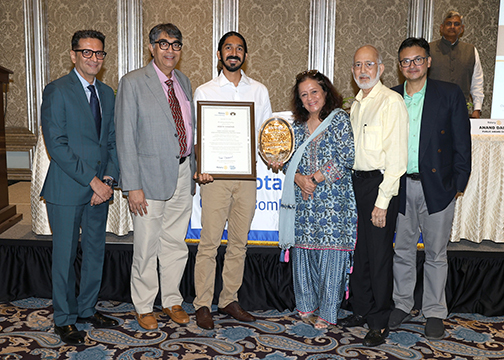
Arjun Kamdar – Transcript
Arjun Kamdar – Transcript
Thank you so much for having me here and for this award. It really means a lot. It is fantastic to be in this place with all of you and to share some of the insights from the journey that I have had. I will take you through a few things that we have seen, what we have done, and the kind of things we are planning and hoping for in the future.
I grew up in Mumbai and studied here for a long time. Then I was in boarding school at Doon School in Dehradun, and afterwards I was pursuing CA, like my father and his father. But I was always interested in wildlife, and I did not know whether it was possible to make a career out of it. Is it feasible? There were many questions. I constantly tried to straddle both worlds, and I realised that it was possible. It was not impossible. Therefore, I switched careers and did a master’s in wildlife biology and conservation.
This was a very intensive two-year degree, learning how and why animal populations are the way they are, and what we can do to save them. It took us all over the country, and it was phenomenal. I am going to try and give you a brief insight into some of these different ideas that we have been thinking about. It is going to be across species, across landscapes, and across ideas and cultures, so co-evolved human and animal cultures.
We can start with the northeast of India, which is where I spent a good amount of time over the past several years. Human-elephant conflict is a very serious issue over there, with close to 100 people dying every year, thousands of people losing their crops and livelihoods, and tens of elephants also suffering and dying in the process. It is a very serious issue.
Rather than give you all these numbers, let me tell you about this through the story of an elephant that we were following. This is a wild male elephant. We called him Bordoisila, which means thunder in the local Boro language, because he was really like thunder everywhere, and that was his personality.
He is about 40 years old and has lived in these landscapes since he was born. His entire range starts from the river islands of the Brahmaputra and goes through these vast grasslands. If any of you have been to Kaziranga or Orang, you will recognise these kinds of places, surrounded by such tall grass.
His range then enters dense tropical broadleaf rainforests and the mountains of Arunachal Pradesh. These elephants are among the only elephants in the world to be found at an elevation of 3,000 metres, with their footprints in the snow. Again, we had no idea about this.
Here is a time-lapse of that same landscape during Bordoisila’s lifetime. You can see the green fading over 1984, 1999, 2001, 2007, and it is gone. Fifty per cent of it was gone.
Now, that means that in his own lifetime, he has seen the landscape completely change. Elephants cannot spend too much time in one landscape because, if they spend too much time there, they will overgraze it and regeneration is not possible. So, they need to keep moving.
What we need to do then is understand what has happened to them. The forests have also been replaced by tea. Fifty per cent of India’s tea comes from this part of Assam. Elephants are supremely adaptive, and they have tried to make the best they can of this situation, but it does not always work as planned.
But what it also does is put them in conflict with people, because people have their crops, their homes and their stored grain, which elephants are looking for. They have a great sense of smell, so they can find it very easily. This does not end well for either species.
You can see elephants eating people’s crops and the very heightened sense of loss. These are just some more images of the damage. Of course, these are extremely marginalised people. They are entirely reliant on this for their livelihood and their food, so it is a very serious issue. When there are children involved, it gets a lot more complicated.
We were trying to really understand how we could stop this. Why are elephants coming into conflict? Is it that there is not enough to eat in the forest, or is it that they really like rice? That is what everybody grows. If you think about it, we have also been making rice more and more nutritious and more and more tasty for thousands of years. Elephants, of course, know that, right? So, they would also pick up on this.
Sometimes, this damage happens at a school because the midday meal rice is being stored there.
So, this is what it kind of looks like. When elephants are killed in retaliation, we really wanted to solve this problem.
First, I am trained in ecology, so I said, ‘Let me understand the elephants.’ We got together and studied all these elephants as much as we could using observation. But they are so sharp that, once they realise they are being observed, they just disappear, and there is no way you can keep pace with them. As you have seen, the elephant grass is twice our height, so it is really hard.
So, we said we would place these camera traps, which are CCTV-like cameras. You can see me climbing the tree and putting one up there. This is the kind of footage that we get from them. We could really understand which elephant was where and what they were eating.
But, as you can imagine, CCTV only captures a narrow part of the picture, so we could not really get much insight from these.
What we did then was put a radio collar on the elephant. It is like the GPS in our phone, powered by a battery and made elephant-proof. It is waterproof, shockproof, everything, and it lasts for four years. The collar communicates with the satellite, which communicates with us, and then we get to know where the elephant is.
However, the elephant is not going to be happy if we just climb on it and do that, so we have to sedate it. This is our team of veterinarians using tranquilising drugs to sedate the elephant very quickly, go in there and put the collar around it.
There is a person standing next to the collar to give you a sense of the scale of this entire idea. It is eight kilos and really thick, and it is completely elephant-proof. That is the technology that we really had to develop and get from Germany to be part of this.
This is Tara, the first elephant we collared. I am going to show you some insights from her data. Each dot is a location recorded every hour over several months. As you can see, she spends a lot of time in the forest, but also makes this annual migration through the human area, which is the centre part of the map.
This is what it looks like. We knew that elephants moved between forests, but we did not know that they spent so much time doing this. That is what this technology told us. This gives you an idea of that. If you look at this, this is satellite imagery, and you can see that the footprints of elephants are actually visible from space. It is crazy to think about, and this is what it really looks like.
When we went deeper and tried to understand this from the people who were sharing these spaces, because the elephants were coming through these villages, we asked them what happens, how do the elephants come, and so on. We made these observations simply by standing at the side and looking at how people interact with elephants, or do not interact with them. Sometimes we knew the elephant was there, but the other people did not know.
We realised that the elephants had really adapted to these new human areas. In some sense, they had learnt how to live with people without being detected. They do not eat tea, which is one of the biggest sources of livelihood for people, so they can find their way through these areas. Once in a while, they eat some crops, but they do not eat tea.
We then did a bunch of social surveys, and I spent a lot of time, several months and actually years, living with these people in these contexts to understand how they were making these decisions and what was really happening. We realised something fantastic. People simply had not adapted to the new behaviours of elephants, and they were having accidental encounters.
For example, people would go outside at night without a torch, or keep grain stored outside, which would attract elephants. Very small things could lead to a lot of danger.
That is when I realised that this was interesting, but I was not trained in this. I was trying to understand human behaviour, get people to do these things, give them information and conduct awareness sessions, but it was not working. Then I thought, why not draw on the marketing psychology of humans to really understand how to send this message across?
That is when I wrote to my current supervisors at Cambridge, and I studied a degree in environmental economics because I also realised that a lot of these things are embedded in economic systems. We really have to make sense of that and take it into consideration as we are designing these things. That is when I went to Cambridge and continued working here as well.
I will show you some of the insights from what we did with this new idea. Using all sorts of information, we said, ‘Let us tap into this idea that people already have.’ Most of us have seen how, two or three generations ago, people had a very different relationship with nature. It was at the core of how nature was understood and how animals and nature were respected. That has been changing over the course of time.
We said there are these huge tea estates, which are where most of these accidental deaths used to occur. We decided to work in these places because they already have to conduct outreach programmes as part of their certifications and compliance.
We used both our ecological insights, looking at which areas elephants prefer and how we can protect them, and worked with the government to give those areas some level of protection. At the same time, we tried to understand how people were interacting with this and what narrative we should use.
Should we talk more about how it is beneficial for them, or should we talk more about how it is beneficial for the community? It is more of a collectivist culture, where it is not only about you. It is also about how your actions impact somebody else in the same community.
Those were the kinds of insights that we used. We then got a few professional visual designers to develop these materials. The best part was that we developed them with the people whose behaviour we were trying to change. That worked really well.
People started using more torches. The number of deaths went down, and the number of crops saved also went up. So, it was a really good win-win. This was across 32,000 hectares and 3 lakh people. It was quite a large intervention, with just the right place, at the right time, and the right intervention.
This is an example. These are children who really love seeing elephants. Sometimes they would get too close, then the elephant would get scared and charge, and it could lead to a mishap. Because we have now had this long-term work with them, they enjoy watching the elephants, but from a distance.
I was not very happy this day because they had skipped school to watch the elephant because he was in the backyard!
Those are some more visuals from the landscape.
Now, this was with elephants, right? Elephants have adapted to these new ideas and new realities, but what about other species? We have also seen that so much of our world has changed in our own lifetimes. How can species learn so fast?
I had heard about this, and, as Milan mentioned, I really like snakes. That is one of my favourite species to work with. I had heard about this case study, or rather this rumour, somewhere on a small island in Indonesia. It was a place called Istana Ular, which in Bahasa Indonesia means the Palace of Snakes.
I said, ‘That is very interesting. What is that?’
I then went on this journey. There was no information available online. I obviously do not speak Bahasa, but I said, ‘Let me go and try and understand.’
The rumours were that there was a tribe that had this very interesting relationship with snakes, where the snakes never harmed them and they never harmed the snakes. They had this one cave, which they called the Palace of Snakes, where they would go and exchange information and reiterate these bonds. It was a very cultural thing.
So, I went on this big journey, and I was going on all these false leads. But then I found this guy, through one person and then another, and he said, ‘Okay, I can put you in touch with somebody who might be able to help.’
And he did. This is how I would communicate. I had a scooter, I would go there, and we would communicate. I said, ‘This is how he said…’ So I said, ‘Okay, I’ve reached.’
It was this small village, and you had to trek down and up a mountain to get to this place. This is what he told me. I said, ‘Okay, I’m here. Let’s go.’
He said, ‘After drinking coffee, we will go straight to the Palace of Snakes, but we are afraid of the rain.’
I said, ‘Okay, don’t worry.’
So, we had coffee, and then I said, ‘Now let’s go.’
He said, ‘Brother, eat first. It is a long journey.’
Very dramatic. This was all in Bahasa, but eventually we did end up going there.
At first, you have to take permission from the spirits of the forest, and particularly from the snakes. Then you walk in, and it is this cave with these huge reticulated pythons, 18 feet, 15 feet long. That bulge is probably wider than me. It has eaten something much bigger.
But in this place, humans and snakes have co-evolved a culture. Snakes know that humans mean them no harm, and humans know that these snakes mean them no harm. Everywhere we went, we would see snakes in every hole, every crevice, everywhere.
I thought, ‘This is so interesting, but maybe this is just unique to this place.’
That is us over there. Both of us went deep inside the cave, found a lot of these snakes and then came out.
I then started reading more, and I obviously had the idea of really understanding what was happening here, and whether this could be replicated in India. Was this something unique, or was it something that could be scaled up?
With that context, I realised that it was possible. This is a wonderful BBC Planet Earth series. If anybody is interested, you can watch it. It is about how a village in Bengal has learnt to coexist with cobras.
These are visuals from there, where this cobra is hunting a frog while the woman is drawing water from the well. Similarly, somebody is stitching and the snake is simply going over their legs. It is incredible.
It is a co-evolved culture.
This is very uniquely different for our country, for India, compared to most other places in the world, perhaps with some parts of Africa as exceptions. This relationship takes generations to evolve, for this understanding to develop and then be transmitted down through generations.
Therefore, North America, South America, Europe and Australia all had large mammals like we do. They also had dangerous animals, but they were virtually wiped out over the last 30,000 years. Everything is gone. So why is India unique?
It is because India has been the cradle of humanity. Humans also came here long ago, and at the same time, these large mammals evolved here. So, we have co-evolved together over hundreds of generations, literally lakhs of years.
Let me think. This is still too abstract for people here, so let us think of an example from Mumbai, right?
I am sure everybody has heard of leopards in Mumbai. They are in IIT, they are in Aarey, they are here. Mumbai has Sanjay Gandhi National Park.
How many of you have been to Sanjay Gandhi National Park?
Yeah, most of you, right?
Sanjay Gandhi National Park is, of course, the area on the slides below, surrounded almost entirely by Mumbai. The density of leopards, the population density of leopards in Sanjay Gandhi National Park, is about 27 to 30 leopards per 100 square kilometres.
Okay, this is a great number, but it sounds even greater when we compare it to national parks anywhere else in the world, including ones in Nashik, Tadoba, Kruger and the Maasai Mara.
The average leopard density over there is about 4.5 to 5 leopards per 100 square kilometres. We literally have five times more leopards.
How is that possible, right?
We are in one of the most densely populated cities in the world. There is so much pressure, yet the leopards are thriving, and the most important part is that this is happening without human attacks.
Long ago, five or seven years ago, there were a few attacks here and there. Why did these happen?
Again, there has been a great deal of work on this, and it was because when people would see a leopard, they would get scared and tell the Forest Department, ‘Do anything. Take this leopard away and leave it where it is supposed to be, in the forest.’
But the leopards there had evolved to understand, had evolved this culture to understand, that humans are best avoided. The moment you see a human, run away and hide.
Similar to the elephant collars that I mentioned, a few colleagues had collared leopards in Mumbai. They found similar sightings, and he showed me some videos as well. There were morning walkers and joggers going into Sanjay Gandhi National Park, and right next to them, there was a leopard four metres away, simply waiting.
Then the leopard saw the joggers go, crossed the road and continued on its way, and these people had no idea. All of this happened within a span of 15 seconds.
So, they have really evolved. That is when we realised that what we have to do is try and focus on really building these cultures and these values together.
Of course, I have a few more examples of this. I will not spend too much time on them, but this has been the founding philosophy of my organisation, Sea Green Foundation, where we work on human-wildlife interactions, community-led initiatives, and also a lot of art.
We use art-based methods because art has the power to build these bridges, to open the door and to encourage people to think differently.
This is an example from Manas Tiger Reserve, where one of our friends and colleagues, Ranjalu, who is a local person, is working to save the Bengal florican, a rare bird of which fewer than 800 individuals remain in the wild. They found them in his area and used these art-based methods to build awareness about the bird and conduct outreach sessions with the local people.
Similarly, with snakes, we follow a similar approach. We work all over the country, particularly in Maharashtra, Uttarakhand and Assam, helping people and snakes share spaces safely.
I will now spend perhaps three or four minutes talking about some of the work that we are doing and some future directions.
I am now doing a PhD in behavioural science, focusing on human decision-making for conservation. What I really want to focus on is how we can create a norm shift, a new idea of how we live our lives.
This has happened in the past. Things that were considered completely crazy 20 years ago are now commonplace and accepted in society. Take smoking, for example. Twenty years ago, it was considered very cool. Today, it is not cool at all, at least in our generation.
There have been these shifts in what we consider acceptable. I want to use ideas from behavioural science and marketing to really understand how we can do this for nature.
Luckily, I have Professor Cass Sunstein on board with me. He was the head of regulatory affairs for the White House under Obama and Biden and has been phenomenal in working on how to make policy more effective. So, that is something we are working on.
Again, we are using these ideas for a very applied issue: snakebite and snake conservation in India, which kills about 80,000 people in India every year. So, again, it is a very big deal, and of course, there are literally millions of snakes. Improving the capacity of grassroots practitioners and organisations to deal with this on their own is a core focus of our work.
And now, why here, now?
This is just a little bit of a story. In the late 1700s, there was the very active Atlantic slave trade, with Black people from Africa being taken across the world, to Europe, the Americas and everywhere else.
Twelve people got together and said, ‘This is crazy. If this is happening, then somebody should do something about it.’
They all got together in London and founded the Society for Effecting the Abolition of the Slave Trade. They said, ‘We have got to work.’ They worked really hard. They legislated, they lobbied, they spoke wherever they could, they put in money, they put in their expertise, their way of thinking, and so on.
Of these 12 people, 10 were businessmen, and I think eight had some exposure to, or were making money from, the slave trade. Yet they said, ‘This does not make sense. We have to do something.’
This was one of the greatest movements in the history of humanity. It was the greatest challenge to humanity then.
Similarly, I feel like the people in this room face the greatest challenge to our humanity today: the polycrisis of the loss of wildlife and climate change together, which are completely coupled. Biodiversity helps sustain and maintain climate, and climate also helps sustain biodiversity, which of course sustains all of us. It is what we are on.
Therefore, I feel we together here can really bring about that change.
This is not unique to something in Africa. Even the Indian freedom struggle has the same principles. I like to look to history, to the past, to inform my present and the future. I feel our freedom struggle also carries these same tenets, which is about working for something much larger than yourself and putting in expertise, knowledge and whatever resources we have to make this world the way we would want it to be.
Therefore, I am really happy that I am able to share these ideas and talk about this here.
And yes, thank you again for having me here.
This would not be possible without the support of really good friends and family, like my parents, who are here, Milan and Kruthi as well, who have always been there to nudge us along when we think of these unconventional ways.
So, thanks again to them.
Q&A
Q1. Member: When he was 13 years old, he rescued his first snake.
He did not tell me about it, but he told his father. I had two options: either to be the mum who would say, ‘Do not do any such thing’, or to be the mum who says, ‘Get informed and do things.’
So, I chose the latter.
I have a question. In countries like Botswana and Mozambique, they have trophy hunting, where they give out licences to people to shoot elephants. What is your view on this?
The second question I have for you is, are you at Queens’ College, and have you met Mohamed El-Erian?
Arjun: Yes. I will take the first one first.
Mohamed El-Erian, who is with Allianz and PIMCO and does that work? Yes, I am actually in the institute that he helped set up, and we have hung out many, many times. He is a fantastic guy, extremely funny, and I am in Queens’ College, where he was the president in Cambridge as well.
It is a really nice place to be, with a very nice atmosphere and great people. If any of you are ever in the UK, please come by. I would love to show you around.
And on trophy hunting, I think that is an excellent question because it ties in with all these different aspects that we have been talking about.
Here, the idea is that people pay money to hunt an animal and take its trophy back home. That money is then used to support conservation efforts in the region.
This is a very contentious topic. On one hand, we can use an economics lens and ask, ‘Does it work?’ The evidence is mixed, but more or less, it does work the way it has been charted out.
But then the other question is the moral question. Are we okay with it?
I would like to tie that back to some ideas that I was experimenting with when I was in Assam. We have rhinos in Assam, the largest population in the world of the Indian one-horned rhino. The rhino has a horn, which is very, very lucrative, and is one of the top things to be sold in the illegal wildlife trade market.
The thing is, it is made of nothing. It is made of the same thing as our fingernails. It has no real value. But people in China think it does.
The interesting thing is that the rhino has no use for its horn. So, it is not of any use to it ecologically. It is not good for attracting females. It is not good for fighting with each other. It is not good for digging up anything, at least not for the Indian ones.
So, I would ask my Forest Department colleagues and conservationists, ‘If the poachers want the horn and they do not care about the rhino, and as ecologists, we want the rhino and we do not care about the horn, then is there really a problem if we just tranquilise the rhino, take away the horn and, not to forget, we do not even want to sell it, we just burn it?’
Then the poachers would have no incentive to kill the rhino, right?
They all, except one person, said, ‘Of course not. Paagal ho kya?’
I said, ‘Why?’
They said, ‘No, because the pride of the animal is the horn. So, we cannot do it.’
So, then that means it is not an economic argument. It is not an ecological argument, but a moral one. You know, that this is not what we do. This is like accepting failure.
Q2. Member: I must say, like, the process of co-evolution. There are a couple of things I want to ask you.
Jim Corbett started off as a hunter and then gradually became a conservationist. One of the things he says in one of the books is that when you spend so much time in the wild, a human being acquires a sixth sense, and he sees things which, in that sense, define his senses. It goes beyond that. It is something I do not know if that is something which you, being in the jungle so often, think can still happen simply by being exposed to nature.
That is one of the things.
And the other thing I want to ask you is about time memory. Is there something where they really remember things that have happened to them for a long, long time?
Arjun: Thank you. Thank you. I think, maybe just before I answer that, I think tigers do exist. I am going to try a little more. But, okay, definitely on the sixth-sense bit.
I feel this is something that I have been thinking about of late because I have been in the UK now for a couple of years, doing coursework and these kinds of things, and then I came back a few months ago. I had gone to a forest recently, and I had no idea about anything in that forest. But somehow, when I walked in, I knew that I had to look on the right-hand side, in a drain, and there was a snake over there.
So, I think it is a kind of sixth sense.
Then I did some reading, as any PhD student is supposed to. There is this idea that people have floated, psychologists call it the naturalistic decision-making process. They use the analogy of firemen. Firemen have to make these extremely high-consequence, high-stress decisions in a very short amount of time. How do you train for that? You constantly expose yourself to these scenarios again and again. Then you build experience, intuition, expertise and different forms of the same thing.
I think that is definitely there.
Similarly, with elephants, because I had spent so much time with them, you suddenly can smell elephants. When we are walking, I can say, ‘Oh, an elephant has passed by. You can smell it.’ Something I would never have thought I would do when I was here in Mumbai. But that is something that definitely gets honed in very organically.
And on memory, there is definitely some evidence that they have a great memory. It is very difficult to associate and test these things because all the tests of memory that we have are made for humans. We have to think like an elephant and feel like an elephant to test it, right?
It is like that old saying: if you judge a fish by its ability to climb trees, it will live its whole life thinking it is an idiot, right?
It is similar in this case. We tend to use complex problem-solving as a test for intelligence. Then we say crows are smarter than monkeys, monkeys are smarter than dolphins, and so on. But, very honestly, it depends on the species.
I think, and this is my suspicion, that if you give a test of a memory task to an elephant based on something it has been exposed to in its natural environment, for example, a new fruit that it had when it was two years old, let us say dragon fruit. Obviously, dragon fruit does not exist where elephants are found naturally. But if we were to give it that at two years old, and then give it a dragon fruit when it is 65 years old, does it still remember? How long does it take to eat?
I think there are those aspects.
It gets all the more confusing because they also have lateral learning, which means that they teach each other. If I have experienced something, I am transmitting that information, and that also happens. So, is it memory or is it learning? It is very difficult to disentangle.
Q3. Member: Fantastic presentation and very humbling. I just want to ask a little bit of a philosophical question.
Any modern innovation of the Western world has somehow been based on the idea that you want to control nature. For example, even something like Fairy Liquid, since you said that you have been in the UK for the last two years, the fine print says that some remnants of this liquid spoil the life of fish in the water.
So, any kind of modern invention, let us come to mobile phones, I mean, there are theories and theories about how mobile waves affect birds.
What is your view? You are talking, quite rightly, about human-animal coexistence. How does this fit in, you know, with all these inventions?
Arjun: I think that is a great point. The core shift that is happening right now is to really question this core assumption, this dichotomy between humans and nature, that we are different from nature in that sense.
And that is absolutely true. It is the Western world. In fact, if we were to take a more philosophical and theological approach to this, this idea traces itself to the ancient Judeo-Christian and Abrahamic religions, where there are mentions of the world being for man to exploit, right?
That is foundationally different from how most of Africa, India and Southeast Asia view their place in the world.
Just think about all our interrelated gods. In some sense, whether it is Jainism, Buddhism, Hinduism, any of them have some relationship with nature. In our stories, in the vahanas, in the avatars, there are so many of these things.
I think that is definitely something that the West is now forced to reconsider.
I was recently in France, where we had a big workshop, and we went to the Alps for a field visit. We went in there and it was beautiful, with lots of trees as far as the eye could see.
But now, once you are trained in this, I saw that all of them were the same species, which is crazy. It is never, ever possible in the natural world that all of the trees around you will be the same species, because that is not how an ecosystem is resilient.
It is like a portfolio, like stocks and mutual funds. You need to have diversity. It would be really crazy to put everything into one stock.
I asked the ranger over there, ‘So, these are all the same species, and do you not think that this would now make them more susceptible to disease?’
He said, ‘Yes, very good point. Actually, if you look over there, that part is diseased, and all the trees are dying and it is spreading through.’
So, the point is that this idea of controlling nature is now having these implications, and it has a time lag. They have been doing this for 300 years, and now the entire implications are coming all at once. And I mean, the US is no different, right, with these wildfires and whatnot?