
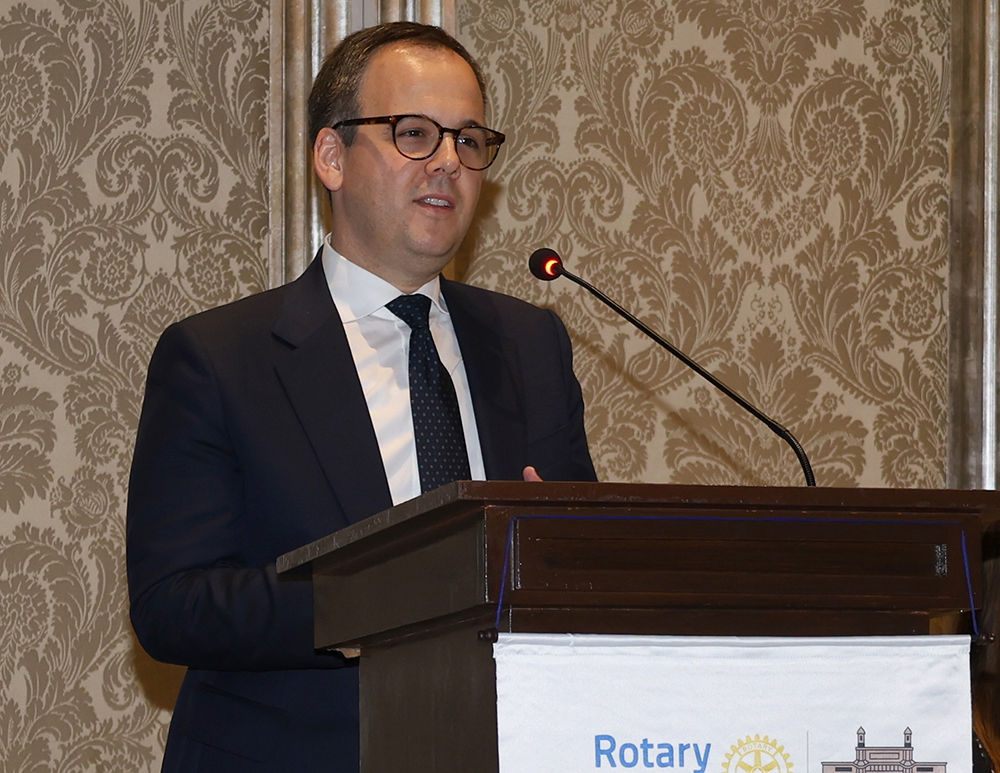
Mr. Paul F. DePascal, partner at Baker and McKenzie LLP USA, addressed the Club on developing trends impeding global families.
Thank you to everyone for welcoming me here today. It is truly an honour to meet with you and speak with you on this topic of families, family legacy, and what trends are impacting families worldwide. I am fortunate to work with families from all over the world on tax planning and transactional matters. I think that by seeing situations that arise in different countries at different times for families that have interactions with multiple jurisdictions, it hopefully allows me to take lessons from one area and apply them in other areas to the benefit of the families.
One question I have is, if you make an investment, how do you know if it is a successful investment? If you make money on it, right? How do you know if a business is succeeding? You look at the financials. You look at the returns, right? It is easy, in some sense, to know for many things whether you have had a success. Have you won the game? Have you made an outsized return?
For families, it is different. How do you know if a family is successful? Maybe they are happier. Would they tell you? Maybe not. And we know in the world, in the United States, all around the world, we are seeing the growth of family offices everywhere. But this raises the question: why or how do you know if a family office is successful?
It may not prepare financial statements that are disclosed to the public. It does not have a share price. You may ask family members. They may tell you you are doing a great job. They may tell you you are doing a terrible job. Or they may quietly drift. And so it is harder to know when a family office is being successful in its objective.
I think to start answering the question, you have to say: why was this family office started? Who started it? In whose vision was it created? Who is it meant to benefit? And who controls it?
These questions are not answered the same way for every family. They are not answered the same way for every family office. But it is important to ask them so that you can have a sense of whether the family office, the family, is succeeding in its goals.
I remember a few months ago, I had lunch with a friend of mine who was running a family office for a very, very wealthy New York family, whose pair of brothers started a business, extremely successful across the United States. And they had, like many families, a complicated structure. They had trusts, they had shareholders’ agreements, wills, and different branches of the family.
The family office was doing a lot of work. And by many measures, I think you would say that they were successful. They were managing complicated structures the same way an accounting firm, a professional accounting firm, would do, the same way a professional law firm would do. They were staffed, but they were designed around the objectives of the patriarch who set up the business, who ran the business for many years.
And when he passed away, the family office was still working the same. By the measures he had instilled, it was still successful. But that was not where the family in the next generation wanted to be. They did not want to be centred around the historical legacy family business anymore. They appreciated the returns that business generated, but individually, they wanted to focus their attention on different pursuits.
And what happened was that family office broke apart. And as a professional, you look at it and say, well, that is not a success, right? It could have been done differently. And indeed, it could have been done differently. But who is to say really what the success is? In the eyes of the new sort of four mini family offices, the control that they get over their own affairs and structures perhaps is the success that they are after.
So now we will turn to some of the themes that are guiding the work that we see with families and how they are thinking about the future.
I think one of the most significant themes I see is planning for stability in a time when things have become so volatile. After political upheavals, wars, sanctions, a new normal, I hesitate to call it normal, but a new normal political situation in many countries where things happen extremely quickly. You may agree or disagree, but the speed of change is something that is challenging how families and businesses react.
Today, wealth management is not about, or it is not only about, asset diversification. It is not about asset allocation, 60% equities, 40% fixed income. The kinds of issues that families are working on today are: what if I get sanctioned, right?
And it is because what we see coming out of the sanction’s playbook that the United States and Europe use against Russia is that sanctions are a very blunt and broad tool. They catch a lot of people. And so now, at a time when people are thinking about, what do I do? How do I access assets? How do I pay lawyers to fight these sanctions? Because once assets are frozen within the financial system, everything becomes constrained.
So how do you position yourselves? How do you diversify when we are not just talking about investment risk? Families are looking at different residencies, different citizenships. Family-owned businesses are looking at diversifying their supply chains, diversifying their productive capabilities.
If global trade is being threatened with tariffs and trade wars, one solution may be to have multiple production lines. We are seeing the separation of the China-focused economy and the US-focused economy. Not to say the rest of the world, perhaps left to see where those superpowers are dividing.
But that diversification also comes with a cost because people are thinking, well, I want my kids to be educated in this country or that country. I want to have an option, whether it is a residence permit, whether in some countries multiple citizenships. I need to have a Plan B. I need to have a way to go.
And that Plan B can be developed only in advance because once the emergency happens, it is very crowded. The exits are crowded and, in many cases, it is too late.
So that planning is happening now. People are looking at Plan Bs. How do we diversify business? How do we diversify our operations? How do we diversify the educational experiences of our family so that if we need to relocate, if we need to set up and start again, we have not just the financial resources, but also the cultural and human resources to thrive in that new setting?
This is something that I think, if you go back 10 years ago and you were talking to families, you would get a lot of blank stares. But one thing that has happened that I think has fundamentally changed how people prepare was the COVID pandemic.
There is very little good that came out of the COVID pandemic, but I think one lesson that I take away from it is that people now understand that extremely disruptive things that are relatively unlikely can happen. And when they do happen, they can create tremendous damage.
And so people that we see today, that we are working with around the world, are looking at risk differently. They understand that this perhaps low-probability event that could cause tremendous damage is at least worth thinking about.
And I say it is worth thinking about because what we often see in cases like preparing for political attack or reputational harm is that you can try to plan in advance and a lot of times the plan does not help you, right? The plan is not the purpose because things will often unfold in unpredictable ways.
However, the process of planning is extremely valuable because it forces you to think about different contingencies, different ways of approaching solutions.
One of the ideas of diversification that we see is relocation. We see families moving around the world. COVID did not prevent people from continuing to be mobile. We see families perhaps going the other direction now, where they are relocating to different jurisdictions.
When we met with families, say, 10 years ago, and they were looking at different jurisdictions, where can we set up? Where can we get a favourable tax status, a passport or residency that allows me to travel, that I want to live in and that I want to raise my family? In those days, tax was such a big driver. People would start the conversation by saying, well, where are the jurisdictions that have the best tax regimes? And let us start looking at those, and then we will take our family’s lifestyle and graft it onto that tax system.
And that is changing as well, because what we are seeing is changes that affect taxation, that tax regimes are changing more quickly than ever. Sometimes rates go up, sometimes new incentives are enacted.
The other trend that affects mobility and residency in terms of looking at different jurisdictions is exit taxes. We see in the United States, in Europe, in many jurisdictions, there are now exit taxes, which prevent you, they do not prevent you, they will just tax you on your way out.
And so the days, I think, of purely moving for tax purposes are probably numbered because what we are seeing are more restrictions, whether it is tax, whether it is transparency.
There is no doubt that in the last 15 years, financial institutions have become transparent. They are sharing information globally with tax authorities wherever customers are resident. And so the idea that you can have an arbitrage by moving to another jurisdiction and having non-reporting back are over.
Another important trend when it comes to mobility that we see is everybody approaches it differently. We see trends in mobility, but we also see the need to meet people where they are because everyone has a different view.
As we sort of entered the second administration of the current president in the United States, there was talk of people leaving, right? Some people wanted to leave, but we have also seen the US attract people from other jurisdictions at the same time.
I sit in New York, and I would say it is approximately equal, the number of people who want to leave and the people who want to come. And I think this idea that it is not just about tax is important because it is a complicated assessment that families make and that individuals make.
And as I said, everybody is different. And what you see are interesting trade-offs, right? You see jurisdictions that offer perhaps significant personal freedoms. You see other jurisdictions that offer tax advantages. You see other jurisdictions that perhaps do not offer the same level of personal freedoms, but maybe they offer a different level of security for certain people.
And so it is important to understand when working with global families that you have to understand where the family is coming from and where the individual is coming from.
The next topic I wanted to touch on was engaging with the next generation. And this is one of my favourite topics because what we have seen in the last few years is that there has been an interesting focus in popular media and some of the clients we work with on longevity.
And it so happens that over the last 100 years, human life expectancy has increased, has doubled. But at the same time, the business life cycle has shortened considerably because of the growth of capital markets, venture capital, cross-border developments in business growth.
And so you see an interesting dynamic here because you see younger people having liquidity events earlier, you see families where you have these wonderful legacy businesses and the next generation does not want to take it over.
So how do you react to that, right? How do you, if perhaps you have always had the business within the family, bring in external managers? What are the other exit options? How do you maintain the business, which may have a very important role in the community, in the economy, but who is going to steward it to the next generation?
And this connects with the earlier theme, where you have seen diversification of educational experiences, you have seen people educated in different jurisdictions.
That sometimes accelerates the divide between what the next generation wants to do and what the parents want them to do. People want to pursue their own ventures.
And what we say to families is that if you are thinking about succession and you are thinking about planning, everybody talks about, well, who is benefiting from the structure? Is it a trust? Is it trust beneficiaries, the next generation? They are economically benefiting.
The other thing everyone talks about is control. Who has control? And I would say, for succession planning, who controls is paramount. But when the control and who you expect to control is not met in the middle because the next generation wants to pursue their own ventures, that is when you have to think differently about succession planning.
And I would posit that the way to think about succession planning is not how do I transfer control, but how do I transfer the values, the understanding about what that business means and how it should operate?
You may not have, in the next generation, all of the best managers to be the CEOs, but perhaps they are the right directors. Perhaps they are the right overseers. And I think that is why we spend a lot of time focusing on meeting the beneficiaries where they are, understanding how they are approaching the question.
We have a family we work with, a multi-billionaire Asian family, manufacturing business, three extremely smart, very well-educated kids in the next generation. So, in the old days, you would say, well, three kids, your chances are great that you are going to pass the business to the next generation.
But they are all doing their own thing. The business in the family is a traditional manufacturing business, and the kids are interested in and excelling in robotics, neuroscience, and venture capital investing, none of which line up with the traditional business.
And this kind of brings me to the last topic in these trends that we see. And that is focusing on the family offices. What does the future hold for family offices?
And I think there is an important opportunity here. The opportunity is that you used to see in large business families a coalescing around the business. And we have talked a little bit about why that has become harder, about how there are different cultures within the same family, different educational systems, different value systems and different interests.
But that does not mean that you cannot succeed as a family office or succeed as a family. It means that you need to engage differently with the assets. You need to engage differently with the individuals.
And in fact, I would posit that you actually have an opportunity for the family office to play a more central role, where you see the business maybe retreating from its historical centrality in the family structure, the family office can step in.
And the family office can have a more decentralised structure. It does not need to be so focused in the mould of one person so that it breaks apart in the next generation. It can be created with a more flexible structure from the outset.
It can be a single family office that operates in some ways like a multi-family office. A somewhat diversified and dispersed structure intended to keep people together, centred around values, around management, around shared lineage, not just the business. And so that is some of the trends that we see in the family office space.
ROTARIANS ASK
Q1. Thanks, Paul. You were talking about Warren Buffett’s change of heart. He was going to give everything to the AIDS Foundation. And now he set up a trust for the street system to run, which is 140 billion, where they do not get anything personally, but they have to run it. How common is that in the US, where a patriarch gives everything to a trust?
So the US has a very long and deep history of philanthropy. It also has a very long and deep history of protesting taxes. And those go together to some extent in the US.
And so you do see many families utilising charitable structures for purely charitable reasons. You also see utilising charitable structures for a combined charitable and tax objective. It is very common among many families to give substantial amounts to charity. I would say in the situations where you have had really extreme wealth growth, like Bill Gates, Warren Buffett, you have seen more of those situations where people are willing to give such a high percentage. But I would say that you would also see, you have seen a pullback in philanthropy as well because, unfortunately, like everything in the US, at least these days, it is very political and even charitable giving has become politicised.
And so some wealthy families are increasingly sensitive about giving to charity at all, lest they be criticised. And on top of that, people are sensitive about what charities they give to because everything is so politicised and polarised. Even causes which you think are not political could, in certain people’s perspectives, be seen differently.
Q2. Thanks, Paul. That was a wonderful thing. So, I have a small question. Family offices, we have seen, I mean, there are big monies managed by the family offices, but there are many times there are feuds within the family. So do the family offices actually work as keeping the family together, or do they work as, or otherwise, how would you tackle that situation where there are diverse interests and wants among the family members?
So, like many things, a family office can be weaponised. So you can have some part of the family using a family office to keep information from another part of the family, or keeping certain executives in the family entrenched, notwithstanding the performance of the business. So there are lots of ways that they can be used to weaponise.
There is also a drift that could happen. So that is kind of my weaponising is a nefarious example. But you can also have a more benign situation over time where the family office is just gravitating towards one part of the family, away from another, and it is not serving the purpose anymore.
And so I think it does go back to the beginning of, well, what is the purpose of this family office? Is it to keep that business intact? Is it to keep a certain branch of the family in power, or is it something different? And I think the more you ask that question, you get a lot of insight, and you also sometimes see different answers where different family members will think the family office is there for different reasons.
Q3. Paul, you know, talking of succession in the families, business families, a recent survey by HSBC said about 45 per cent of the Indian business houses do not expect their children to get into the business. Is it just an India trend or is it a global trend?
I think it is a global trend. It is a global trend. And I mean, you see the industries and the technologies that are capturing so much attention for many people, but especially the younger generation. So AI, new biotech, lots of new innovations that the younger generations are really, really focusing on.
Q4. Is it true that some of those very rich families are funding change in countries, or are they funding activities they should not be funding?
So I think the question is, are people funding activities they should not be funding? I am sure they are.
Q5. I just wanted to ask, is it sensible to set up a family office outside of the country’s tax jurisdiction and what is the cut-off for you to do that?
So, it is an interesting question. There are several jurisdictions which have passed tax and regulatory rules to attract family offices. And so there can be benefits. I would say there can be tax benefits to setting up in certain jurisdictions.
There can also be regulatory benefits because not every jurisdiction recognises a family office as something that is different from a regular asset manager. And so certain jurisdictions, if you set up your family office there, you will be regulated unless you limit yourself to activities that are within the exemptions.
One thing that I would say is that with many families who have had a history of relocation, a history of moving around the world, you see interesting structures for family offices.
For example, we have a family office we work with where the family office is all based in Miami. None of the family lives in the United States. Everybody lives in the Middle East and in England. Zero people in the United States, except for all the staff.
And so, there are these historical connections. At some point there were people in the US, but not anymore, where you have the right people. And I would say that is a big driver, because for many structures, the family office is not itself a profit-making entity. It is a management entity. It is a cost centre.
And the family is investing and generating returns in other structures, whether they are companies or trusts or foundations. But the family office itself is more management and cost.
And so a lot of it is driven also by where the people are. So you have the right people in Miami. You can set up your family office in Miami, even if the family is not there. I think you have to find the right mix.
There is also one of the big trends in family offices we did not talk about, which is talent, finding talent at the level that you need within the family. And I would say that that becomes a primary driver. And you see family offices set up in jurisdictions that have less workforce. They do not have as many people. And so they may have the right tax system, but it becomes very difficult to staff that family office in a way that is really going to operate functionally.
Q6. You have the flavour of the global locations. Would you like to comment on our own India foreign jurisdiction, so-called, is a GIFT City where a lot of family offices are setting up?
I think a lot of people are very excited about GIFT City. I think there are still some questions about how it will be administered, how it will be set up, and exactly how foreign exchange will operate within GIFT City.
But I think it signals a real change in thinking about attracting capital, about keeping capital, recognising that hard foreign exchange controls have an effectiveness, but they also, over time, tend to accelerate other behaviours which are perhaps not achieving the main objective of the policy.
And so perhaps some loosening of the rules can, in the long run, be a furthering of positive policy.
Q7. What was the regulation of the family office? Who regulates the family office? Are there any jurisdictions which have family office regulation, or is it just regulated by some of the entities?
So that is a great question. So, you would look at, I would say, if you are setting up a family office in a jurisdiction, you would start by looking at it through the lens of the regular regulatory regime. And then you would see if there were any exceptions that could apply to exclude the family office.
And then there are jurisdictions that have special targeted incentives for family offices. Hong Kong and Singapore are kind of like in an arms race to always have the best framework for family offices. But in the United States, for example, anybody can call themselves a family office in the United States. There is no regulator specifically for family offices that approves them or not.
So anybody can, and that is another point about fraud and misleading in the market. There is definitely a challenge around identifying who are the legitimate family offices. I mean, usually you can tell when you are in a community and you know the people you see all the time.
But there are certainly people in the market who say that there are family offices who are more just pure asset managers or intermediaries or brokers that are connecting families to deals, that are not perhaps family offices.
Now, in the US example, if you are managing assets for someone else, that is a regulated activity. But if your firm is only advising family clients, which is specifically defined in the law to include also employees to some extent, then you are exempt from registration.
And so, in that sense, that is how the US approaches it, where you are an asset manager and you are subject to asset management regulation, but there is an exception if you are only providing services to a certain family group.
Q8. Hey, Paul. So far, great information you have provided. But when does a family really decide to set up a family office? What are some of the key drivers for that?
It is interesting because, going back to the point about bigger liquidity events earlier and the fact that everybody now knows at least the term family office, people are thinking about setting them up earlier, right? Maybe when you have a liquidity event, maybe even before your main liquidity event if you have other assets.
But we are also seeing that even in places with otherwise relatively deep talent pools, there is serious competition for people to staff the biggest and most sophisticated family offices. And it is becoming very, very expensive.
And so if someone, a client, comes to me and they say, I want to set up a family office because my neighbour has one, everyone on my street has one, I say, let us really see what you need, right?
Because maybe what you need is a multi-family office relationship. Maybe you need an asset manager, an accountant, right? There are different ways of meeting your immediate needs without necessarily jumping into a more costly structure.