
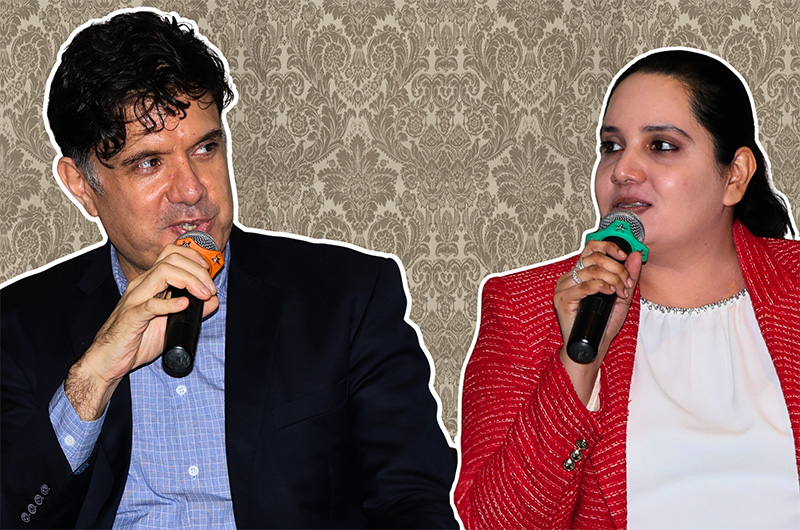
Adolfo Garcia Estrada, Consul General of Mexico in Conversation with Rtn. Tahera Mandviwala on India-Mexico Relations, Diplomacy, the World Cup and more.
Rtn. Tahera Mandviwala: How do you see Mexico’s position in the region and the world today? And how do you think all of this, what’s happening around the world, the global crisis, geopolitical issues, the war, will affect Mexico’s position, and how will it affect Mexico’s position in the future?
Adolfo Garcia Estrada: Well, first of all, thank you, Tahera, and it is a true honour and pleasure to be here at the Rotary Club of Bombay to talk to such a distinguished audience, such distinguished members, about our country, about Mexico. You told me, Tahera, that you would ask very simple questions, and from the outset, you mentioned geopolitical problems, crises, and so on.
The reality of today. To put it very simply, I want to start with what you just mentioned: the crisis. That is true. We are living in very challenging times, very difficult geopolitical times. And if you ask me what the position of Mexico is in this context, if you go to the etymology of the word that you rightly used, “crisis”, it comes from the Greek meaning “a turning point”, right? So, it is both a danger and an opportunity. We must look at this moment in its dual meaning.
Yes, of course, we are living through what we all read in the news: tariffs, energy prices going up, war, etcetera. And what is the position of Mexico, or any other country for that matter? Well, it is a difficult one. We are neighbours to the largest superpower in the world, the US, and that puts us, of course, in a challenging position, but also in a unique position to make the best use of the opportunities of this turning point.
So that is what I would say. If you can think of a country that has very much in mind this dual meaning of crisis, it is my country. Yes, we face challenging times in terms of tariffs, access to the US and other markets, but I also think that this crisis underscores all the advantages of Mexico and the strengths of my country that I would like to put on the table and communicate to you.
We are uniquely positioned to serve as a logistical platform for companies from other countries, especially from India. I was mentioning, for instance, the global rise in energy prices. So what does that mean? Indian companies must think about being closer to the supply chains of North America if they are participating in the North American market. Any disruption in travel or energy prices highlights the importance of being present in Mexico, in the American continent, because otherwise, you are much more exposed to these changes.
Not to deviate much more about this, I would say that the uniqueness of Mexico is its geopolitical location. We are the manufacturing and logistical hub in the Americas, geographically located in a strategic sweet spot between North America and Central and South America. So we are part of two worlds: both North America, with an economy that is very much integrated into North American supply chains, but also culturally, emotionally, commercially, and linguistically part of Latin America. So that is where we are at this moment.
Rtn. Tahera Mandviwala: Thank you for that. How do you see India standing in the world today? How important is India for Mexico? Tell us a bit more about the relationship we share today. Some statistics will help as well.
Adolfo Garcia Estrada: I think that everybody knows that India is a very important country. It is the largest country in the world in terms of population. But I think that, coming from outside, as I did, I never expected India to be as vibrant and dynamic in terms of economy and everything else.
I think that, for us, India has perhaps simply been too far away, because that is a geographical fact. Mexico is very far from India. We are on the other side of the planet. If you dig a hole here, you will end up in Mexico. It takes a long time to go there. So it is natural that both countries did not really develop their relations to their full potential. But I think that is changing, and it is changing very fast.
There is now a recognition of India in Mexico not only as a very big and important country in Asia, but as a truly key and strategic partner. Especially in these times of geopolitical turmoil, we need a partnership with India.
What I would say is that what I have seen is that India is not only important for us in sheer terms of the volume of trade, but also in terms of technology, innovation, scientific advancement, and knowledge. Those are key areas where India truly excels and is truly a champion in the Global South, and not only in the Global South, but globally in general.
So we have come to the realisation that we need Indian technology. We want Indian technology. We want closer collaboration with the Indian private sector.
Regarding statistics, the bilateral trade between Mexico and India is around 10 to 11 billion US dollars per year. That sounds like a big number, but it is not nearly enough for the potential of both countries. To put that into perspective, 10 or 11 billion US dollars is about four or five days’ worth of trade between Mexico and the US. So, our trade with the US in a week exceeds our annual trade with India.
Of course, we are neighbours to the US and our history goes way back with them, but still, that should be a point of reflection. We cannot, and this is a realisation for Mexico, have relations with such an important country like India at that level. So we are working to change that, and I can tell you that it is changing very fast.
Rtn. Tahera Mandviwala: Can you elaborate on that? What should the future of India and Mexico look like? What are the opportunities? What are the hurdles? What more needs to be done?
Adolfo Garcia Estrada: Well, first, of course, there is the recognition that distance is not really a very good argument for not being there in Mexico, or vice versa. We do not have direct flights, but we have one-stop flights through Dubai, Istanbul, or any European hub, and then you can be in Mexico. So it is very convenient to be there, and vice versa.
Second, I think that one of the main hurdles is reaching agreements between Mexico and India to open up trade and investment. And we are working on that. Of course, now we have tariffs, phytosanitary barriers to trade, and all kinds of certificates that are needed for the importation of foodstuffs and things like that. Those are practical issues on which we can work together to really allow bilateral trade to take off.
Rtn. Tahera Mandviwala: So, from January 2026, Mexico started imposing additional tariffs for non-FTA countries. I believe India is one of them as well. And India has been very active in doing FTAs with several countries across the globe, but not Mexico. So are you saying there are some talks on an FTA between India and Mexico? Is that something we can see in the near future? What would it look like?
Adolfo Garcia Estrada: Yes, our two countries are working together. Our governments have been talking to see how we can tackle that. We are not at the stage where we can have fully fledged FTA talks, but it is certainly a very important issue that we will be dealing with very soon.
Of course, I do not know what form these agreements will take, but any sectoral or partial agreement would be very welcome because it would allow us to start opening up trade between the two countries.
Rtn. Tahera Mandviwala: Now for some fun talk. Many of us have been to Mexico or want to go to Mexico. For those who want to go to Mexico, why should we go to Mexico? Secondly, the World Cup, right? Everyone is talking about it. It is unique this time, with three countries participating and hosting it. The opening is, of course, happening in Mexico. What is happening in Mexico for the World Cup? Why is it a not-to-miss event?
Adolfo Garcia Estrada: Well, what can I say? Along with India, we are two of the most fascinating, culturally diverse, rich, and historically relevant societies and countries in the world. I think Indians who go to Mexico are really fascinated by the wealth of history and this unique mix of our pre-Hispanic civilisations, the Aztec and Mayan civilisations. You can see the ruins there, and they are fantastic.
Then there is our Hispanic heritage. As you know, we were colonised by Spain, and the Spaniards remained in Mexico for three centuries. In that way, we also share some elements with India. India was also colonised by a European power, and we have this dual heritage that is fascinating and interesting.
Along with that, we have this wealth of natural beauty. It is truly a gorgeous place to be. I may be biased because I am from there, but it is a really beautiful place to visit. We have beaches, jungles, deserts. Mexico is one of the top 10 tourist destinations in the world. Depending on the year, we are usually around sixth or seventh place as the most visited country, just below Italy and Turkey. So we are talking about between 30 and 40 million tourists visiting us every single year. That gives you an idea of how popular and how beautiful the country is.
This year, as you may know, we were talking earlier today about the FIFA World Cup. The Football World Cup is the largest sporting event in the world, larger than the Olympics or any other sporting event in terms of viewership and matches. We are organising the World Cup along with the US and Canada. It is the first time that the World Cup is being organised by three countries. Usually, it is organised by a single country. With the exception of the World Cup in Japan and South Korea, it has always been organised by one country.
In our case, it is also unique because this is the third time Mexico has organised the World Cup. We hosted it in 1970, then in 1986, and now, along with our partners, the US and Canada, beginning on 11th June, we will host the inaugural match in Mexico City.
It will be a great celebration. The Mexican government is striving to make this a popular and inclusive World Cup. As you may know, seats for the matches are very limited and tickets are on the more expensive side, but we have done our best to provide facilities and giant screens in public spaces so that people can truly enjoy the matches and the atmosphere of the World Cup, along with foreign visitors.
So it is going to be a great public celebration, and it is the perfect occasion to visit our country, eat great food, and visit very popular tourist destinations that are just a day trip away from Mexico City, Monterrey, or Guadalajara, the three cities that will host World Cup matches.
Rtn. Tahera Mandviwala: Do you know how many people are expected for the World Cup?
Adolfo Garcia Estrada: Well, the Mexican government is estimating around 2 million additional visitors over a normal year in 2026. As I was saying, we currently receive around 30 million visitors per year, so perhaps we will receive 32 million in 2026.
Rtn. Tahera Mandviwala: That is a big number. Just to move away from the World Cup and generally talk about travel and migration between the two countries, I was wondering what sort of flow you see. You do not, of course, have visa programmes like a lot of other countries are now offering, such as golden visas and things like that. I am not sure if something like that is going to come up for Mexico. But even without that, what does the flow between India and Mexico look like in terms of travel and migration? How easy or difficult is it, and what type do you see more of? Do you see more education, more business? What is it that you are seeing?
Adolfo Garcia Estrada: Well, it is super easy to go to Mexico. In general, Indians do need a visa to enter Mexico, but there are major facilitation schemes in place to make travel easier for Indian visitors to our country.
For instance, if you already hold a US, Canadian, UK, or Schengen visa, you do not need to apply for a Mexican visa. You simply present your US or Schengen visa and that is it. You do not need to make an appointment with us. Of course, if you do not have one, we can always issue you a Mexican visa at the Consulate of Mexico in Nariman Point.
That means that most of the travel flow is concentrated in certain segments. It is not as widespread as we would like. Most visitors come from the US — Indian nationals who are already living, travelling, or studying there and then visit Mexico, which is very easy from the US.
We estimate that there are annually about 1.5 lakh Indian visitors to Mexico. Again, that is not a bad number, but in relative terms, compared to the 30 million annual visitors, it is still a small number that we believe can grow significantly in the coming years. We are working on that, and we hope that now, with the World Cup, we will see the statistics of Indian visitors rise significantly in 2026.
We do not have a golden visa per se, but there are many facilities for Indian nationals to live and retire in Mexico, and it is very easy. You simply need to show a certain minimum level of income, which is very competitive in comparison to other countries. If you can prove that you have the means to live in Mexico, then you can get a temporary resident visa — initially a one-year visa, renewable for up to four years — or apply for what we call a pensioner’s visa, which is essentially permanent residency for people retiring in Mexico.
So in a way, it is also a form of golden visa, but it is much less onerous and the requirements are far lower than similar schemes in the US or Europe. You do not need to invest in Mexico or buy property or anything like that. You simply need to show that you have the means to live there. So that is certainly an option for Indian citizens who want to live in Mexico.
Rtn. Tahera Mandviwala: And what sort of sectors do you mostly see investments in? What sectors is Mexico known for in terms of foreign investment, particularly what would be of interest to us in India?
Adolfo Garcia Estrada: Many sectors concentrate trade and investment with Mexico, but I would highlight three or four.
The largest sector for investment in Mexico is automotive and auto parts. The largest Indian investor in our country would be Motherson in the auto parts business. They employ more than 20,000 people in Mexico. JK Tyre is also a very important investor. They produce trucks, and Bajaj is dramatically increasing their production of two-wheelers in our country. So the auto industry would be the first major sector.
The second would be the IT sector, which is also a very large employer. We have TCS, Wipro, Infosys, and Hinduja Tech, among others. They are very important players in the Mexican industry and in Indian investment overall in our country. Both sectors play to the strengths I mentioned earlier about Mexico being an excellent platform for re-export to the US and for integration into North American supply chains. In the case of the IT sector, companies can service their American clients from Mexico.
It is extremely convenient to have your data centre or delivery centre in Guadalajara or Mexico City and serve US clients in the same time zones and very close to the major American cities. So IT is also a very important sector.
The third major sector would be pharmaceuticals. India, being the pharmacy of the world, has a very strong presence in the export of medicines, vaccines, medical equipment, and medical technology, as well as in the production of medicines and compounds in Mexico. You have Dr. Reddy’s and several other major Indian pharmaceutical companies there. India has a unique advantage in this area, producing excellent-quality medicines at a fraction of the cost of competitors in the US and Europe. So I think that is a booming sector and very much appreciated in our country.
Apart from that, we have other sectors as well. We have major investments by UFlex in the packaging industry, and UPL has a very important presence in the agro-industry. As you can see, it is quite varied. But automotive, pharmaceuticals, and IT would be the top sectors.
Rtn. Tahera Mandviwala: Coming towards the end of my questions, tell us on a personal note, how has India treated you? You have spent a lot of time in the US, Europe, Asia, and some other countries as well. So how has India been different for you?
Adolfo Garcia Estrada: India has been the greatest surprise of my professional life. And I tell this to everybody: here you can see the future being made right now. There is no other city where I have been posted where I have seen this level of activity, dynamism, vibrancy, and people constantly looking at business opportunities every single day.
And we are not talking about idle chatter, as in some other countries. People and businesses here are genuinely interested. They show interest, they come to the consulate, they follow up, and within a couple of months they are already in our country exploring these opportunities.
I have never seen this level of ambition from the private sector, which is perhaps the most important part of our job in trade and investment promotion.
And in India, what is not to love? I really like the weather in Mumbai. People say it is hot, but I love warm weather, so for me it is perfect. I love Indian food. I think it is absolutely the best. Some colleagues in the diplomatic circle say, “Oh, but it is too spicy.” I tell them, “Well, I am from Mexico, so I do not really care much about that.” I actually enjoy it, so it is very, very good.
And last, but certainly not least, the Indian people are super friendly and welcoming, unlike anywhere else. I have been very well received; people have helped me all along the way, and they are always very receptive. So I am absolutely thrilled to be serving here in Mumbai.
Rtn. Tahera Mandviwala: We are glad to have you here.
Adolfo Garcia Estrada: Thank you.
Rtn. Tahera Mandviwala: So, just as a last question to sum up before I open up for the difficult questions from the audience — these were all the easy questions — is there something you would like to sum up from this conversation that we have had so far? Anything you would like us to remember or take away with us? You can even talk about things I did not ask you, so that I am not putting you in a difficult political position. But if there is anything you would like to say on your own, I would like to hear it.
Adolfo Garcia Estrada: The main thing I would like to say is: look at Mexico as a very good partner and a very good option for business, travel, and for discovering a fascinating country. Of course, what can I say? But it is true. It is really a place where you can have a great visit and do very good business.
And I will finish with what I started with. These are challenging times, of course, but do not go only by the headlines. Sometimes the world is not such a bad place. There are, of course, important challenges, difficult problems, wars, and conflicts, but there are also opportunities.
These opportunities may not be very close. Maybe they are on the other side of the world, but that is exactly why they are opportunities for you, because they are in places that may still be relatively unexplored. But I can tell you they are there, and you will be very welcome to visit our country. Thank you very much.
Rtn. Tahera Mandviwala: Thank you. I will now open up for questions, if anyone has any.
ROTARIANS ASK
Q1. Thank you, Your Excellency. When I was studying in America in the 1980s, the richest person in the world was Carlos Slim from Mexico. We do not hear much about him now. I know he made his wealth in telecommunications. What has he been up to?
Adolfo Garcia Estrada: As far as I know, he is still at the top. As you know, he is the owner of the telecom giant in Mexico, the major mobile operator not only in Mexico but across Latin America. The largest mobile operator in Latin America by far is called Claro, and it is part of the conglomerate led by Mr. Carlos Slim.
That is actually a very good point to raise, and I think I only mentioned it in passing earlier: Mexico is also a very good platform for doing business in Latin America. Many large Mexican companies have major operations across Latin America, as is the case with Claro and Mr. Carlos Slim.
Indian companies also approach Mexico in two ways. On one side, you have companies that want to integrate into North America. On the other side, companies are looking at the Mexican market itself or the broader Latin American market. Those are two different propositions: one is North America, the other is Latin America.
I will give you one example: motorcycles and two-wheelers. If you go to Mexico, you will see delivery workers and commuters using two-wheelers just as in India. Indian manufacturers are world champions in the efficiency and design of two- and three-wheelers. That is not really a market in the US, where people are more focused on sports bikes and things like that, but in Mexico and Latin America, two-wheelers are an important means of transportation.
So Indian companies are doing very good business by targeting both the Mexican and Latin American markets from Mexico.
Q2: Thank you so much for being here this afternoon. I have two small questions. One is regarding your love for Indian food. I want to know what is the spiciest food you have encountered so far in India? Given the shared love for spices among Mexicans and Indians, and especially green chillies, do you carry habanero everywhere, or have you encountered something here that really made you sweat?
And on a more serious note regarding the World Cup, India has not yet secured broadcasting rights, so we still may not be able to watch it. Do you have any feedback on where the negotiations stand regarding the broadcast rights, or should we all come to the consulate to watch the matches?
Adolfo Garcia Estrada: I can certainly answer one of your questions, but I have no idea about the other.
Regarding Indian food, I think you will know what I mean when I say that Indian food can be super spicy in the most unsuspected ways. You never really know whether something will be mildly hot, super hot, or ultra hot.
There is also a key philosophical difference between Indian and Mexican cuisine when it comes to spiciness. Mexican cuisine is known for being spicy, but it is not usually spicy by itself. In Mexico, the dish is prepared, and then the chillies or salsa are served on the side. You can choose how spicy you want it to be.
You mentioned habanero — for those who may not know, habanero is one of the spiciest chillies on earth. Even smelling it can irritate you. But in Mexico, you would not normally have everything mixed in the dish itself.
With Indian cuisine, there is no escape. Even something very innocent-looking, like palak paneer, can turn out to be super hot, and you never know in advance. I usually manage it well, but I have great respect for Indian chillies and Indian levels of spiciness in general.
As for FIFA and the broadcasting rights, it is indeed surprising. What happens is that FIFA has a bidding process for broadcasting rights in different regions. Of course, it is a very big business in most countries. India is different for two reasons — and this is only my personal perception; I do not actually know the details of the negotiations.
Firstly, India has cricket in a way that no other country has as a nation’s sport. The passion and fanaticism that Mexico has for football, India has for cricket.
Secondly, there is also a geographical reality. The matches will be broadcast live, but at very difficult hours for India Standard Time, mostly in the early hours of the morning. That is a challenge.
For example, the inaugural match on 11th June — Mexico versus South Africa — will be on a Thursday night turning into Friday at around 1 a.m. India time. So it is definitely a challenging schedule. Other than that, I really do not know what will happen with the broadcasting rights.
Rtn. Tahera Mandviwala: I think he is asking how you will watch the matches, and whether we can join you.
Adolfo Garcia Estrada: Yes, I will probably have to turn on my VPN and see how that works. People have asked us whether we are planning a viewing party or something similar for the World Cup. But the matches are at 1 a.m. or 1:30 a.m., and a match takes around two hours, so it would finish at 4 a.m. on a weekday. It will certainly be challenging.