
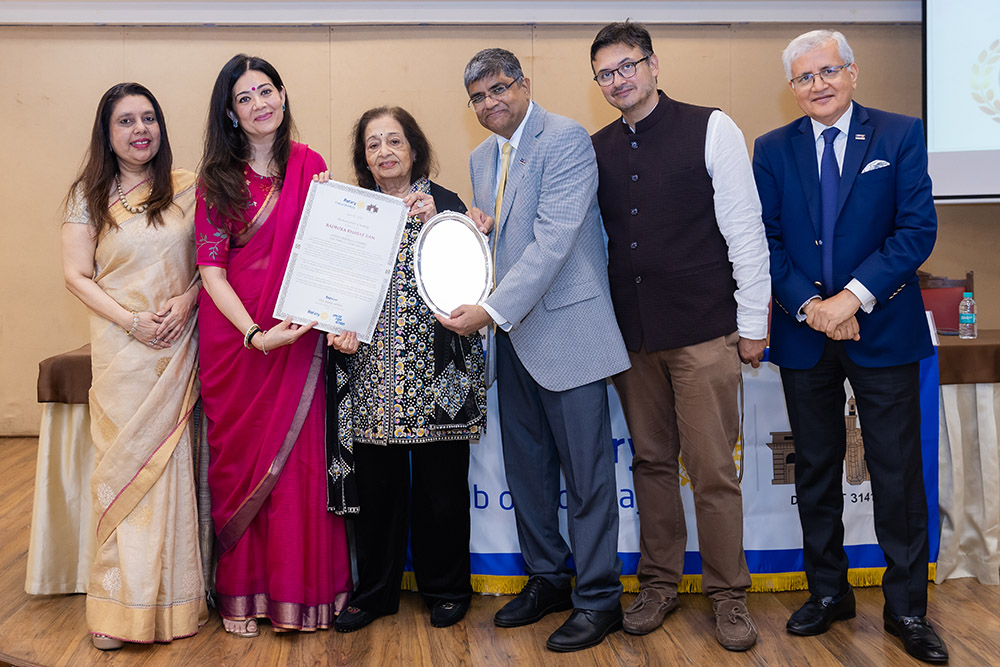
RCB Anita Parikh Award for Women’s Empowerment to Radhika Bharat Ram, Joint VC of The Shri Ram Schools and Founder of KARM for Young Indian Women
Namaste.
Just a little overwhelmed. Thank you for this extraordinary honour. I receive this award with deep, deep humility. Awards such as these are not only personal milestones, they affirm a shared purpose and renew our commitment to building a more equitable and inclusive world.
My journey in education and social impact led my husband and me to create KARM. We have always believed that privilege must come with responsibility. The responsibility to open doors, widen pathways, and ensure that opportunity does not remain the preserve of the fortunate few.
Through building KARM, I became even more certain that education is one of the most powerful forces for equity, dignity and freedom. Yet, over time, I realised that education alone cannot solve what we are truly trying to address. Gender equity is ultimately about agency, dignity and the freedom to make choices. And for that, financial independence is critical for women because dependence and dignity rarely go together.
Growing up, I had the privilege of agency from a very young age. My gender was never presented as a disadvantage. I was raised to think independently, make my own decisions, and eventually become financially independent. That freedom shaped many of the most important choices in my life.
For a long time, I assumed that most women in India experienced the world in a similar way. It was only when I started engaging closely with young women from different backgrounds that I realised how unequal that experience truly was.
I met young women who were bright, ambitious and deeply capable, yet whose choices were constrained by circumstances beyond their control. Young women who were expected to compromise on education, postpone their aspirations and settle for futures far smaller than their potential.
The more I listened to their stories, the more convinced I became that something needed to change. Something had to move.
That conviction ultimately led to the creation of KARM.
And as we look more closely at the broader landscape of India, some uncomfortable truths become impossible to ignore. Less than 1% of domestic philanthropic and CSR funding in India goes directly towards gender justice work. That percentage really bothers me.
The Global Gender Gap Report of the World Economic Forum 2025 places India 131st out of 148 countries overall, and we are near the bottom on economic participation when it comes to women.
These rankings are not abstract. They reflect the lived reality of millions of women whose talent remains unseen, unsupported and underutilised.
Yet the issue is not a lack of capability. Girls are succeeding academically. Today, 58.4% of girls complete high school, yet only 30% reach college, and an even smaller percentage enter formal employment.
While 76.6% of working-age men participate in economic activity, only 38.8% of women do.
So, the question, therefore, is not whether women are ready. The question is whether our institutions, workplaces, homes and social expectations are ready for them.
Even in sectors where women form the backbone of the workforce, like the development sector, leadership remains overwhelmingly male. Women continue to be underrepresented in boardrooms, policymaking spaces and senior management roles. Leadership by women remains the exception rather than the norm.
Part of the challenge is that many of our systems were designed for a different era. If we truly want women to lead, we cannot keep asking them to fit into spaces that were never designed with them in mind.
Instead, we must build workplaces, homes and institutions that recognise care, partnership, flexibility and shared responsibility not as concessions, but as the foundation of a just and equitable society.
Gender equity cannot be the work of women alone. It requires men, families, workplaces and society to evolve alongside women.
It also calls on women to support and champion one another, to create opportunities, lift each other up and believe in each other’s potential.
Above all, it requires women to not give up. Progress is rarely linear, but every woman who perseveres despite obstacles makes the path a little wider for those who follow.
And yet, despite these challenges, I remain very, very hopeful.
Education is enabling young women to imagine a different future for themselves, a future shaped by ambition, agency and independence. They are more aware of their rights, more financially conscious and far less willing to accept inequality as inevitable.
What they really need is opportunity, support, love, care and belief.
And that is where KARM seeks to contribute.
KARM for Young Indian Women is our humble attempt to address this imbalance and to do so with urgency. Waiting more than a century for this statistical equality to emerge is neither inspiring nor acceptable.
At KARM, we believe that financial independence through higher education is one of the most powerful pathways for lasting change.
Our flagship programme, the KARM Fellowship, which includes a Graduate Fellowship and a Law Fellowship, supports first-generation learners through college, into employment, and towards leadership.
Our girls are now working in companies like Genpact, MakeMyTrip and Yatra.
Alongside this, KARM Awaas provides a safe social-emotional space for young women. KARM Conclave is the first-ever platform in our country for young women where the conversation is on work, learning and financial independence. KARM Vidyavritta extends learning through a digital hub, making access to knowledge far easier.
Together, these initiatives reflect our commitment to supporting young women in ways that are thoughtful, responsive and rooted in their realities.
Through the fellowship, every young woman is mentored and supported for three years to grow into the person who can speak up, show up and lift others as she rises.
We have seen young women who once questioned their own worth become financially independent, challenge long-held norms, support their families and emerge as role models within their own communities.
Today, the average salary of a current fellow is ₹5 lakh to ₹5.5 lakh annually, often earning as much as, or even more than, their fathers.
But the real transformation is not in the salary itself. It is in what that income truly represents.
It represents a young woman who contributes to family decisions, supports the education of her siblings, helps secure her family’s future, and is listened to in ways she never was before.
Most importantly, it changes how she sees herself.
She no longer views herself as someone who needs to be taken care of, whose future will be decided by others. She begins to see herself as capable, deserving and full of possibility.
That shift in itself is where true leadership begins.
Every day we meet young women whose courage renews our belief in what is possible.
One of our fellows, Jyoti, who now works for us at KARM and completed one year with us today, said:
“People were disappointed when I said no to early marriage and chose to study further, but today my income has brought comfort to my home and given voice to my decisions. To say financial independence is optional for girls is to believe that voice itself is optional.”
Another young woman, Shabana, said:
“I was raised to serve others in my home, but today I take decisions for my family. The salary I bring home does not just support us financially; it gives me the confidence to express my opinion.”
The power starts to shift.
For me, these stories are the true measure of change because gender parity is not achieved through statistics alone. It is achieved when girls see someone like themselves doing what previous generations could not.
It is achieved when ambition becomes normal, when earning becomes expected, and when leadership emerges from communities that have historically been excluded.
The young women we support are not simply beneficiaries of change; they are the architects of it.
They are changing conversations in their homes, reshaping expectations within their communities, and expanding possibilities for generations to follow.
Witnessing this transformation is a true privilege for me, and it gives me immense joy and happiness.
This award, therefore, belongs not to me alone, but to every young woman who has dared to dream differently; every mentor who has guided us generously; my incredible KARM team, which works tirelessly to support these young women; and every person who understands that equity is not an act of charity, it is an act of justice.
Many people ask me what success at KARM means.
My answer is always the same and very simple.
Success is seeing a young woman discover the strength to earn, lead and sustain herself.
Success is watching opportunity replace limitation and confidence replace doubt.
Success is knowing that one life changed often changes many, many more.
And if we invest in the potential of young women with courage and consistency, we will do far more than transform individual lives. We will help build a more equitable, more prosperous and more hopeful India.
So, thank you so much for this honour. It really does motivate me to do far more than what we are doing because I refuse to wait a century for gender equity in India.
Thank you so much for this honour, and thank you to Rotary for the amazing work that you all do.
Thank you, and namaste.
Rotarians Ask
Q1. Congratulations, Radhika. You’re like a one-woman Rotary army.
My question is this: Have you also received feedback from the parents of the girls that they are so happy to see their daughters earning, becoming more confident, contributing to the family and influencing society around them?
Yes. While we don’t work directly with parents because we believe these young women are 18 years old and are young adults, we want them to take accountability for their decisions. So, the training really starts as soon as they enter KARM.
But when the parents come for the convocation, they cannot believe the transformation. And I really do believe that when a young woman starts earning, when that money comes into the home, something changes.
Shabana, the girl I spoke about, comes from a Muslim family. She was not allowed to wear trousers. There were incredible limitations. She went on to do her MBA at Vedica. She raised money to do that MBA, and now she’s earning ₹8 lakh a year. And now her father is like, “Tumhe jo karna hai, tum karo.” So it’s also about behavioural change, right? It’s about possibilities.
It’s a huge jump for that family.
We always tell our girls that while they are making these leaps, transformations and changes, so are their families. You need to give them time to understand. Educate them. Give them time. They will come around.
When the money comes, when they see you confident, when they see you taking charge, things change. You have to walk this journey with your parents. You don’t have to leave them behind. And that’s what education is about.
Q2. Why don’t you shed some light on the other philanthropies that you are part of as well – we have only focused on your work in women’s empowerment.
Yes, of course.
Twenty years ago, I started volunteering at the Crafts Council. I think that was transformational for me. Just working with craftspeople, understanding their lives, and embracing the concept of always working with people by putting them at the centre and creating interventions that are truly sustainable.
Don’t do charity. I do not believe in charity. Build people up to a level where they can live a life of dignity.
I think that translated into the work I later did at the Blind Relief Association as well. Working with the visually impaired was transformational for me as a human being. To see the kind of energy and positive attitude they have towards life is truly inspiring.
At the Blind Relief Association, nothing is impossible. Everything is possible.
I simply love working with people. I love working for people. Whenever I get an opportunity to contribute, whether it is at HelpAge India or Teach For India, I feel I need to be there and lend my voice.
When you serve on these boards, you also get to see the real India, which, when you live in metropolitan cities, you do not always get to see. It is an eye-opener. It also educates me and helps me design better programmes, even at KARM.
Q3. One of the challenges that we’re facing in the colleges that we run, and we have 2,000 girls in one college, is the issue of early marriage. The problem is not only early marriage itself. After marriage, many of these girls drop out and are unable to return to college and complete their programmes. How do you address this challenge when you face similar situations?
KARM started only about six years ago.
When Karthik and I started KARM, we said, “Okay, we’re going to support these girls for three years.” But when you look into the lives of young women, three years is not enough. So now we have an alumni network in place. We also have super mentors as part of the alumni who regularly come and speak to our girls.
We discuss very practical issues. Many of our girls do not come from homes where they can have conversations about negotiating salaries. Our girls are working in corporates. They have bigger aspirations and are incredibly driven.
So we discuss how to negotiate salaries and how to deal with a difficult boss. Who else are they going to talk to about these things?
We have realised that, to avoid slippage, we need to provide ongoing support. If you look at the data, many women are joining the workforce, but by the time they reach 30 to 35 years of age, many start dropping out. We therefore have very open conversations with our girls. We tell them to lean into their support systems.
If you want a career and want to be financially independent, you have to negotiate with your family and your husband for the support you need. You have to be able to say, “I can work and have children.”
These are conversations they often do not have access to. So we are constantly building our alumni community so that we can continue supporting these young women through external support systems as well.
This is incredibly important. Otherwise, you will lose them because they are often the first to quit work when difficulties arise. They are the first to say, “I will stop working because I am needed at home.”
Q4. Brilliant work, Radhikaji, and congratulations to you. Salute to you and the KARM team.
My question is this: while I have heard a lot about helping girls gain employment, are there any stories about helping them become entrepreneurs, starting small businesses and becoming employment providers themselves?
Could you also throw some light on how you help them access the necessary investment through government schemes and banks?
My second question is about the name KARM. Over the years, KARM has become a very complete term in itself, but has it become an acronym for anything? Have you ever thought about expanding it and giving it a fuller meaning?
To be very honest, at KARM, we haven’t really focused on entrepreneurship. Our girls come from acute poverty. When I say acute poverty, I mean that sometimes they do not even know where the next day’s meal will come from.
So entrepreneurship is still a distant dream.
Having said that, the whole purpose of KARM is that when you enter a company, you open doors for other girls.
We have seen this happen. One of our girls works at WTW, and I’m sure many of you know what an outstanding company it is. Now another girl has joined there as well.
So it is really about creating a pipeline.
One of our girls, Parminder, who works at WTW, once said, in a TED Talk:
“You see that lift that goes up and down. When it came down, I went up. When it goes down again, another girl will come up.”
That is transformation.
That is what we are building at KARM.
We are asking how we can create a ripple effect rather than simply saying we have touched 20,000 lives and that’s it.
We are going to walk with you for as long as it takes. And as for KARM, it actually stands for Karthik, Ahana, Radhika and Mahesh.
That’s my family.
Q5. We run a similar programme that started in 2009 for municipal school children from slum communities. They are now around 26 years old, so the programme has been running for nearly 15 or 16 years.
The biggest challenge is getting people to spend time. Money comes, but very few people are willing to devote their time. I was just speaking to Jaya, and wherever people spend time, the transformation is visible and immense. I want to ask you this: during your journey, how many of your friends from school, college and among your relatives have participated with you?
I am incredibly lucky, I have to say.
I am often known as the stalker at a party because anybody I like, I will try to get on board as a mentor. And I do this very seriously. I genuinely believe everybody needs to contribute. Contribution does not necessarily mean money. It means giving your time. I think the next generation needs our time.
At KARM, we have an army of almost 150 mentors. These are highly accomplished people such as Aditya Ghosh and Deep Kalra.
These are friends to whom I have said, “I don’t need your money. Money is never the problem. I need your time. I need you to mentor a girl for three years of her life.”
And they do that. If you have a clear vision and you can convince people that this is something that truly needs to be done, people come in.
For me, giving time to KARM is imperative. It is not as though Karthik and I are simply writing cheques.
I am deeply involved. I know every girl. I read every application that comes into KARM. Every girl is interviewed by me.
That is the level of investment I am putting into KARM because it has to be aspirational. It has to move the needle. I have to be deeply involved in building KARM. My thinking is very different. It is all about depth. It is not about scale. It is about going deep and making sure that we create a top-class institution.
Q6. If I may share my experience, five, six, seven or eight people may commit, but very few actually devote time. I keep corresponding with them and asking whether they will contribute their time.
Actually, I am very tough on my mentors. If you do not deliver, I ask you to leave.
I always say, please do not do this as charity and do not do it to look good. Do it because you genuinely want to. Conveying that is critical. Getting people involved is tough work, and I hear you. I know it is difficult, and I find it difficult as well. But giving up is not an option.
I have been lucky. The friends I bring on board are not the sort who will simply dabble in it. If I feel that they are not committed, I do not bring them on board.