
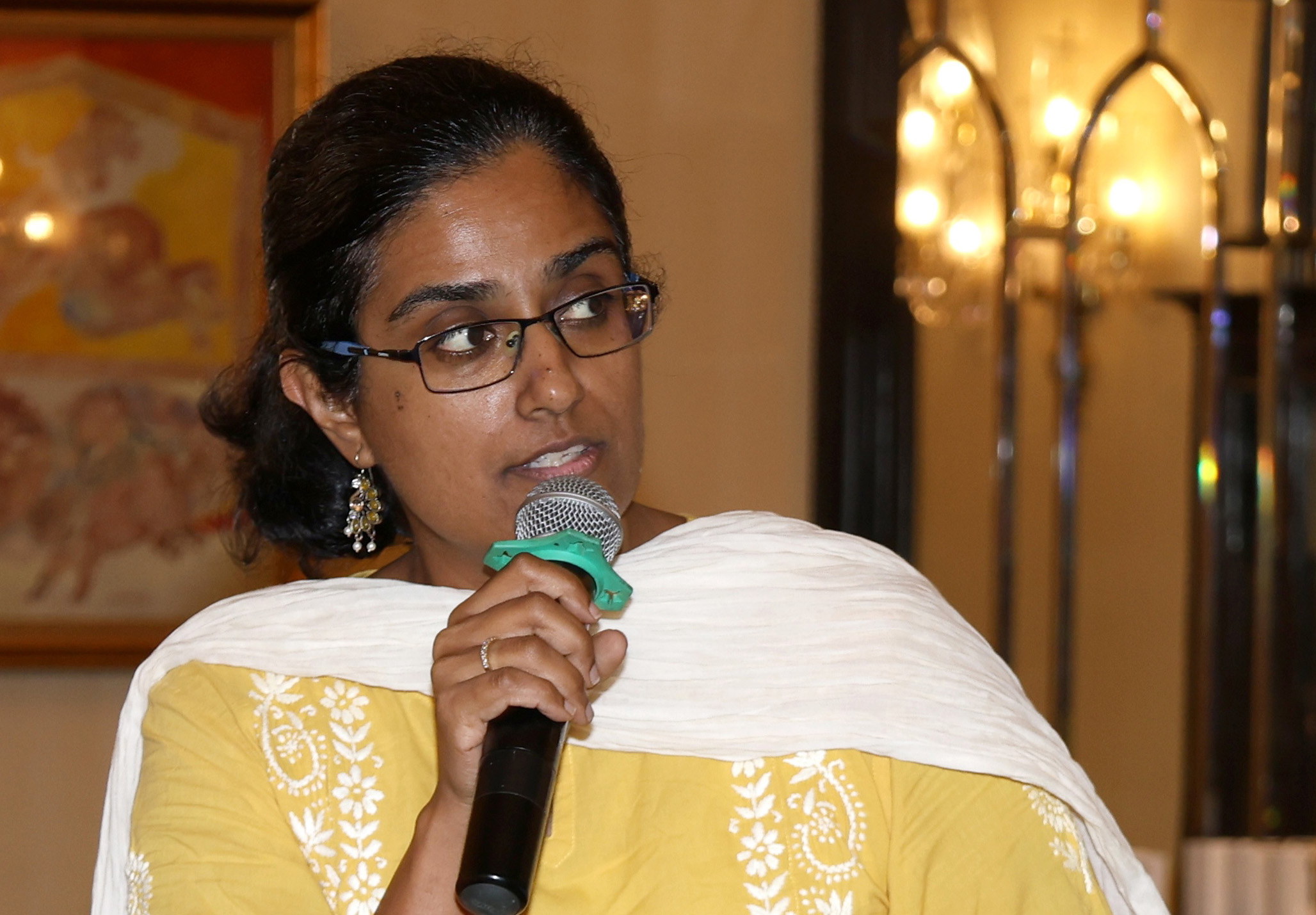
Author Mallika Ravikumar on 565: The Dramatic Story of Unifying India
Thank you so much. Good afternoon, and thank you to the Rotary Club. Thank you to Mr Jain, who has been the person who put me in touch with you. Thank you to the Rotarians here and to the committee for inviting me.
So, the book I am going to be speaking about is 565: The Dramatic Story of Unifying India. The story is mostly about various things, but in the other book I’ve written on Sardar Patel, he is the protagonist or the hero of most of the story.
Yes, so I’ll begin with this, just a bit of background before I jump into the story. Before Partition, India was divided into two broad categories of territory: British India and the princely states. British India was the territory directly ruled by the British, while the princely states were ruled by their own Maharajas, Nawabs, Nizams and other princes, although they accepted British paramountcy.
Now, we’ve all studied a bit about princely India, Maharajas, Nawabs, Nizam and so on, but the extent of the territory that they controlled is quite mind-boggling. The princely states covered nearly 50% of the subcontinent, so it was a vast territory, while the British directly controlled the other part.
So, when we read about the Non-Cooperation Movement, the freedom struggle and so on, all of that happened largely in British India. In the princely states, the British were only indirectly in control, and I’ll explain what I mean by that.
But the interesting part is that on 15th August 1947, when Britain was to withdraw from India, they were to withdraw only from the territory that they directly controlled, not from the princely states. So what was to happen to the princely states?
Can you imagine the map of India with all these separate princely states remaining outside the new Indian Union? That could have meant a fractured India, with hundreds of independent or separately aligned territories within the subcontinent. Of course, Pakistan, with East Pakistan and West Pakistan, would have separated as well.
And the man who put it all together, for the most part, it is not, of course, only his contribution, but for the most part, it is Sardar Patel, who is therefore rightly called the architect of modern India.
This is a picture I took when I was researching. This is at the Sardar Patel Museum in Ahmedabad. If any of you visit Ahmedabad, I would highly recommend a visit to this museum. Typically, an Indian museum is a rundown, sort of ramshackle place. You really don’t want to go there. But this is not like that. It’s a very good museum. Excellent. The artefacts, the storytelling, the exhibits, all of them are worth spending about three hours here.
At the entrance to the museum, there are two maps. One shows the India that we know today, and the other shows what India could have looked like had Sardar Patel and the others not succeeded in integrating the princely states.
So you can see the extent of how already we are living in a geopolitical volcano sort of area. We don’t have very good relations with many of our neighbours. We’ve had several conflicts. Can you imagine what India would have looked like with other countries within our borders? So I’ll come to that, of course, later.
Now, this princely India, what does it mean? The Maharaja is the iconic figure of Air India. Air India chose the Maharaja because the world knew India through its royalty. And it was a very important image, an icon of India.
I won’t go into details because I don’t have much time, but these are the kind of people you would meet if you went to princely India. They were men for the most part, as you can see in this picture, but also some women. There you have the ruler of Bhopal, who was a lady.
And there’s also this perception that these people were living opulent lives. They lived in large palaces, jewellery, cars. They weren’t interested in administration. To some extent, that is true, but it is not entirely true. There were many Maharajas who were very benevolent and interested in doing good for the people. Like, for example, the state of Mysore was far ahead and far more progressive than British India.
The second person you see on the top row from the right is Maharaja Sayajirao Gaekwad, who is the ruler of Baroda, and without him we may not have had Dr B. R. Ambedkar and his contribution, because he was the person who sponsored his education, who gave him a scholarship and so on. So, there were many people who were benevolent, who were progressive.
On the lower row, the person in the middle is the Nizam of Hyderabad, who was the richest man in the world at that time. And when it is today fashionable to be on the cover of Time magazine, he was on the cover of Time magazine almost a century ago, so a very cool perception.
Also, the man next to him is Maharaja Hari Singh, who is the Maharaja of Kashmir. We may not have enough time to get into all the stories, but this is just a brief introduction.
There’s Ranjitsinhji right at the bottom, on whom the Ranji Trophy is named. And the last person with a dog that you see, I will spend some time on his story. He is the Nawab of Junagadh.
Junagadh was a small princely state in Gujarat, and he was so dog-crazy. As you can see, he has his dog. He declared a state holiday for the wedding of two of his favourite dogs, Roshanara and Bobby. He had the dogs, but they showed up in diamonds and in jewels, and he had a state holiday and spent about $300,000 at that time for the wedding of the dogs.
And when he finally escaped to Pakistan, again, that’s a story that I will come to, he took all his dogs, the caretakers of his dogs, the vets and so on, and he forgot his own son. So that’s how dog-crazy he was. So, when you talk about dog-crazy people, he’s right up there as an example.
They lived in opulent palaces like this. The Palace of Baroda is four times the size of Buckingham Palace, one of the largest private residences in the world. Again, because of paucity of time, I won’t go into sharing a bit about their lifestyle. That is from Gwalior.
I’ll go straight into the story, which is the more important part.
We all studied about the Revolt of 1857 in school. The revolt was a moment when the British East India Company realised that they could not carry on the way they were carrying on till then. They were acquiring territory by conquering those princely kingdoms, and they realised that there was a backlash.
And then, in 1857, it was decided that the East India Company would transfer the power, transfer whatever territory they’d acquired, to the British Crown. And the British Queen, Queen Victoria, would be in charge and not the East India Company.
So 1857 was the moment when they stopped acquiring more land by conquering the territory. What they did instead was they came up with agreements. And these agreements are what they called agreements of paramountcy.
They came up with them, they were very, very creative and intelligent, of course. The Industrial Revolution began in England. There are many reasons why they became rulers of the world. But paramountcy is an interesting arrangement that they came up with.
And what it essentially means is, the territories that they did not conquer, they said, “Look, we’re not going to conquer any more territories. I know, we know you’re upset. What we will do instead is have agreements with those rulers. As long as you accept our Queen as the paramount power, we will not invade you.”
And, of course, these rulers were very scared because they knew militarily the British were far superior. If they could escape being conquered, their territories being conquered, and they were given guarantees that they could sit on their thrones, they could continue to rule, they would have their powers as long as they accepted the British as the paramount power. So they agreed and entered into these arrangements of paramountcy.
Now, why have I arranged them in different sizes? Because the British, like I said, they were very clever. They knew how to keep them busy and not turn them against the British by introducing something called gun salutes.
So, a gun salute essentially is, if the president of the Rotary were to walk in, you’d have guns going up 21 times. But if the secretary were to walk in, it would go out 17 times. If the ordinary members were to walk in, only 15 times, and so on.
So that’s what they essentially did. They said the Nizam is very important. The Nizam of Hyderabad had a 21-gun salute. The Maharaja of Kashmir had a 21-gun salute.
There were five 21-gun salute states. Some of them, like the Maharaja of Indore, had a 19-gun salute.
The others, like the Maharaja of Patiala, had a famous Cartier necklace. The necklace you see on the Maharaja of Patiala was one of the most expensive pieces of jewellery crafted at that time. It also happens to be the piece of jewellery that was central to Ocean’s Eleven, the movie where there is a theft that takes place.
And Maharaja Ranjitsinhji, in the small picture, had a 13-gun salute, and many states didn’t have gun salutes at all.
So, what did the British do? They essentially made these people constantly squabble amongst themselves, because much of the correspondence with the Viceroy, if you see it, is Maharaja writing to the Viceroy saying, “Please increase my gun salute. I want to have a 17-gun salute or a 21-gun salute.”
And they also played it very well. Somebody with a 21-gun salute, if they were coming to meet the Viceroy, their horse carriage could come right inside. Somebody with a 19-gun salute could only come to the door. Somebody with a 15-gun salute could come only to the gate, and so on.
So they found it very insulting that another Maharaja could go right in and I can’t. So they kept squabbling about these minor things and didn’t turn against the British, which is what the idea was in the first place.
So now, from 1857, we’ll jump to 1947.
In 1947, in Britain, there’s an election that takes place. Clement Attlee comes to power, Winston Churchill loses the election. Churchill is an imperialist, and he has said multiple times, “I will not let India go.” He would not let India become a free nation.
But Attlee, who is from the Labour Party, has promised that. Of course, Britain is in a shambles. They have no money to continue ruling the Empire, so they decide to let India go.
And to fix up the details, he appoints Louis Mountbatten as the last Viceroy. He’s also the great-grandson of Queen Victoria, with whom the Empire in some sense began. And he has now been appointed to close it all up, to wind up the Empire.
This is an important meeting of 3rd June 1947. Mountbatten comes to India at that time in March 1947. He meets all the parties, the Muslim League, the Congress, the other leaders.
So he has been told to hand over power, but hand over power to whom? Because they’re all fighting here. Who do I give power to? Who do the British hand over to and leave?
So, he tries and consults many parties, and he finally sees that Partition is, according to him, the only option, because the Muslim League and the Congress are not willing to work together. And this is the decision that they take at this meeting.
But, like I showed you earlier, Partition and withdrawal is only for British India. What about the princely states?
The princely states had agreements with all these Maharajas and Nawabs and so on that the British would protect them as long as they accepted the British as the paramount power, paid them some taxes and allowed them to retain their thrones. There were many favours that they did each other.
So what about them?
This was a huge territory, almost 50% of the subcontinent. These rulers were given three options: they could either join India, join Pakistan, or remain free.
Obviously, the British were withdrawing from the agreement. When two parties have an agreement, both become free in legal terms to do what they wish after that. So the Maharaja or the ruler could do whatever they wished: stay independent, join Pakistan or join India.
Now, in some cases, those territories were so small that they could not have stayed independent. They would not have been viable. They would either have to join India or Pakistan.
Now, India and Pakistan were being divided on communal lines. Pakistan was to be a Muslim state, a state for Muslims. And India had chosen that it would be a republic and become a democracy.
So, for many of them who had Muslim rulers and Muslim-majority populations, it was an easy decision to make. For many of them who had a Hindu ruler and a Hindu-majority population, also, it was relatively easy.
But for some of them, and when I say some, because they were a total of 565, even some of them is a large number, if there’s a Muslim ruler and a Hindu-majority population, or a Hindu ruler and a Muslim-majority population, it was not an easy decision to make.
Obviously, for obvious reasons, the ruler doesn’t know whether he should join Pakistan because he’s Muslim or he should stay in India because his population is Hindu. It’s not an easy decision to make.
So, on the Indian side, you have the team on the Indian side batting for India. It is, of course, Nehru, who was the interim Prime Minister. He’s the first one who alerts the States Department that this is urgent. We need to address this issue, because otherwise it’s going to be a disaster.
Because all this time, the Congress has been focusing only on British India. We need to address the issue of the princely states.
Vallabhbhai Patel is appointed the States Minister, and he is really, essentially, one of the heroes of the story.
And unfortunately, most schools that I go to, and I guess even adults, when I show that picture, most people cannot recognise him. His name is Vappala Pangunni Menon. He is V. P. Menon.
He was the Secretary to the States Department and worked very closely with Sardar Patel. And had it not been for him, we would not have had the map of India that we have today.
And unfortunately, most people don’t know about him. There is one book written about him which is available. It’s written by his great-granddaughter. And it’s called Menon, the Architect of India, if I’m not mistaken. Worth reading, a great biography, a wonderful story.
On the Pakistani side, as I said, there were three options: join India, join Pakistan or remain free.
On the Pakistani side, of course, they also wanted the princely states to join Pakistan. They were losing. Jinnah actually thought he’d get a large part of North India on his mantelpiece in his house. He had a map of Pakistan as he imagined it.
And it actually shocked a lot of people who went and visited his house because it was almost the entire stretch of North India, what is today North India.
So he thought, and what he ultimately got as Pakistan, he himself called it a “moth-eaten Pakistan”, because it was a much smaller area than he initially wanted.
So, of course, he wanted to make up for it by getting the princely states to join Pakistan. Liaquat Ali Khan was his right-hand man and Sir Muhammad Zafarullah Khan was a very astute lawyer who actually then represented Pakistan’s case in the UN when the Kashmir dispute went to the UN.
So, this was the team on the Pakistani side.
And the team that was batting for the third option, stay independent, is Conrad Corfield, who was working in the Viceroy’s Office and liaising with the various states, and Nawab Hamidullah Khan, who was the Nawab of Bhopal.
He happens, for those who like this sort of trivia, to be the great-grandfather of actor Saif Ali Khan, and he was the Nawab of Bhopal.
He was of the view, and he was the head of the Chamber of Princes at that time, and he was of the view that, look, Pakistan is a state for… Jinnah is creating this as a state for Muslims. I do not identify with the idea. I believe in the idea of secularism, and I don’t want to be a part of a Muslim state. Although I am a Muslim, I don’t want to be part of a Muslim state.
India has made it very clear that they’re going to be a democratic republic, whereas we are monarchs. We want to have a system of monarchy and not democracy. So, I don’t want to be a part of India either.
So, he came up with the idea saying, “Why can’t we be independent? If Europe can have small countries like Belgium and Switzerland and even smaller countries, why can’t India have smaller countries like Bhopal or Travancore or Kashmir within the subcontinent? Why can’t the subcontinent have these small countries within its borders?”
So that was his case, and he was batting for the idea of having a third country called Princestan or Rajasthan, not the Rajasthan state that we have, but a union of princes, a union of princely states.
And that was his idea, and he tried to get all the rulers on his side, of course.
So these were the three perspectives.
Patel was appointed the States Minister. Gandhi told him, and this is part of the correspondence, he said, “This problem is so complex that only you can solve it.”
Now, 565, like I told you, are the number of states. This is an age where there’s no internet, there is no high-speed travel, no high-speed communication.
Patel is 72 years old. He is also the Home Minister. He is also the Information and Broadcasting Minister. He is also on various committees drafting the Indian Constitution. This is not the only thing that he is in charge of. And it was a very complex problem constitutionally as well.
So Patel is appointed. This is a picture from the book, just to give you a glimpse of, like I said, I can’t go into all the stories, but some of them. The whole ball is set rolling with Travancore. Travancore is, of course, today a part of Kerala, but it was a large kingdom within what is today’s Kerala.
And Travancore, the ruler, was the first person who declared that from 15th August 1947, Travancore will be an independent country.
So, he made this declaration, and then a lot of Maharajas said, “Well, if Travancore can be an independent country, we can too.”
So, the next announcement was made by the Nizam of Hyderabad. He issued a farman saying Hyderabad will also be independent from 15th August 1947.
So, as these declarations came in, naturally Nehru and Patel panicked because the India that they imagined, already it was being broken into two parts or three parts if you count East Pakistan as a separate arm that is going off.
And then to have it broken even more was something they were just not prepared for.
Even before we form as an independent country, we’re already breaking into pieces. So this had to be stopped at any cost.
So, a States Department was set up in June 1947. By then, Mountbatten had already announced that they would withdraw on 15th August 1947. So they had two months to do this, only two months.
So it’s really a thriller of a story on how it happened.
Talk about two stories.
Travancore, as I said, this is the Maharaja. He was a very young man, Maharaja Chithira Thirunal. Travancore has a matrilineal system, so the ruler’s son does not become the ruler. The ruler’s sister’s son will become the next ruler.
She was his mother, the ruler, and it goes in a matrilineal way. He was very young, so she did call the shots to a large extent.
And they had a very clever Diwan called C. P. Ramaswami Iyer. C. P. Ramaswami Iyer did not see eye to eye with the Congress. He was a Congressman earlier, but then he fell out and he decided that Travancore had everything to be an independent country.
They had very good trade, they had a large coast, so they could have coastal trade going on. They also were very progressive in education.
Even today, we know Kerala has high literacy, has a very high, almost 100% literacy rate, and he also, for example, temple entry rules.
Temples were not open to Dalits in British India at that time, but Travancore, much before British India, opened temples to people of all communities and castes, so we were very progressive.
And they said, “We don’t want to be a part of the Congress. They called them ‘Dhotiwalas’. We don’t want to be a part of these guys who are not as progressive as us, and we’d rather be an independent country.”
So that is what they declared.
- P. Ramaswami Iyer was actually the subject of an attempt to assassinate him. What happens, why it happens, again, not enough time to get into that, but after this assassination attempt, Travancore changes its decision and joins India before 15th August.
So something quite dramatic happens. That’s why the story is also called The Dramatic Story of Unifying India, because many such episodes are quite dramatic.
This is a state that is very interesting, I’ll spend some time on the story of Bikaner.
Maharaja Ganga Singh was the ruler of Bikaner before 1947, and Maharaja Sadul Singh was the ruler at the time of Independence.
Now, Maharaja Ganga Singh had been the ruler. If you see the picture of the Treaty of Versailles, it is full of white people. The only brown man you see there is Maharaja Ganga Singh, and you can see he is a decorated soldier with all the things that you see on his uniform.
He was a soldier. He fought the First World War for the British. He fought in the Second World War. He provided a lot of arms, money, materials and a lot of support to the British.
And why was he doing this? Because he wanted a favour in return.
Bikaner, as you know, is in Rajasthan, is a desert kingdom. They did not have water. He wanted the British to allow him to build a canal from Punjab to Bikaner so that he could divert some water there for his people.
It had taken him 20 years of appeasing the British by giving them arms, giving them men, giving them materials and money for their wars to finally get a canal. The canal is called the Ganga Canal, named after him.
And he dies a few years before 1947, and his son, Sadul Singh, is in charge. His father is, of course, the great hero of Bikaner, and he is a young son who wants to fit into his father’s shoes.
And then this decision comes upon him about whether to join India, join Pakistan or stay free.
But the important question is the canal that his father built, which starts in Punjab.
Now, we all know Punjab was to be divided and part of it went into Pakistan. But where would that boundary line lie was not clear in the early years of 1947. We know it today, but at that time he didn’t know.
And it was very likely that the headworks of the canal from the Sutlej, which is taking water to Bikaner, would go into Pakistan’s hands.
So he was very worried. Of course, his father had taken 20 years to get that canal and now it was going to slip out of his hands.
If Pakistan got control and he acceded to India, he expected a lot of backlash, that Jinnah would not cooperate, not release the water.
There were a lot of worries because there was so much communal tension at that time.
So he goes to Nehru and says that if the headworks of the canal go to Pakistan, Bikaner will have no option but to accede to Pakistan.
And then Nehru attends to Mountbatten. He goes and meets Mountbatten. Mountbatten says, “It’s not in my hands. There is a man called Radcliffe. As you know, the Radcliffe Line is the one dividing India and Pakistan. Radcliffe is drawing the line. It’s not in my hands.”
A lot happens. Now, the headworks of the canal are in a district called Firozpur. And Radcliffe was drawing the line based on demographic data. If a certain region had a Muslim majority, it would go to Pakistan. If a certain region had a Hindu majority or Sikh majority, it would go to India.
And, of course, he had to factor in some other factors as well. For example, if there was a very important gurdwara that was important to the Sikhs, he would not let it go into Pakistan, and so on. So he had some leeway to factor in some other factors.
And the district of Firozpur, which is where the canal was, had a Muslim majority. So that is why the worry for Maharaja Sadul Singh that it would go into Pakistan’s hands.
But ultimately, there is a lot of negotiation, meeting. There’s actually a midnight meeting. Menon hurries to the Viceroy just the day before the boundary award is going to be handed over. And ultimately, Firozpur goes to India in the boundary line, and Bikaner stays with India.
Much after that, Jinnah and the Muslim League continued to say that Nehru has tampered with the boundary line, and because of that, Firozpur has gone to India when it should not have.
Now, nobody knows the answer to that. Of course, Nehru denied it. Viceroy Mountbatten said, “I didn’t have anything to do with it.”
But ultimately, Firozpur went to India and Bikaner stayed with India.
Junagadh, again, I did very briefly introduce you to the Nawab of Junagadh, Nawab Mahabat Khanji, who was the dog-crazy man.
Although we sort of laugh at the fact that he was so dog-crazy, the Asiatic lion, which is called the Asiatic lion because it had a territory across Asia, is today found only in a small part of Gujarat, in the Gir National Park. And that is because of him being such an animal lover.
So it is one side laughable, but on the other side, we have the Gir National Park because of him, because he protected that territory, which was part of around Junagadh.
So, Junagadh is a very interesting story.
The people in charge in Junagadh were Nawab Mahabat Khanji, as I mentioned. Jinnah, of course, is the head of the Muslim League, but Shah Nawaz Bhutto was the Diwan.
Now, when I say Diwan, it means the Prime Minister. They were called Prime Minister at that time, but it is like the Chief Minister of a state. They were called Prime Minister in English or Diwan in Hindi, and Shah Nawaz Bhutto was the Diwan of Junagadh.
He is the grandfather of Benazir Bhutto, so his family continued to wield a lot of power in Pakistan later. But he was a Muslim League member and he was the Diwan of the Nawab, and he was very close to Jinnah.
He receives instructions. He assures Jinnah, actually, that Junagadh will join Pakistan, and Jinnah has told him that although Junagadh did not have any land connectivity with Pakistan, through the sea there is a port called Veraval, and through Veraval, which is not very far from Karachi, it has sea connectivity with Pakistan, so it’s all right.
And already, East Pakistan had no connectivity with West Pakistan. So already it’s okay. They had no problems in having a country which was not joined. So why not?
And also, one of the important things, one of the interesting things I found in this research, is there was actually a demand made by the Muslim League to have a corridor cutting across India to join East and West Pakistan, which was a bizarre demand.
But because of that, they actually reached out to a lot of rulers on the way.
Like Rampur had a Muslim majority, he had a Muslim ruler, a Nawab, but the population was Hindu-majority. It is in today’s Uttar Pradesh.
And Rampur is actually a story in this because he was one of the people who actually asked Liaquat Ali Khan to leave when he comes to meet him and says, “We’re going to get a corridor connecting East and West Pakistan, and Rampur will be in that corridor, so you can easily join Pakistan.”
He actually asked him to leave, and he says, “I am an Indian first and a Muslim only after that.” And that is one of the dramatic stories that take place.
And he, of course, has no question about joining Pakistan. He joins India.
But coming back to Junagadh, Shah Nawaz Bhutto is the Diwan, and he is a Muslim League member, and the Nawab has consistently told Sardar Patel and the States Department that Junagadh will join India.
But suddenly, on 17th August 1947, Sardar Patel finds out from a newspaper that Junagadh has acceded to Pakistan.
So it comes as a shock to him because it is also in Gujarat. He thought he had some connection, at least with the leaders of Gujarat, speaking in Gujarati and so on. And it comes as a great shock to him.
And that is when, so here you see the headline in the newspaper. It comes much later, 21st August, “Accession of Junagadh to Pakistan: The Union of India Disapproves”. They don’t accept it.
But the Rajas and the Maharajas, the Nawabs, were given the right to decide, so it wasn’t something for anyone else to decide, and he took a decision to join Pakistan.
Here, you see, on the same day, “Bhopal May Join Indian Dominion”, so Bhopal was still not a part of India then, and there was uncertainty whether they would be.
Now, this person, V. P. Menon, I spoke about, he is really the hero of the Junagadh story.
There is also a person called C. C. Desai, who I find was the assistant of V. P. Menon in the States Department. Unfortunately, I was not able to find a photograph of this person, but he also plays a very important role in the Junagadh story.
So, what they essentially do is, within the map of Junagadh, they go to three territories: Manavadar, Mangrol and Babariawad. They are small feudatories, rulers who rule over five or six villages.
They are not Nawabs or rulers in that sense, but they are small feudatories who have some power.
So Menon goes to them and says, “Why should you accept the ruler, the Nawab of Junagadh, as your overlord? Why are you paying taxes to him? You have authority on your own. You accede to India so that your territory becomes a legitimate part of India.”
And these rulers, of course, they were not happy being under the Nawab for so many years. They were very happy to throw off the yoke of the Nawab.
And they signed an agreement with the Union of India saying Babariawad, Mangrol and Manavadar will become a part of India.
Now look at the situation that has been created. Junagadh within Indian territory is legally a part of Pakistan. But Babariawad, Manavadar and Mangrol inside Pakistani territory is legally a part of India.
So he creates an absolute mess of a constitutional situation because he wants to stall what is going on and buy time to sort of end this disagreement and fix the problem.
So the best constitutional lawyers are consulted. People in the UK come down, fly down to solve this constitutional mess, and they cannot.
The Indian Army at that time is actually on Junagadh’s borders. That is why the Nawab of Junagadh panics and he leaves for Pakistan. He abdicates and he leaves for Pakistan.
And when he leaves for Pakistan, that is the story I mentioned where he takes his dogs but he forgets one of his own sons. So that’s the level of panic he has.
Later on, there is a plebiscite in Junagadh. So that is the other thing when we say, why was the plebiscite promised in Kashmir?
To some extent, Junagadh was the complete reversal of Kashmir.
Kashmir had a Hindu ruler, Maharaja Hari Singh, and a Muslim-majority population. Junagadh had a Muslim ruler and a Hindu-majority population.
To reverse Junagadh, India had to have a plebiscite. A plebiscite was taken where the vote of the people is taken. Ninety-nine per cent of the people of Junagadh voted to be in India and not in Pakistan.
That is when Junagadh formally, legally, constitutionally became a part of India, but Pakistan did not accept it till the 1970s. Junagadh was to be shown in their map.
So Junagadh had to be reversed to a plebiscite. How do you offer a plebiscite in one place where it favours you and not offer it in another place where you think it may not go in your favour, right? So legally, a plebiscite was offered at the same time.
This headline, which you find in the Free Press Journal, I can’t see the date clearly, but you see the headline here, “Kashmir Situation Explosive”, because at that time the Maharaja had not decided whether to join India or Pakistan, and a group of tribals had attacked Kashmir from Pakistan.
But what you see at the same time, “Junagadh Ruler Abdicates”. It’s on the same day. So this is not history where things happen one after the other. Everything is hitting them at once.
And a decision to have a plebiscite is taken in Junagadh, and that cannot be… So Kashmir cannot be understood without understanding Junagadh.
Today, when we judge people for what happened in Kashmir, the Maharaja’s decision at that time also was, “I don’t want to be a part of Pakistan because I don’t see myself as a part of a Muslim state. I don’t want to be a part of India because I don’t see myself as part of a democratic state. I want to be a monarch and I want to continue to be the way I am. I want to make Kashmir the Switzerland of the East.”
That was his idea. “And I will be independent.”
Of course, we know today that didn’t work out. But the story of Kashmir is, of course, a completely different story, and it’ll take very long to cover.
But maybe the last one I can talk about is Jodhpur.
Jodhpur is today a city, of course, but it was a large territory. It was one of the largest Rajputana states. The Maharaja of Jodhpur is a very young man called Maharaja Hanwant Singh.
If you’ve seen the movie Zubeidaa, it is about the Maharaja of Jodhpur. I think Manoj Bajpayee and Karisma Kapoor star in that movie. Rekha, yes, his mother, she plays the mother.
So Maharaja Hanwant Singh is only 24 years old when, in 1947, his father has just passed away unexpectedly. He is not prepared to take this big decision of joining India or Pakistan.
And as you saw here, it is on the border. He could be territorially not inconvenient to go either way.
He goes along with Zafarullah Khan and the Nawab of Bhopal. These three people have a meeting with him. He’s only 24 years old. He’s in mourning. He’s just lost his father.
And Jodhpur has had a drought for the last two or three years. His people don’t have water.
At that time, Jinnah hands him a blank sheet of paper, signs it, and says, “Whatever conditions you want, I will accept them as long as Jodhpur joins Pakistan.”
And he says, “I will give you a railway line to join Jodhpur with Karachi. You can completely control Karachi Port.”
He offers him all kinds of goodies, and the Maharaja, as I said, he’s a very young, impressionable person.
And he’s almost about to sign on the dotted line when his assistant tells him, “Don’t you want to go back and speak to your mother? Don’t you want to go back and check with the people if it’s OK?”
He says, “OK, I’ll come back to you”, and then the story goes in another direction.
Again, no time to go into it, but when he goes to meet Menon, his mother tells him, as you said, Rekha plays his mother. His mother tells him that, “You know, Jinnah has offered you all this. Why don’t you go and meet Sardar Patel and ask what he’s willing to offer you? Maybe he’ll also give you all this.”
So, he goes to meet Sardar Patel first. He meets Menon, and Menon tells him, “Look, I’m not going to fool you. Jinnah has promised you the moon. I’m not going to tell you that I’m promising you the moon because I cannot give you the moon. I’m not going to be able to deliver it.
“I will be realistic. I will tell you what I will promise you. This is what I’m going to give you, just as I’m giving the others. Take it or leave it.”
So, he was very pragmatic, very direct, not sugarcoating what he’s saying.
The Maharaja was also under pressure from his mother and from his religious guru and the others who said, “No, you cannot join Pakistan because you have a Hindu-majority population.”
He was so tense at this meeting that he pulls out this pen to sign. Menon also gives him the papers and says, “Sign.”
He pulls out this pen to sign the papers and, at the click of a button, this pen turns into a revolver.
And this is something that he has made. He’s this daredevil pilot. He also has a little workshop in his palace where he designs all these things. So he has actually made this on his own.
At that time, the Viceroy walks into the room and he sees him pointing this gun at Menon’s head.
And often when I’m speaking about this, people say that if ever this becomes a Netflix series, that is the moment where the picture will begin.
You know, Viceroy walks into the room and he sees this and he says, “What is going on?”
Finally, under pressure, he does sign and join India.
But this gun intrigues the Viceroy so much, he actually gifts it to the Viceroy. It is actually in a museum in the UK today. I forget the name of the museum, in Leeds somewhere, where you can find this pen that turns into a gun.
ROTARIANS ASK
Question: May I just make a comment? It was a fantastic speech. Why don’t you sell this to Netflix?
Mallika Ravikumar: If you know somebody at Netflix, I’d be happy to connect. I don’t know anyone. I know, I think it would make, I always feel it’ll make for a dramatic screen avatar, but if you know anyone who knows anybody, please, I’d be happy to connect.
Question: It’s a fantastic story, whatever you said, and obviously, dil maange more, so one will buy the book. What is the difference between Dominion status and paramountcy you mentioned, number one? And I was told that the Instrument of Accession, the legal instrument, was the same that Sardar Patel and V. P. Menon used across the country, be it for Kashmir or Junagadh. And in view of that, why is that being raised as a kind of an excuse for why J&K should not be part of India? Why is that?
Mallika Ravikumar: So, yes, absolutely. Good question.
So, Dominion status was that India, whichever country was given Dominion status by the British, could be free to a large extent, but they would be under the Commonwealth.
So, the Commonwealth of British states was a family, a community that the British wanted to keep together because they wanted to remember the glory days of their Empire.
And that was not acceptable to some people. Why should we be part of the Commonwealth? Why should we have the British flag, bow before the Queen? If we are going to be independent, we should be completely independent.
So that became contentious for a few years, when we were, you know, whether to be a part of the Commonwealth, get Dominion status and so on.
And yes, the Instrument of Accession, you’re absolutely right, was identical in every case.
Sardar Patel continuously was asked to negotiate, and those who’ve read the Arthashastra by Kautilya, there are four strategies to get anything done: Saam, Daam, Dand, Bhed.
So, as an example, if I want to get a child to brush his teeth and he’s refusing to brush, I can convince him, talking to him nicely, which is Saam: “Please brush your teeth. It’s good for you”, and so on.
Daam is where you give, “If you brush your teeth, I’ll buy you a chocolate.” So that is sort of bribing him.
Dand is, of course, punishment. “If you don’t brush your teeth, you have to stand in the corner for half an hour.”
And Bhed is the third one where I say, “If you don’t brush your teeth and your brother does, then he can have ice cream and you cannot.” So that is the other way of getting.
So these are the four strategies that Patel uses everywhere.
But he consistently says, “I will be equal to all of you, because if I give you any special treatment, it would be unfair to the others who have already signed.”
So, an Instrument of Accession for Kashmir is identical to the others.
Article 370 actually came in later in Parliament, where it was negotiated because of the special conditions in which Maharaja Hari Singh, like I said, he didn’t want to join India or Pakistan, and until October 1947, he was part of neither.
But then this attack takes place from Pakistan, and he appeals to the Indian Government to say, “Please send your Army. I am not able to defend Kashmir.”
And Nehru says, “How do I send in the Army? Kashmir is not a part of India. We cannot send in our Army into a foreign country or kingdom. Till you accede, I cannot send the Army.”
So Maharaja Hari Singh accedes to India.
Now, Pakistan says that he acceded under pressure, so it is not acceptable, it is not a valid accession.
India says, “Hello, you put the pressure, and therefore he acceded, so what are you talking about?”
But after that, the Army has been there, and special conditions were given because of the special situation in which Kashmir acceded. But the Instrument of Accession is identical.
Question: In your reading of all of the history, did the British divide India or did we divide ourselves?
Mallika Ravikumar: Well, that’s so much to unpack there, but the British made the maximum of the various fissures that already existed.
But I think, as the overlord, as the ruler, they had a choice of either deepening those fissures or trying to fix those fissures. And I think they did their best to deepen them more than fix them. But the fissures existed, and they sort of added fuel to the fire. That’s what I would say.
So not only one party is responsible, but they’ve also played a part.
Question: But I would just like to give you one anecdote, if you don’t mind.
Just one anecdote, and it’s such a serious one. Gandhiji, who’s often been blamed, unfortunately and tragically, by certain ruling parties, had a masterstroke. He wanted Jinnah to be the Prime Minister of India, knowing full well that Jinnah would not last for more than two or three months because he was dying of cancer.
Gandhi knew it. Only Jinnah’s doctor in Bombay knew it. In Bombay House, Dr Patel. Jinnah knew about it, and Gandhiji knew about it, and that is why he wanted Jinnah to be the first Prime Minister, knowing full well that he’s not going to last, and therefore there would be no Partition at all.
But unfortunately, Vallabhbhai Patel, no matter what one says, the greatness about him, he was a wily character also. So, it was Sardar Patel largely who influenced Nehru to say no to this. I just wanted to share that.
Mallika Ravikumar: There is, of course, this anecdote of Gandhi offering that Jinnah be made Prime Minister, and both Patel and Nehru, of course, it was not acceptable to them. And it was a way Gandhi tried to save India from getting Partition, but Patel is the one who actually gets Gandhi to accept Partition as well.
And he says, “You know, if two brothers are fighting and can’t live together, it’s better that they separate, and then both of them have good relations in the future rather than they keep fighting.” That was the analogy in his mind.
Of course, things didn’t work out. The brothers continue to fight, but hopefully one day that won’t be the case.
Question: A very layman question, and in the same sentiment as Dr Contract has said, the 565 states were brought together to create one India. Today, our challenge is perhaps different. We have one political India, but how do we continue to build an emotional unity among people with such diverse languages, cultures and beliefs?
Mallika Ravikumar: My God, that’s really not my domain and expertise at all. I guess you need a sociologist or a politician, but I think the story also holds out for those who, like I said, the Rampur story, where the Rampur ruler was a Muslim with a Hindu majority, and when Liaquat Ali Khan tells him, “Join Pakistan”, he says, “I am an Indian first and a Muslim after that.”
So there are many stories like that as well.
It wasn’t that everybody was officials also, but there were also several stories of, like in Partition, you have stories of absolute cruelty, but you have stories of people who went out of their way to help and save other people of different communities.
So you have all kinds of stories. I think stressing the positive stories will hopefully influence others and make things better. Yeah.
Question: You know, I was just wondering. You haven’t mentioned anything about the Northeast, because the Northeast had a lot of kingdoms. In fact, Tripura and Sikkim, in fact, joined India much later. They were independent, really.
Mallika Ravikumar: Yes, there is a chapter on Tripura in the book, because Tripura there was also, you know, it was very close to what is today Bangladesh and East Pakistan then.
And the Maharaja of Tripura died in June 1947, leaving the Maharani to rule as a regent because her son was a minor.
So, she was ruling as a regent on behalf of her son, and the Muslim League actually approached her brother-in-law, saying, “Why should your minor nephew become the ruler? If you agree to join Pakistan, for Tripura to join Pakistan, we will accept you as the ruler.”
So, there was a lot of political tension there as well. But Tripura is a part of… If I had more time, I could have gone into Tripura.
Question: Mallika, just one small question. First of all, I think your storytelling is really riveting. All of us are glued to our seats.
Mallika Ravikumar: Thank you, despite it being history. I know many people like history, but as Mr Jain said, he hated history in school, but now he has started liking it, so I would be happy if I played a small role in that.
Question: I fully endorse you need to have a docu-series and where you should be narrating.
Mallika Ravikumar: Thank you so much. I hope, like I said, I don’t know anybody in the movie industry, but I would be happy to connect with anyone who does.
Question: Just a small question: How long did it take to do this entire research?
Mallika Ravikumar: It took me five years, almost. So, I used to work as the writer and curator. Thank you.
As on the Government of India’s website, they had a website for a virtual museum on various leaders. So, one of the websites was on Sardar Patel, and I was appointed as a writer on Sardar Patel’s website. So that is when it all began.
So, a little more than five years is what it took.