
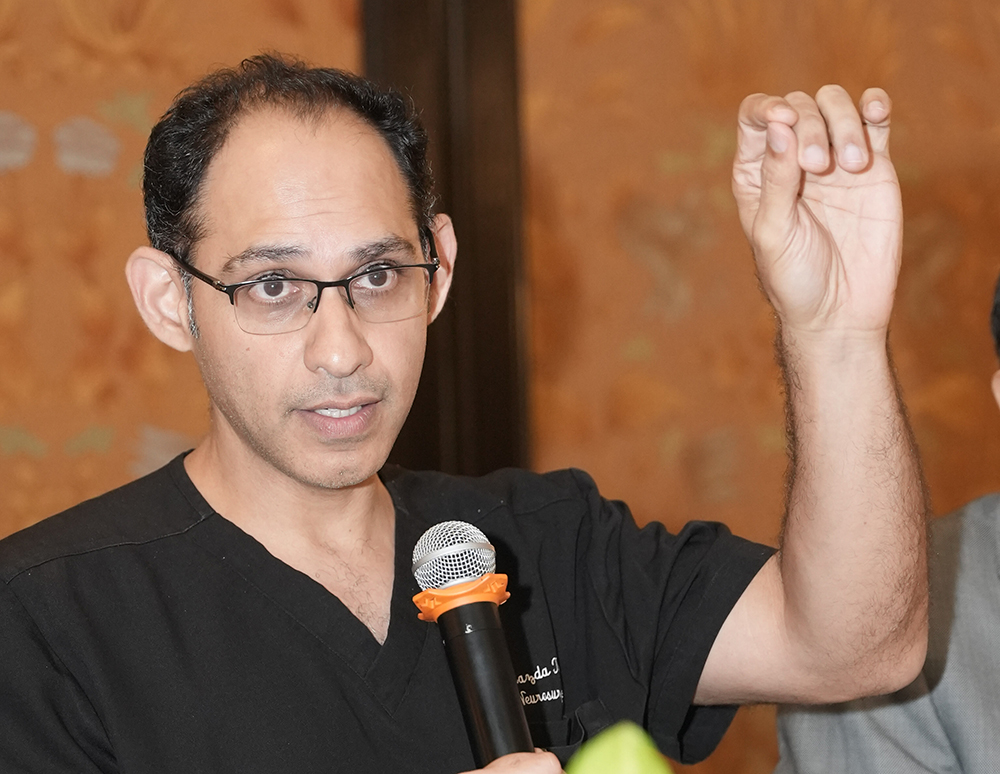
Bheja Fry Stories from the Human Brain and the Heart by Dr. Mazda Turel
Thank you to the Rotary Club of Bombay for allowing me to speak at the most expensive venue that I’ve ever spoken at before.
A lot of health-conscious people keep telling me, as a doctor, how can you promote something fried? So then I tell them that the next book is going to be called ‘Bheja Air-fried’.
But thank you very much for coming and taking the time out to listen to this talk. In a sense, the talk is not about the brain, but it’s about people. It’s about the human condition. It’s about what happens when a patient comes to the clinic and how the entire saga of a doctor-patient relationship unfolds.
Many people ask me, why did I write this book? Don’t I have enough work to do? Don’t I have patients to see? Don’t I have people to operate on? But I think instead of answering everybody individually, I decided to make a PowerPoint presentation around it.
So, the reason that I write is that the brain is this beautiful three-pound mass of jelly that you can hold in the palm of your hand, that can contemplate the vastness of interstellar space. It can contemplate itself contemplating.
There are about 100 billion neurons in the brain. Don’t ask me who counted them, but 100 billion neurons interact with one another to form close to 300 trillion synapses. It is from this interaction that the entire spectrum of human consciousness arises.
We are still trying to really fathom what the potential of the brain is. You’ve heard a lot of people say that we use only 10% of our brain. And we’ve all met people who use much less than that.
But the amount of electrical activity that goes on in a single brain is equivalent to all the cell phones in the world put together. Can you imagine? That’s the actual amount of activity that’s going on. And most of us have two cell phones nowadays, so you can imagine what process is taking place in the brain.
Scientists over millennia have tried to understand the capacity of the brain. Does anybody know what the physical capacity of the brain is, what it can store?
The capacity of the brain is about 2.5 petabytes. But one petabyte is 1,000 TB. Can you imagine? And 1 TB is 1,000 GB. So, if I fill this entire room up with small hard drives, that’s the capacity of a single human brain. And the reason I’m telling you that is this: so be a little careful, anybody who is up to some mischief.
While the brain contains about 100 billion neurons, it weighs only about 2 to 3% of your body weight, even if you’re pig-headed, but it consumes 20 to 30% of your body’s oxygen or your capacity. You can imagine the amount of work that’s going on in the brain.
A lot of elderly people tend to ask me, how do I keep my brain sharp? What do I do? How do I prevent Alzheimer’s? How do I prevent dementia? And the beauty is that there’s no real rocket science to it. Eat less. This is especially after a hearty meal that all of us have had. Try and sleep adequately. Seven to eight hours of sleep is very, very important.
Eliminate stress. I know it’s difficult to eliminate stress, but now we have the ability to learn deep relaxation techniques to be able to significantly and scientifically reduce stress.
And we must be very careful about what we eat. All kinds of processed food really, really affect the brain badly.
A lot of the time, people ask me what foods are good for the brain, and all kinds of nuts are good for the brain, including friends. Berries are really good for the brain. If you want to stick to sweet stuff, then have dark chocolate.
Fatty foods are good for the brain, like fish and eggs, so try and consume some of these.
I’m Parsi, so my fridge looks like this. They say that food that resembles a certain body part is good for that body part. So, walnuts are good for the brain, kidneys, beans are good for kidneys, mushrooms are good for ears. Tomatoes are good for the heart.
Don’t ask me what grapes are good for, but I don’t know why everybody really wants to live so long. Everybody is now talking about this crazy longevity brigade.
On account of being Parsi, I’ll automatically live to 100, but this is for the rest of you who are really struggling.
Maintain your vitamin D levels very high. Between 60 to 80, whatever your lab says, high vitamin D levels are very, very important for good mitochondrial function.
Exercise is key. At any age, the dictum is to keep moving. Movement is medicine. So, wherever you can move, you just move. It’s very, very important.
Avoid sugar, seed oils, starches, all that stuff. But it’s important. These are the scientific tips to live to 100. This is what I believe will really help you, irrespective of the fact that you really take good care of yourself.
Always be willing to learn. I tell everybody, try and learn something new every single day. It’ll make a huge difference to your well-being.
If you really want to keep your brain stimulated and constantly recruit new neurons, use your non-dominant hand to do stuff. Use your non-dominant hand to brush your teeth. Try and stand on one leg while brushing your teeth. If you do both at the same time and fall, don’t blame me.
Open doorknobs with your non-dominant hand. Use your computer mouse with your non-dominant hand. Walk backwards.
Any other tips that you all have been using?
Try and do something different. Take a different route to work. Wherever you go, you’ll get stuck in Ganpati traffic. But it’s important to just push yourself a little bit, feel a little uncomfortable daily. And that’s what’s really going to make a big difference.
That’s going to recruit neurons that are not routinely recruited.
They say that right-sided brain people are creative and special and artistic, and left-sided brain people are logical and methodical and all of that. Forget that! It’s actually how the two brains communicate with one another, how they interact with one another. What they’re doing at that particular time determines your particular personality, your particular disposition.
Without looking at the person next to you, how many of you see this shoe as pink and white? Raise your hand.
Quite a majority.
How many of you see it as green and grey?
How many of you see any other colour?
Everybody sees it pink and white? Any other colour? Brown, beige, peach? Everybody else?
The pink and white guys are wondering what’s wrong with the other guys. How are they seeing all this stupid stuff?
Everybody agrees this is a shoe, but the reason why I want to tell you that different people see it differently is because nobody sees what you see, even if they see it too.
A lot of the time, the house is completely divided amongst what they see because the way in which light falls on your retina is the same, but the way in which your brain processes a certain visual clue, a shade, a shadow or a hue, is different in different people and might be determined by what you’re thinking at that particular time, what you’re doing at that particular time.
Also, philosophically, we’re so quick to pass judgement about other people. We’re so quick to give opinions without really understanding someone’s backstory. And that is what doctors really tend to do. They don’t tend to treat a diagnosis just as a symptom. When someone comes to me with a headache, I really want to understand what the detail of that headache is, what is the real genesis of that headache, rather than just labelling it as a headache.
On the surface, all of us look the same, whether you’re the President of the Rotary Club or whether you’re a doodhwala. But internally, each of us is very, very different emotionally, spiritually, functionally and mentally. But the beauty is that despite this difference, we can all live so wonderfully under one roof, so unanimously.
I also wrote this book to study whether there are differences between the way men and women react to illness. Are there any differences between how men and women respond to certain ailments? And for that, we had to really try and map.
The other reason why I also wrote this book is to be able to raise awareness of certain conditions. One common condition that we often tend to see is forgetfulness or dementia. A lot of people in our family might have it.
I like to tell people that it’s okay forgetting names, faces, keys. If you forget where you’ve kept your keys, it’s all right. But if you forget what keys are used for, then that’s a problem. If you’re looking for keys in your refrigerator, then that’s a problem. If you’ve gone somewhere and you don’t find your way back home, and that’s because of forgetfulness, that’s something that’s worrisome.
This gentleman went to a doctor saying that he’s forgetting stuff, and the doctor said that this seems like it could be Alzheimer’s and started him on some medication for Alzheimer’s.
Forgetfulness is another word for dementia. Alzheimer’s is one of the types of dementia. There are a couple of types of dementia. Alzheimer’s is the commonest one.
So, this guy continued to forget even more and more, and that was affecting his quality of life. He had four children. He started calling Reshma, Ram, Ram, Rahim, all of that stuff. And then finally it dawned on somebody, let’s get a scan done.
When we got a scan done, it showed a large tumour sitting in his left temporal lobe. You can see that white blob over there. That’s the tumour.
Sometimes tumours, or brain tumours, don’t present with headaches. They don’t present with dramatic symptoms. They can slowly present just with a slight personality change.
They don’t present with headache, vomiting, double vision, all those dramatic things that you’ve heard of. They can silently present with memory dysfunction. They can present with an altered personality. They can present with changes in language.
So, don’t neglect any of these things, especially in the elderly. These symptoms are attributed to being old. But my suggestion is that something as simple as vitamin B12 deficiency can cause memory problems. Thyroid dysfunction can cause memory problems.
Please get all the metabolic and structural things done. Do an MRI if you’re forgetting excessively, because it costs less than a meal somewhere today, and at least you can reverse a structural problem.
I write to ask questions. Do you know that the right half of the brain controls the left half of the body? If we have a stroke on one side of the brain, we get paralysis on the opposite side of the body, but nobody really knows why. Whether it’s evolutionary, whether it’s a reflex mechanism, why does that happen? We really don’t know.
Nonetheless, at least you should be able to identify the symptoms of a stroke.
A stroke, you’ve all heard of, right? A stroke is a condition where either there’s not enough blood flowing to the brain or there’s a sudden-onset bleed in the brain that causes a sudden-onset neurological dysfunction.
So, if you have sudden-onset weakness or paralysis of an arm or a leg, sudden-onset slurring of speech, sudden-onset imbalance while walking or sudden-onset double vision, don’t neglect these things. Go to the hospital closest to your home and get evaluated.
I know people are reluctant to go to hospitals because they think that doctors are going to fleece them and hospitals are going to ask for unnecessary investigations. But if that reverses your problem for you, it’s a boon. So, try and consider those things.
I also write to alert and warn. For example, a headache. Everybody’s had a headache at some point in their lives, not only the married guys. Which headaches are sinister?
If you’ve had a sudden-onset severe headache, then that’s something to worry about. If you have had a dull, aching headache that’s not going away, then get your eyes checked, get your sinuses checked and make sure you don’t have obstructive sleep apnoea.
Snoring in the night can cause obstructive sleep apnoea and can wake you up with a headache.
But this guy here, a 40-year-old guy, all he had was a dull, aching headache. He was absolutely functioning at the highest level, performing executive functions and doing very well in the office. Looking at him, you can’t really tell that he has a brain tumour growing inside his brain, unless you ask him to pull his hands out. You’ll see the non-dominant hand drifting because there’s a large tumour in the right side of his brain pressing against his motor cortex, which is responsible for hand and leg function.
Now, don’t go home tonight and raise both your hands out, and if one tends to drift, think that you have a brain tumour, because the non-dominant hand will usually be slightly weaker.
But what I’m saying is, don’t ignore this. Don’t not address these things, because I tell people that symptoms are a gift that your body gives you. At least get it ratified by someone whose voice you trust.
We take these patients to the operating theatre, connect them to various electrodes. Our operating theatre looks like we are operating on a beach in Goa. This is what the whole setup looks like, and we are able to remove these tumours. His left hand is now actually even better than his normal-functioning right hand. You can see, and we’ve removed that blob of tumour there.
So, we are constantly trying to get better. We’re constantly trying to, after every surgery, think, how can I do the next operation a little better than what I did the previous one? How can I help this patient who’s come to me in the OPD slightly more than the one I helped previously?
Sometimes patients don’t know that there are brain tumours going on inside their head, but sometimes they don’t even know that it’s coming out of their head.
This guy, you can see, had a tumour that’s coming from the brain. It has eroded his skull and it’s coming out of his head. That big bulge that you see over there is a tumour.
In his defence, he went and tried to get operated. So, here he tried to get surgery done somewhere else and they bled about two litres of blood during the operation. They had to close, otherwise he would have died.
He came to us. We didn’t touch the tumour. We went all around it. This is a tumour coming from the brain, having eroded the skull. We removed the entire bone and then refashioned the skull with a titanium mesh, and now he looks like this.
He’s so happy that I’m on his WhatsApp DP for the last five years.
But, you know, better is possible. It really doesn’t take genius. It simply takes moral clarity, it takes diligence, it takes ingenuity. Above all, it takes a willingness to try.
If each of us is just able to say to ourselves, how can I be a little better in whatever I’m doing compared to what I was yesterday, that incremental consistency at the end of the day is going to help us a lot. Also, we are constantly innovating. Do you know that we can operate on brain tumours fully awake, while the patient is awake, while talking to them?
This is a patient who had a tumour in their speech area, abutting their hand and leg area, and we wanted to be very careful that we didn’t damage any of those functions. So, this is a resident doctor examining hand and leg function while we’re talking to the patient.
The patient will tell you, “I went to this school, I went to this college, this is where I met my first girlfriend, this is where I’ve invested all my money.” You get all this information while we can remove these tumours from someone’s brain, while he’s watching his own brain open up on a screen in front of him. And patients really love that.
In today’s day and age, you can enter the brain through the eye, through the nose, through the ear. Don’t imagine any other hole, but you can enter the brain through the groin. Supposing you have a blood clot that’s obstructing a blood vessel, like how you do an angiogram for the heart, you can do an angiogram for the brain, and you can grab that clot with a guidewire and pull it out completely from that blood vessel and restore blood circulation and completely reverse the paralysis if it’s done at the correct time.
Similarly, this patient came to us with a tumour that was pressing against the optic nerve. Those white, beautiful structures you see are optic nerves. This tumour was pressing against the optic nerve, causing him to be blind. We operated through the nose. This is us entering the brain through the nose, removing this tumour and completely recovering his vision with a simple operation.
Just because I’m saying it’s simple, don’t try it at home.
I also wrote some of these stories in the book to inspire people. Sometimes patients have told me after reading the book, “I wish I had read this before I went through whatever I went through. It would have made my world so much nicer and so much better.”
I want to tell you briefly the story of a young boy who, when I was training at the Christian Medical College in Vellore and I was a resident doctor, was about 13 years old. I was 26. He had come in with some blurry vision and he had a tumour in his hypothalamus, which is like the centre of his brain.
We became really good friends very quickly. At the end of each day, after I finished all my work close to midnight, he would pull up a chair and sit next to me and he would tell me, “Teach me what the MRI shows.” I would show him what the MRI shows and he would give me some trivia. And at the end of every day, he used to write me a beautiful poem.
I used to be very fond of art and literature and Shakespeare. In return, I used to tell him, “Okay, go fill up investigations for that patient, go fill this patient’s form, do this, get consent for this patient.”
Three or four years later, we did his operation. Fantastic operation. We spent about seven to eight hours, removed and peeled off the tumour from the hypothalamus. He came back, woke up beautifully after surgery and was able to quote Shakespeare in the ICU.
Two or three days later, he had a massive fluctuation in his sodium levels, and he slipped into a coma. He was on a ventilator for three weeks in the ICU, but somehow, we managed to get him off the ventilator and out of the ICU.
But when he came out, he was shaking very badly. He had damaged certain areas of his brain responsible for voluntary control. So, his head was shaking, his hands were shaking, his legs were shaking. We had to give him a lot of hormonal replacement and do aggressive physiotherapy.
Having said that, three months later, somehow, he got discharged from the hospital. But a year later, because of the steroids he was on, his hips got necrosed and he required a bilateral hip replacement at the age of 15.
Nonetheless, he wrote his ICSE exams lying in bed with a writer. He was so fond of learning.
One year after that, he required removal and replacement of all the teeth in both his jaws because the steroids had worn off that enamel. I had left Vellore at the time, but every year he used to send me an email along with a poem that he used to write for me.
I had left Vellore, but he came back two years later with another brain tumour, which again was removed over there. By the time he had emailed me saying that he had finished his master’s in literature and, a couple of years after that, he finished a PhD. By the time he was walking independently, he was shaking much less, and his speech had become better.
I asked him, “What did you do a PhD in?”
And he said, “I did my PhD in fairy tales.”
And in a sense, he was writing his own fairy tale. I told him, “Hey, listen, I’m going to write about you,” and I wrote about him and sent him the chapter. He was extremely thrilled.
But three months before the book was published, I got a call from his brother saying that he fell off the third floor of his building and died. I don’t have the heart to ask how, what, where, when, why. Sometimes life just gives you blows that you’re not able to make peace with.
Similarly, when I was a resident doctor at the Christian Medical College, our first year was spent doing general surgery. In general surgery, we see a lot of hernias and hydroceles.
Everybody knows what a hydrocele is. It’s a large collection of fluid in the scrotum. So, we had to rush this patient to the operating theatre. And when we rushed him to the operating theatre, we saw that he had a really ugly, big wart on his scrotum. So, as part of the incision, we removed the wart also for him.
When he came out of anaesthesia, he got so angry with us. He said, “Kyun nikala isko?”
I said, “Kyu, aapko pareshan karta hoga?”
He said, “Jab bhi mujhe tension hota tha, main iske saath khelta tha. Mujhe bada sukoon milta tha.”
So, sometimes what you think might be better for somebody might really not be better for somebody. We must be a little careful about what we do.
I have also written this book to sometimes protect patients from misdiagnosis.
This elderly gentleman, because of the way he was walking, his gait slightly shuffling and a slight tremor in his hand, was told to have Parkinson’s disease. Everyone’s heard of Parkinson’s. It’s a neurodegenerative condition in the brain where we become stiff and slow and walk a little wobbly.
He kept getting medicine for Parkinson’s. And I said, “Hey, this doesn’t look like Parkinson’s,” when he came to be examined by me for a second opinion.
I said, “This looks like spinal cord compression.”
We got an MRI done. It showed significant compression in his cervical spine. We needed to remove this. We removed this. There’s this spiky piece of bone pressing against his spinal cord, and we were able to give him back his walking quite dramatically.
So, sometimes when somebody tells you that, “Oh, this is the final diagnosis, nothing can be done, don’t do anything about this anymore,” I had a 90-year-old gentleman who was in bed with a compression fracture of his spine, and some physician said, “Listen, don’t touch him, he’s too old.”
But his son came to me three months later crying that, “My father is just withering away in bed.”
I said, “Come, let’s take a look.”
I said, “We can inject some cement into this and he’ll be okay.”
He thought of me as some doctor just trying to make a buck out of him or give him some false hope, when everybody else said that nothing else can be done.
And we did that, and within three hours of surgery, he was walking.
So, there are sometimes answers that we don’t have, but oftentimes we can do a lot for a lot of people.
So, if someone tells you that nothing can be done, please don’t consider it as a final decree, because we can.
The best hospitals or good doctors, it’s not that they take less risks or they fail more. They’re able to rescue more. And that’s, I think, very, very important.
Sometimes, in the process of trying to do that, we also fail.
And this book is also about our failures. Medicine is an art and a science that is practised by people on people. And doctors, like the rest of us, learn by making mistakes.
This patient was an HIV-positive patient, and that big white blob that you see inside the brain is a tumour. In HIV-positive patients, it could be one of two things. It could either be a lymphoma, which is a tumour where you need to remove just a small piece and send it for testing, and it shrinks with chemotherapy and steroids. Or it could be a high-grade malignant brain tumour, which, if we know what it is, we need to go ahead and excise the whole thing, otherwise the brain would swell.
So, we removed this piece and sent it to the pathologist. The pathologist said, “Hey, it’s a lymphoma.” We were damn thrilled because we were operating at seven o’clock in the evening, so we could close.
The next morning, we get a call from the ICU saying that the patient has become unconscious and has had a seizure. We get a scan done. It shows a tremendous amount of swelling in the brain.
We took the patient back to the operating theatre. The brain had swollen out of the head and we were not able to salvage this patient, and this patient died.
Every surgeon carries within himself a small cemetery where, from time to time, he goes to pray, a place of bitterness and regret where he must look for an explanation for his failures.
A few days after that, the pathologist calls me up and tells me, “Hey, that patient you sent me now, actually it’s not a lymphoma, it’s a high-grade brain tumour.”
So, in retrospect, if I knew that information, I would have removed the whole thing. But I can’t tell the patient that, “Sorry, my pathologist goofed up.”
If a patient develops an infection after surgery, I can’t tell the family that, “It’s not my fault, it’s the hospital’s fault.”
The patient is coming to you with an immense degree of trust and responsibility, and the buck eventually stops with you.
But every time you’re able to find some humour in a difficult situation, you win. And that is why this entire book is peppered with slightly funny anecdotes.
In no way does it make fun of anybody’s situation. The book is funny, but it’s not frivolous. It doesn’t make light of any situation, even though it tends to deal with several situations lightly.
I had this elderly gentleman and his wife who came to us. They were married for about 60 years and madly in love. Yeah, that’s possible.
This patient had this condition called normal pressure hydrocephalus. You see on the left-hand side, you see the MRI of the brain. Those two slit-like, fluid-filled cavities are thin, but in normal pressure hydrocephalus, they balloon out a little bit. And that ballooning causes a stretch on the leg fibres and the bladder fibres of the brain.
Patients walk with a slightly shuffled gait. They tend to have excess urination and they have slight memory problems as well.
So, this patient had this thing, classically, all three of them. And unfortunately, a lot of those symptoms are just attributed to old age.
So, when this patient came to us, we got an MRI done. We said, “Hey, all these symptoms match your MRI. We just need to drain the fluid.”
And we put in a shunt and drained the fluid. His walking got dramatically better. He stopped getting up to pee at night.
His wife said, “I don’t have any work to do now because I used to change eight diapers a day.”
And I said, “Let’s jog his memory a little bit.”
So, I asked him, “Where did you first meet your wife?”
And he blurted out some name and his wife started laughing.
I said, “Why? That’s not where you first met her.”
She says, “No, that’s the red-light area next to his house.”
So, we rewired some memory. I think we pushed it way too far back to his early youth.
I also do a lot of spine surgery. And on the left is a normal MRI of the spine. You see those box-like, square things are vertebrae, and between those vertebrae are discs.
You’ve all heard this word, disc prolapse, or slipped disc, or herniated disc, which is when you have back pain and pain going down into your leg, which is typically called sciatica.
And the image on the left is that of a slipped disc or a herniated disc.
So, whenever a patient comes to me with that, and it’s not getting better, I get an MRI done to see what the MRI shows. And I send them down to the MRI room, where we have a technician who can’t pronounce the word “disc” very well.
So, I asked him, I call him up and ask him, “Hey, Suresh, MRI mein kya dikhta hai?” He said “bahot bada dics hai!”
I also write to protect, you know. All of us are on WhatsApp the whole day. Looking at WhatsApp for half an hour with your head down is like putting a 20 to 30-kilo weight on your head. It causes an immense amount of wear and tear.
Wherever you go, whether it’s the metro or the car, everywhere someone’s on their phone all the time.
Until I met someone in the by-lanes of Varanasi really taking good care of his spine.
And all of you should do a little bit of isometric neck exercises. If we had time, we would have gone through it. But just Google “isometric neck exercises”.
I also wrote this book to be able to validate relatives.
You know, this patient who had a brain tumour, he told me, “Doctor, I just want to live for my son.”
And I told him, “Your wife is sitting right next to you.”
And his wife started crying. She started sobbing because she was never heard of, or thought of, or considered an important part of that ecosystem. It was just assumed that she was going to be taking care of him.
A lot of the time, women really don’t complain about their symptoms. They ignore a headache, they ignore a pain which might be festering something sinister because they think that the entire household depends on them.
Men sometimes do that. They don’t get attention for, let’s say, a back pain or something else, thinking that what if something happens to them, the household might not run.
I think it’s very important that we talk to one another.
We know what time our people wake up, we know what they eat for food, we know what time they come back from work, but we don’t know what their fears are. We don’t know what keeps them up at night.
These are the things that we should talk about, and we should address, and we should communicate.
Some of what we do is actually saving lives.
This guy wanted to commit suicide and he stabbed himself in the neck. That’s a knife going through and through his spine. Medico-legally, even if someone doesn’t want to live, you are supposed to save them. So, we removed this knife and I don’t know if he’s still cursing me.
We also write to save marriages. The first time his wife threw a utensil at him, he did not listen. This was the second attempt. We were able to salvage him as well.
I also write for the thrill of adventure.
Being in nature, I think, is the best thing that you can do for yourself. I tell all my patients, go out, spend some time in the sun.
If all of us can get 15 to 20 minutes of sunlight within the first hour of waking up, that single thing has more health benefits than anything else, or all health benefits combined.
There’s enough data, enough science to tell us that 15 to 20 minutes of sunlight in the morning, looking at the sky without a cap or glare, resets the entire body’s circadian rhythm.
I’m not going to go into the science of it, but just trust me and do it. You’ll automatically start feeling way better within the first couple of days.
I went to Mount Kilimanjaro, which is the highest peak in Africa. When you climb from 10 p.m. at night on the final day of the summit and at 5 a.m. you see the sun rise over the entire universe, it’s one of the most majestic feelings you can ever feel.
The beauty of nature is that it really piques your curiosity. It teaches you persistence, it teaches you creativity, it allows you to take risks. And when you know there’s nothing left in you but the only ability to put one foot in front of the next, sometimes life does that to us, where we have only one option, and that is to be able to put one foot in front of the next.
Nature teaches you that resilience.
Nature is a reminder for us that this life is meant to travel light and for us to be able to shine that light on the lives of others.
I want to end with one story. I want to tell you this story because it changed my life.
This is a 30-year-old guy who was recently married. He started complaining of some mid-thoracic pain in his back, a little bit of gait disturbance, some tightness in his legs.
Looking at him, he seems pretty okay while he’s walking, but he has a tumour inside his spinal cord, within the contents of his spinal cord.
Just imagine the cream to be the entire spinal cord. The green is the tumour that’s coming from within and pushing the normal cream to the side. In his case, there was no cream. The only thing that was left of the spinal cord was that thin silver foil.
All right, the entire thing was tumour within, and he was just functioning with that thin sliver of spinal cord left.
If you look at it carefully, you can see that this is the normal spinal cord, and that spinal cord is now pushed to its complete edge all along this by the tumour, and then it again comes back here.
So, we do this operation with what we call intraoperative neuromonitoring, where we connect every single muscle of the body to a computer. So, if we are operating and we cause some extra pressure on, say, the left leg, the neurophysiologist will tell us, “Hey, the left leg is getting weak.” So, we know we can release the pressure, or we can go to another area. We know that we won’t cause damage.
What happened was, in this particular case, that when we took him to the operating theatre, the neurophysiologist told us, “I’m not getting any signals. Everything is flat.”
What does that mean? That means that we will not know if we are causing any damage to the patient.
So, the conundrum is, should you go ahead with such an operation?
The patient is under anaesthesia, already lying on his stomach, ready for the incision to be made. The anaesthetist says that he’s 30 years old. What if you end up paralysing him? It’s not only going to be paralysis of the legs, but also loss of bowel and bladder function and sexual function.
The assistant didn’t want to wait for a 10-hour operation and he said, “Let the tumour itself cause the paralysis and once that happens, you remove the tumour.” But then you’re not really going to be able to reverse function for him. He’s going to eventually, anyway, be paralysed.
The nurse said, “At least go ask the family outside. Ask them what they want.”
We asked the family. The family said, “You are the doctor. You decide. How are we going to know what to do?”
If you are the patient, how many of you would be willing to get this surgery done, knowing what you know?
Very few people have confidence in my ability as a surgeon. So, about 25%. The rest of you will not get the operation done.
So, this is a difficult decision to take on an operating table.
Good surgeons don’t just concentrate on the technical ability, but also on the appropriateness of what they’re doing.
On one hand, I could possibly remove this tumour and give him back his life. On the second hand, I could cause a damage that’s potentially irreversible, and he could be in a wheelchair for the rest of his life.
And how do I take that decision, not knowing? Not knowing that I’m going to get… I don’t have any feedback to help me.
The technology that we use daily has failed me. Not that the technology is not working, it’s that the signal of the spinal cord is so poor that it’s not being picked up by the technology.
So, this battle of the brain and the heart, patients rarely understand what we go through. Patients rarely understand that doctors are constantly thinking about their patients.
Even right now, there’s one tab open in my brain thinking about the patient that I operated on yesterday or the patients that came to me in OPD this morning.
Good physicians are rarely dispassionate. They’re constantly agonising and self-doubting about their patients.
How many of you think we went ahead with the operation?
About half.
How many of you think we didn’t do the operation?
But a few.
We went ahead with the operation, and, over a 12-hour surgery, we removed this whole tumour, very, very meticulously dissecting every strand of tumour from the spinal cord.
I must have sweated about two litres of sweat, and I thought I had done a fantastic job. I was very happy with the outcome of the operation.
What do you think happened to him after surgery?
How many of you say he was fully okay?
Only a few have confidence in my ability as a surgeon.
How many of you say he was fully paralysed?
One.
How many of you say he was partly paralysed?
The rest are non-committal.
He was fully paralysed after surgery. Completely.
And I was devastated. I was completely heartbroken. I’d made the worst decision of my life. I was almost in tears.
I could have easily not done the operation. It wasn’t my ego that made me do the operation. It was my firm belief that this was the right thing to do.
I went to my office and there was a book lying in my office. I just opened to a random page and it said that most things will be okay eventually, but not everything.
Sometimes you put up a good fight and lose. And sometimes you hold on really hard and realise there’s no choice but to let go. Acceptance is a small and quiet room.
And when we have a complication, for us to see a patient that we have hurt is very, very difficult. To see such a patient on a daily basis when we go for rounds, to see dejected faces of family members.
And the natural tendency is to back off a little bit or to avoid questions, or to really make a quick entry and exit.
But I stayed with the family. I really thought that I hadn’t done anything wrong.
And two or three weeks later, he was able to put one foot in front of the next. He was walking with a walker with the help of four people. But he still had a catheter bag hanging from his waist, as you can see.
And over the next few weeks, I forgot about him until, three months later, I got a message on my phone with him having climbed 20 stories and running on his terrace.
So, in hindsight, it was the best decision of my life. But in those three months, I had aged three years, and that’s why I look like this.
But at the end of the day, every cord has a silver lining.
He has now recovered completely. He has no tumour in his spinal cord. He’s absolutely fine.
He even had a baby.
I had nothing to do with that.
And that’s the entire preface of this book, to be able to enlighten the common man about the stories that real people have in their lives.
And I think all of these are really important and meaningful because life itself is a story, and in all these stories, endings matter.
Thank you very much, everybody, for a patient hearing.
Anybody wants to reach out to me for anything, I’m happy to share my number. I’m happy to take questions in case somebody has questions.
I’ve been strictly told that questions should be limited only to the book and not personal problems, though I’m happy to answer any of them if the big people don’t have a problem with that.
Questions and Answers
Q1. I wanted to ask you, I lost a friend of mine at the age of 52. She developed a brain tumour, which she had operated on. Then she had a recurrent brain tumour and it progressed very quickly. What concerns me is that there were three other people in the same building who went through a similar experience.
Dr. Turel: There is some data that tells us that mobile phone radiation is not good for the brain, but there is no conclusive scientific proof that it is responsible for causing brain tumours. We don’t have enough data that can tell us consistently that there is a direct link.
There is a particular kind of tumour called a vestibular schwannoma, or acoustic neuroma, which is a benign tumour that arises from the hearing nerve. The problem is that it is very difficult for us to randomise patients into two groups because everybody now has a mobile phone and everybody is exposed to more or less the same degree of electromagnetic radiation.
It would therefore be very difficult to ascertain whether, for example, three out of 300,000 people living in a particular area developing a brain tumour is related to that exposure. It could just be sporadic. Some brain tumours have a genetic component, but these people you mentioned are not from the same family; they just happen to live in the same building. It could purely be coincidence.
Q2. Hi. Thanks. That was a fantastic talk, Dr. Turel. I want to ask about the impact of AI on the brain. We’re relying so much on apps like ChatGPT to do work that our brain should be doing. What impact is that having? And now it’s in the news again about the dangers of this super-brain being created.
Dr. Turel: Several of my patients have told me openly that they don’t trust their doctor anymore. They would rather use Claude instead. So I tell them, basically, you’re just calling your doctor Claude without the C.
But no, it definitely has an impact on our brains. There’s no doubt about it that we are not recruiting the kind of neurons that we should be to perform the kind of work we used to. Nowadays, people are struggling even to reply to emails the way they used to, let alone remember phone numbers or find their way to places they used to know.
So it’s up to us. We know, more or less, what’s good for the brain, so it is up to us to preserve that function and continue doing the things we need to do. But it is definitely going to have an impact.
And now, if you look at morphometric skull analysis, the next generation’s eye sockets are already a few micrometres larger than those of our generation. So, in 20 or 30 years, you’re going to see a morphometric change in what humans look like. Eventually, it’s going to go one whole cycle and we’re all going to look like monkeys again.
So it is definitely going to have an impact. How we choose to allow it to impact us depends entirely on us.
Q3. Absolutely fascinating, Doctor Turel, but I refuse to believe that you’re just a consummate surgeon. I think you’re a philosopher. Seriously, I’d be interested in knowing what you’re reading outside medicine.
Dr. Turel: I read a lot of books written by doctors. All of Atul Gawande’s books have really been an inspiration to me. If you’ve read Better and Complications, there’s another doctor who’s written a beautiful book called When Breath Becomes Air by Paul Kalanithi. And there’s Siddhartha Mukherjee, who’s written books which are absolutely brilliant. The Emperor of All Maladies is one of them.
I don’t read a lot of fiction, unfortunately. I don’t get the time to be able to read so much. But that basically forms my reading. I have a bumper book of insults on my bedside, which I refer to once in a while, but whatever catches my fancy. I’m not as much of an avid reader as I would like to be.
Q4. So, Doc, this is my third time hearing you. I missed the fourth earlier at Nehru Library, my apologies. I get so much comfort from hearing you. My question, Doc, has nothing to do with your science, but there’s this lady, Louise Hay, and also Anita Moorjani. They cured themselves of cancer without any treatment. How would you attribute that? It’s obviously something to do with the mind. That’s why this question.
Dr. Turel: Louise Hay has written a beautiful book called You Can Heal Your Life, and at the end of the book, if you see, there’s a table that lists every single symptom and every single emotion that might be contributing to that symptom.
She, I think, was raped and got cervical cancer, and she was able to heal herself of that cervical cancer. It is not without reason that all of us know somebody who might have healed themselves of cancer or might have outlived a survival period that a doctor might have given them.
Obviously, there is a certain power of the subconscious mind that allows you to alter your epigenetic milieu within the body, the way you think, your attitude towards certain things, and the positivity with which you live your life. I don’t know the exact science behind it, but these anecdotal examples tell us that there is something for us to learn.
It is astonishing how much we don’t know. What is even more astonishing is what passes off as knowing.
So there is this entire world that’s now opening, where people are using alternate forms of healing to be able to heal themselves. And I am very openly willing to learn because science does not have all the answers and we are not able to prove everything scientifically.
I think these are books that you can get inspired by, and you can use those ideas in your day-to-day functioning, not only to cure yourself of diseases but to use those affirmations to prevent those diseases from entering your system.
There are very strong proponents of this alternate form of healing, and I think the beauty is that when science and this other world come together, we’d be able to… because everyone would want, in some way, shape or form, not to suffer at the end of the day. So whatever works is something that we should veer towards.
Q5. That was a brilliant presentation. Thank you. You really gave us an insight into our brain. I think we take it so much for granted. I have a question. You know, our parents and their friends and family, in their day, we never heard so much about dementia as we are hearing today. Why is it now that every third person we are hearing is suffering with dementia?
Dr. Turel: I think two things. One is that we’re living longer. And because we’re living longer, all the problems related to living longer will also manifest. So dementia increases dramatically with every decade; it increases a couple of fold every decade.
Similarly, we are now identifying a lot of environmental causes. We’re living in a slightly harsh environment, consuming microplastics, and the air is not great for regulation of homeostasis within the brain. All these environmental factors are also leading to some kind of dysregulation in the brain that is causing dementia or forgetfulness.
We are also exceedingly lonely, even though we seem superbly connected. I think all of those factors are contributory and attribute to dementia.
Unfortunately, in women, the risk of dementia is twice as much as in men. The influence probably is hormonal, with a lack of oestrogen. So, there are some studies that tell us that HRT now supports against getting dementia later on in life.
But if you’re able to remain relatively active, do the right things, sleep properly, learn at this age, learn a new hobby, learn a new skill, all those things can help. At least, they may not reverse or completely cancel dementia, but they might be able to slow down its progression.
But there are a lot of environmental factors. Forget dementia, even something like cancer: 100 years ago, cancer was 90 per cent genetic and 10 per cent environmental. Now it’s the exact opposite, so you just must move to Finland or something.
Q 6. Thank you, Doc. So, on a lighter vein, I just had a question: how can I diagnose this as an excuse? My wife always complains that I never see the things of mine am lying around the house, which she happens to see every time and for days, which I don’t see. So, how can I protect myself by saying that this is a certain illness I have?
Dr. Turel: You can’t protct yourself. Everybody, you’re on the same question. You can’t protect yourself. Whatever you do, whether you have dementia or not, you’re screwed.
But now, there is a test to identify the possible chance of getting dementia. It’s called the P217 protein, which is now available. Some labs do it. It costs about ₹15,000. It will tell you your chance of getting dementia later on in life.
And now we also have a couple of new drugs that have come up that might delay the onset of dementia or control its progression if you have it. But if you exercise, sleep well, eat correctly and foster good social connections, I think those are better medicines than the actual medicine itself.