
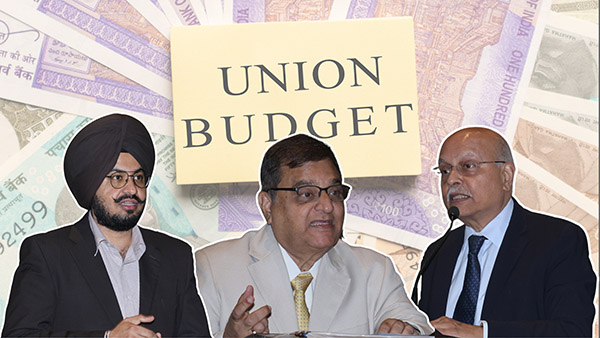
Decoding the Budget: A Deep Dive into the key announcements, their implications for economic growth, inflation, and employment…
Decoding the Budget: A Deep Dive into the key announcements, their implications for economic growth, inflation, and employment, with PP Shailesh Haribhakti, Rtn. Anil Harish & Onkarpreet Singh Jutla, Chief Investment Officer, Nuvama Pvt.
PP Shailesh Haribhakti: Thank you very much. It’s a delight to be with so many Rotarians and friends. India was reeling under the onslaught of falling growth rates, and complete depreciation in the rupee. At one time, people predicted that we would make a beeline for 90. It looks like we are getting there. And then there was that spectre of complete volatility that a new President of the United States was going to bring. In tow, he had an amazingly, I don’t know, insane man, Elon Musk, who is capable of doing things. I just finished reading his biography, and he’s just on the border of insanity. He’s just unbelievable at what he has done in his life. So we needed to do something dramatic, and I feel that is what our Finance Minister has done this time. What I thought rather than telling you that we have a 325 lakh crore economy and our budget deficit is 4.8% and our inflation is at whatever, 6%-6.5%, I thought it is better for me to use what I have learned from this budget and the signals that it is giving me and share with you my vision of what kind of strategic framework India’s AI-powered economic supremacy can deliver to all of us.
So, I am positing, and I am saying this before a very august audience of Rotarians, that India can achieve a sustainable 20% nominal growth rate. For this, it has to overcome certain constraints, and it needs the complete collaboration between the central and the state governments, between global and sovereign funds, Indian and multinational corporations, impact investors, and everybody else who has an interest in India. So what are the three things that I would like you all to keep in mind?
- We can become the world’s AI-powered manufacturing hub through Make in India 6.0.
- We can become the global AI-driven services and technology capital, serving the world from India.
- The food and energy basket for the planet, an agri and energy superpower.
How do we achieve this breakout strategy? We need to first recognise the constraints, as my friend Rajas pointed out to me just before I started. So what are our constraints, and how do we overcome them? Our constraints are fragmented state and central policies, and the solution is AI-driven unified economic governance for seamless state-central synergy.
The other constraint we have is capital in infrastructure and manufacturing. Infrastructure spending fell off by over a lakh crore last year. So we need to make a huge effort, get US$10 trillion of sovereign private AI-guided investment pools to come in and invest in India. There is no place on earth that can take in that kind of investment, none whatsoever. Only India can take it in. Underdeveloped logistics and energy systems — solution: AI-managed smart infrastructure and low-cost energy expansion. Thank God we have started turning our eyes to nuclear. Hydrogen at a mini level is already a reality. Our small organisation is moving into converting biofuels into hydrogen. Low per capita income and consumption — that’s what this budget has done.
Universal AI-supported skill monetisation is the next step that we need to take. And regulatory rigidities and legacy systems. So we need to change all of this to have world-class authentic governance and policy reforms for agility.
Key Pillars
I’m borrowing a little bit from the Finance Minister’s speech, but largely what I believe is necessary:
- Unified Central-State Economic Strategy: This can be delivered through economic clusters, AI-driven real-time industrial zoning and cluster mapping for sector-specific growth in each sector. We need to move from macro to micro. A dynamic tax optimisation to attract capital into priority industries has to be dynamic, it has to change. It has to look at the data and keep changing. Quantum-enhanced ease of doing business. Complete automated clearances for infrastructure, business setup, business closure, and FDI. Special economic zones for ultra-high growth. We can easily establish 50 such zones focused on manufacturing, GCCs (which are AI-led), AgriTech, and DeepTech exports.
- $10 Trillion of Global Funds into India: Public-private, AI-financed growth pool. Multi-source capital mobilisation. Two trillion from sovereign wealth funds, such as Abu Dhabi, Saudi PIF, Singapore GIC, and the Norway Fund. A trillion-dollar institutional fund led by BlackRock, Vanguard, Temasek, IFC, and AIIB. A trillion-dollar infrastructure and manufacturing REITs. Real estate monetisation can massively change India’s financial landscape. Just imagine one piece of property on Peddar Road, which is owned by the government, can wipe out 15% of Maharashtra’s deficit. That’s the large potential for invITsation of real estate. And another few trillion dollars in tax-incentivised corporate contributions through MNC players.
- Global 6.0 Manufacturing in India: The China Plus One strategy should be fully leveraged. Digital twin manufacturing zones for AI-optimised production planning. AI-driven supply chain mastery to minimise costs and delivery time. Hyperspeed export dominance by making all our ports autonomous, AI-led, fully digitised, and quantum cyber-secured digital trade corridors.
- 10x Powered Agriculture and Food Supply Expansion: Mega vertical farms optimising yield. Better soil, water management, and climate intelligence. Precision food supply chains to eliminate waste. Organic farming promotion. I saw a farm recently where the farmer tells me that my farm is an ATM. I can pull out produce at any time and get whatever money I need. That’s where we need to go. 100% renewable energy grid, very critical. Agentic AI managing nuclear, solar, hydrogen and storage. This cannot be done manually. It has to be done robotically through Agentic AI. What this will deliver is a net food and energy supplier to the world. That’s what India can become.
By 2035, India’s AI-powered economic machine will hit 25 trillion dollars in GDP. We will not just participate in the global economy — we will architect its future. That, Rotarians and Friends, is the future that we can all create together.
Thank you.
Rtn. Anil Harish
In her speech, the Finance Minister first mentioned taxation, where she said that the budget aims to initiate transformative reforms over six domains, and the first one that she mentioned was taxation. Then she talked of a new bill to replace the existing Income Tax Act that we have had since 1961. Even though they were going to come out with a new tax bill just next week, I thought there would be no changes to the Income Tax Act this year in this budget, but then there have been as many as 85 clauses to amend the Income Tax Act now, and we’re going to get a new tax bill next week.
Last year, we had 99 clauses to amend the Income Tax Act. The year before that, we had 112. So if there were to be an Olympic event called Amendment of One Particular Law, the maximum number of times, I think we would have got the gold medal right from 1964 onwards. Now how will this span out? We do not know. There will be a new law that will be coming in next week, but when will it be introduced? Will it be from 2025, or will it be from 2026? Will all these amendments that are being made now under this budget be subsumed into the new one? Will they all be a part of it, or will some of these be replaced? We just have to wait and see, no indication has been given of whether the new law will come in from 2025 or whether it will come in at a later point of time.
The biggest change that the Finance Minister announced was, of course, the rates of tax and the slabs. From the year 2020, we’ve had the new regime. We have the old regime of taxation, and we have the new regime. Under the old regime, you could claim certain deductions. For instance, if you invested in the Public Provident Fund or LIC, or you gave a donation to the Rotary Club, you’d get a deduction under Section 80G. But under the new scheme, they do not want you to give donations to charities. There will be no deduction available for that at all. But the new regime gives you certain benefits, in that there are lower rates for many different slabs. Now they’re changing this again. So the old regime continues in that the first 3.5 lakhs is going to be exempt from tax. But under the old regime, you get deductions such as for 80G, et cetera. But you hit the maximum slab rate of 30% surcharge plus cess at 10 lakhs of rupees of income. Under the new regime, you hit the maximum rate at 24 lakhs. So there is going to be a benefit. Most people are going to move to the new regime. I don’t even know why they are continuing the old one because they made it – they also disincentivised it. But anyway, we have the old regime and we have the new regime. The old one will be useful only for those who are giving donations and are claiming certain other deductions.
On the first 24 lakhs, as I said, there will be lower slabs and lower tax rates. And if a person has income under the new regime of, say, Rs 12 lakhs or even Rs 12.75 lakhs, there will be no tax at all. But does that mean that you don’t have to file a return? Suppose a person has an income of Rs 10 lakhs and is opting for the new regime, you still have to file a tax return and then you will claim a rebate under Section 87A. So the number of returns is not going to go down. The number of returns is still going to be high. The Chairman of the CBDT said that there are about nine crore assessees. Only three crores of those will be taxpayers, but all nine crores will still have to file tax returns. So we will have six crore tax returns, it seems, with no tax at all, but just filing a return, claiming a refund or claiming a rebate under Section 87A. And only three crores of those will be taxpayers. Well, this is very good for those who opt for the new regime, as many of us will, because we all get some savings, Rs 60,000 or Rs 80,000 or a lakh of rupees. And of course, we will have to claim the rebate under Section 87A.
This will be a boost to the economy. In fact, the share prices, as you will tell us more about that, but the share prices of some of the consumer items, such as air conditioners, scooters, et cetera, have gone up in the last few days because they expect this money to go into such assets. So it will be a great boost to the economy because the amount that is estimated to be in the hands of people, left in the hands of people on account of this, is about one lakh crores of rupees. And of course, it’s very good politically with the elections in the offing and it’s excellent optically. But this will have an impact on many people’s lives. Now, on the other hand, even though one lakh crores is expected to remain in the hands of people, what is the tax collection that is expected? Up to now, the tax for financial year 2025 was estimated at 22.37 crores. This is expected to go up to 25.2 crores in the coming year. That means it’s 22.37 lakh crores to 25.2 lakh crores. So it’s expected the tax collection, in spite of giving away this one lakh crores, is expected to go up by 12.65%. The GDP is expected to go up by 6.8%. Therefore, the collection is going to be much more than the increase in GDP, which means that money will go out from our hands to the government, maybe not from those with incomes up to 12 lakhs or up to 24 lakhs, but from the companies and from those who have higher incomes. So the government expects to get about three lakh crores more in spite of giving away this one lakh crores. In any event, I think this will help. It will give a fillip to the economy because so much more money will be available in the hands of almost every individual.
Now what are the kinds of amendments that have been made? There are many clauses, some of them are a little reasonably significant, some are not very significant, but I’ll just tell you about them briefly. We have a system of what is called tonnage tax, that if a person owns a ship, then they don’t have to just work out the income tax on the basis of the regular profit and loss account and so on. But based on the weight of the ship, the tonnage of the ship, they pay tax. Now that was available only for ships flying in the oceans and internationally, etc. Now this is going to be available even for inland shipping. So therefore, we have a huge coastline, we have rivers, and now this is going to be available for even those vessels which ply along the coast and inland. So this is a good thing.
Then there is going to be a new provision whereby a non-resident providing services or technology to someone who is in the electronics manufacturing sector will get a benefit, in that if the non-resident is to get, say, Rs 1 crore for rendering these services, only Rs 25 lakhs will be taxed and the full Rs 1 crore will not be taxed. Now this is fine, and we hope that some people do avail of this, but on the one hand, they have been talking about, for the last so many years, doing away with all these different exemptions. Now again they are saying that a non-resident who gives services to an Indian company, not to an Indian partnership firm, not to an Indian LLP, but only to an Indian company will get this tax benefit. But why should they not apply to a resident? Suppose a resident is giving the same services to an Indian company, he will not get that benefit. He will have to pay tax at the regular rate. So I think this is the kind of distinction that we need to do away with. It’s unfair to Indians.
On the one hand, they say that we must develop the semiconductor industry and we must export more services and goods, and then you say that you will give the benefit to non-residents and not to residents at all. So this is very discriminatory, and it’s not good. Startups have been given benefits since the number of years, whereby out of the first ten years of their existence, they can select any three years and claim a 100% tax benefit in those three years. But that was available for startups, which were registered before 2025, 31st March. Now they’re extending that, and they say that this will be available to startups even which are registered up to 2030. For charitable trusts, they said that they have simplified it to some extent in the sense that you can apply for registration. Up to now, the registration could be for a period of five years. Now the registration will be valid for ten years and you don’t have to keep applying again and again, provided the trust has income of up to Rs 5 crores. Most trusts will be in that region and therefore they will get some benefit of a little bit of simplicity in the sense that they’ll have to make one application in ten years rather than two applications in ten years. Not very significant, but this is the way they do it.
There is some decriminalisation. If there is a delay in payment of your TCS – TCS is a tax collection at source. We are all familiar with TDS, tax deduction at source, but there’s also TCS. So they’ve decriminalised to some extent that if you’ve defaulted, but you pay before the next quarterly statement is due, then they will not prosecute you. That means up to now, even today the law is that if you delay even by about three months, your payment of TCS, you can be prosecuted. So next year you can delay a bit, but this year we’re very careful, we don’t delay at all. They have sought to amend Section 23. This already provided that if you have two houses which are vacant or self-occupied, then you don’t have to pay tax on the notional income. The notional income concept is this, that if you have a house and it is vacant and you are not earning rent from it, you would still have to pay tax on it on the income that you would have got if you had let it out. So that is the notional income concept. They’ve just clarified the language in Section 23, so it will affect some people, it will become a little bit simpler.
Then there is the LRS, the Liberalised Remittance Scheme, which many have revealed that you can remit out up to the equivalent of US$250,000 every year, that is what a resident can do. But then they had introduced the provisions for TCS. So even if you wanted to remit out, let’s say, Rs 2 crores, you would have to pay a TCS. So you remit out Rs 2 crores and you’d have to pay about Rs 40 lakhs to the bank, which would pay it on to the Indian government, and then you would get it back as a credit against your advance tax or your final self-assessment tax. So now they’ve said that the basic exemption for this TCS is being raised from Rs 7 lakhs to 10 lakhs. So if you remit out up to Rs 10 lakhs, there’s no TCS. And if you want to remit out money for the education of a person, then you can take a loan from a financial institution, and if you remit that out, then there’s no TCS. So this can help in some cases. There’s a reduction in TDS to some extent, on bank interest and so on. But if there is some TDS, of course, you’ll have to file a return and claim credit for that, or maybe get a refund. There’s also a change in the TDS on rental income, but not very significant.
One significant change is updated returns. If you have made a mistake in your income tax return, you can refile, and then you have to pay additional tax. Now the position is that you can refile within two years from the end of the assessment year. They’re going to change that to four years, but with a much higher rate of tax. You’ll have to pay 60% or 70% additional tax, depending on the third year or the fourth year. So these are a number of different provisions that there are.
Overall, what would I say about the budget? I think that this new regime and giving a benefit to many people is excellent. It will actually help many. But in terms of the way in which the income tax law is structured, it’s just the same as it’s ever been. Some provisions like Section 50AA were brought in just last year on July 24, and it’s already been removed. So they found that it was mistaken. They should have given thought to it earlier rather than introducing it and changing it in just six and a half months. So that is not good at all. And I find that there are so many changes that I think about it this way. And in fact, my sister Shobha said exactly the same thing. They’ve come out with what is called the Atal Tinkering Scheme, whereby they want to assist 50,000 government schools to concentrate on science and give opportunities to students to innovate and so on. But I think the word tinkering is completely wrong, because I checked what it means, and it says to repair or modify in a casual or desultory manner. Now, that’s not a scheme that the government should have, for tinkering. What you need to do is to develop a scientific temper. And, especially, tinkering should not be used with Atalji, who was a great Prime Minister. But the reason why they use tinkering is I think it’s become their habit to just tinker with the Income Tax Act all these 60 years.
So we hope that the new law will be quite different. But then, I think, what do we actually need in terms of the tax laws? We need stability in laws and in rates. Hong Kong has had the same rate from 1999 up to now, with one change. In the year 2008, they reduced it by 1%. So it was 17.5% for companies from 1999. In 2008, they made it 16.5%. We have changes every year. In fact, just as an exercise, I would like all of you to read Section 3 of the Finance Act. And if you think that you would like to go to Disney World to make your head spin, after you read this, you know that you just have to read the Income Tax Act.
So the first thing is there should be stability in laws and in rates. The second thing is that every year, the government must come out with a report card. You know, every company has to have annual accounts. And they present the accounts of the year that has gone by. And you see the preceding year’s figures, and also the figures of the year just gone by. So you can compare the two. Every student has to go through exams and get a report card. But we don’t get anything like that from the government. Every year, there are new schemes, new ideas, new changes. For instance, last year, they talked about internships. And they said that the 500 largest companies should have 20 lakh interns, which amounted to 4,000 interns per company for each of these 500. What has happened to that scheme? We do not know how much subsidy has been given, how many companies have actually appointed so many interns. What has been the benefit? Is this going to continue? Or is this a scheme that is forgotten, done, and dusted? So therefore, the first thing is we must have stability. The second thing is that we must have a report card every year. And the third thing is that we must have such a scheme of income tax that black money must be eradicated from the country. We do not know what’s going to happen. We can only hope and pray.
Thank you.
Onkarpreet Singh Jutla
Good afternoon, everyone. It’s a pleasure speaking at this gathering. So, see, I think when we look at investments, what has this budget done for investments? I think the first step when we look at any set of investing is what is a macroeconomic set of data which will lie for the next three, five, or ten years. So, in that context, what the budget has given is clarity in terms of how much this country will have debt as a percentage of GDP. There is a fiscal glide path, which is like a governing path for the government. Like today, India’s number is 57% debt to GDP ratio. By 2030, the government has a trajectory that they will bring it down to 50-odd percent, which I think is a very good guidance. If you look at even US markets, the debt-to-GDP ratios are far, far higher. So, I think this is extremely important when you think about which asset class you should be investing in.
Secondly, the government has held on to the fiscal deficit numbers. The market borrowings, the government market borrowings, are pretty much in line. They are going to be around 11.6 lakh odd crores. The fiscal deficit is projected to go down by 20 bips from next year as well. So, what does this say that fiscal consolidation is largely in place? The biggest boost is the consumption, which they have done by reducing the tax rates, which is the middle class. Rs 12.75 lakhs, there is absolutely no tax, which gives money in the hands of consumers, which can be spent on discretionary expenses. So, when we combine all of these three things, how does each asset class get impacted?
So, first of all, if we talk of equities, what it does to the equities, if you look at entire portfolios of mutual funds or PMS schemes as of today, a significant part of them are invested into CAPEX heavy themes, PSU themes. And now, since the government has given a lot of weightage to discretionary consumption, there will be a cycle where CAPEX stocks will effectively take a backseat. There will be a churn, which will be required in the portfolio. So, you will need to position portfolios in a way where you can capture consumption. So, there are different ways. So, maybe it is banks, it is FMCG companies, maybe tourism also, even hotels also in that way. So, you need to have a portfolio within equities where you have exposure to these sectors. These can be played either by direct stocks or you can invest in mutual fund schemes, which are over with them.
The second benefit that this budget has thrown for equity investing is focus on solar. So, a significant impetus has been given on. In fact, if you look at the entire budget in a CAPEX cycle, solar budget, the allocation was around 11 lakh odd crores. That has been increased to 20 lakh odd crores. So, it’s close around, it’s almost a 45%-46% jump. And this is largely meant for domestic cell manufacturing. There is a vision of the government to have this green and urgent place, solar being one of them, followed by hydrogen and maybe later on nuclear also. But I think the portfolios of clients are significantly under-invested in this particular theme. There are very limited opportunities. We have seen some opportunities are very expensive to invest in. But I think this is a theme which needs to be looked for. So, if you can’t invest via listed stocks, there are a lot of opportunities in unlisted markets which can give you access to these kinds of themes.
Similar theme that is building up after this budget is EVs. We have seen 100% EV car-riding apps which are coming up. I think Bombay is starting up with a company called Blue Smart. It has done very successfully in Delhi and Bangalore and even Dubai also. It’s a 7,500 fleet of all EVs, which is far, far larger than anything that we see. So, we all know Swiggy and BlinkIt. The delivery boys who deliver these goods to our homes, they essentially use EVs which are largely owned by a company that provides this EV scooter only. So, this is a theme that effectively needs to be played through. And the way the government is giving incentives, there are limited opportunities in listed markets where you can effectively play this. So, you need to be mindful of this theme, both solar theme as well as EV theme, how you need to play it out. Because listed markets are giving less exposure to that.
The third is when you look at global stocks, I think slightly digressing from the budget. After the immediate budget, we have Trump saying, there are tariffs which are being imposed on Mexico, Canada, and China. And obviously, we have seen what has actually happened yesterday in the United States markets. And the moment he said, we’ll wait for a month, the markets were completely recovered by the end of the trading session. So, what tariffs can bring to your portfolios? They can bring inflation to your portfolios. So, whatever happens, you need to think when you are investing, a significant part of your allocation is invested into opportunities where you can be a beneficiary of inflation or at least not negatively impacted by inflation. So, I think these are the two things which need to be balanced out in a significant way. It is very relevant for Indian investing as well.
So, while equities inherently are positively linked to inflation, so if you are increasing allocation to discretionary consumption themes, you are anyway taking care of inflation. But if you move to another asset class, which is fixed income, where a significant part of money is deployed. If a FD or a debt mutual fund is essentially giving you 7% or 8% and you have inflation which is closer to a similar level, in fact in nominal terms it is far higher, you are essentially even losing the true value of money. So, what is an opportunity within fixed income if you don’t want to take equity risk, what is that you need to do? So, there are a lot of opportunities which have essentially opened up in this segment. You have something called InVits, you have something called REITs which are significantly positively correlated to inflation. They behave like quasi-fixed income products where you get a certain part as an annual yield, then there is an appreciation which happens in price over a period of time and this can take care of your fixed income allocation in a rising interest rate or an inflationary scenario.
I think talking about alternates, I think a couple of themes which are very interesting after the budget are, first I think GCCs, which Mr. Haribhakti also spoke, I think that is going to be the core theme. We have seen how GCCs, which are global capability centres, have proliferated in tier one cities. Now, the government has clearly seen the success, they have said we will move to tier two cities. Now, how can you participate in that? Now we have a very successful model of these by way of REITs where there are certain investment vehicles where you invest as unit holders, they will create a portfolio of 8 to 10 such GCC buildings GCCs where the rental is effectively passed on to you. And your typical total returns can be in the range of anywhere between 15 to 20 odd percent depending upon which one you choose. So, I think this is a theme which needs to be captured in portfolios and these are instruments which can be held for 15, 20 years. They are essentially perpetual investments. So, a significant part of wealth when you are investing can actually be used for even intergenerational transfers when you are investing into such kinds of investments.
Second theme which has clearly come out is start-ups. I think the government is very clear that the start-up ecosystem has to grow. They have allocated Rs 10,000 crores for funds for start-ups. They are even thinking of funds for deep tech investing also. There are ATI benefits which means a three-year tax exemption which will be given to them till 2030. So, all these boards are very good for the start-up ecosystem.
Even the gig workers have been brought into the formal system as a part of incentives from the government in this budget. So, unfortunately, most start-up investments are unlisted. So, while historically investing is largely restricted to listed stocks, bonds, I think as the economy grows, as we develop, a decent part of allocation has to move into these unlisted opportunities as well. There are a lot of start-ups where you need to figure out which is good, which is bad. Obviously, there has to be a thought about that. Start-ups inherently have a lot of mortality because sometimes business ideas are being validated, some businesses are able to scale up. But I think as a portfolio, as we transition in a longer term, you need to have a way of participating in these start-up investments. And I think we have seen a lot of family offices in the media. They are investing into Swiggy which was unlisted when they invested, Zeptos to Oyo, all these are part of unlisted investments which are being invested, which are going to be beneficiaries of this boom.
And I think the fourth theme which is very important which you need to capture is asset monetisation. Now, the government every time says we will monetise assets. Now how will you use this theme for your investments? So, when the government, so I think just to give you a few examples, in the last asset monetisation plan, the government came up with a concept of selling roads. They used to do a bundle of roads, they will sell it to an invITs or a private party. Once they were sold, the rentals from those roads were essentially passed on to the investors. So, are there any opportunities in that? Definitely, there are opportunities, there are funds, AIFs which invest into that, there are invITs which essentially invest into that. So, you need to have a structure, you need to figure out opportunities in terms of your risk appetite which can fit in, but I think this 10,000 crores of pool is going to open up significant opportunities from an investing point of view which earlier were not available.
So, I think this is largely domestic, what is available. I think for GIFT City also, the government has given a few incentives. In fact, over the last two years, the way GIFT City, while obviously there are frequent changes which have happened, there was a concept of family investment funds where a family office was allowed to make an investment into GIFT City for investments which was later not implemented, but still a significant part of money has started flowing into GIFT City funds. There is a geographical diversification which is in play. Now, if you look at the way these trade wars are going on, if you have to take exposure into international markets, you need to diversify yourself. I think you need to look at some international opportunities by way of LRS, GIFT City investing, the AIF funds which are registered in GIFT City, wherever there are private limited companies, even 50% of net worth of those private limited companies can essentially be used for investing only in GIFT City-based AIFs. So, I think that’s a segment which is still under-invested. A lot of funds are coming up in GIFT City, I think close to around 90 managers are already present which have live funds. So, you need to pick some of those funds depending upon your appetite. I think these are like broad investment implications.
So, overall if I have to summarise, I think the budget data balancing act of fiscal prudence and consumption boost, this will be a theme at least for the next four to five years. The core message is you need to think how you can play, how you can ride consumption boom, how you can take care of inflation in your portfolios, how you can create long-term income streams and how can you monetise a few of the themes which the government has focused, whether it is EV, whether it is solar, whether it is green energy theme, whether it is asset monetisation, so what are the vehicles which essentially you can use for that.
Thank you.
ROTARIANS ASK
Shailesh, I really admired your forward-looking theme of AI in the area of finance and growth. And as we all know, AI stands for artificial intelligence. Now you’re going to place this tool in the hands of our leaders where AI stands for absolutely ignorant. So how are you going to reconcile intelligence with ignorance?
Wow, what a great question. I’ll retort to that by saying that it is for the first time in the history of humanity that intelligence has been monetised and democratised and it is incredible that this has created what some people have called an Atlantis, a completely new landmass and it has created Centaurs. Centaurs is the man intelligence enhancement and as I am seeing it play out, it does not matter who is using it because if intelligence is ubiquitous and you can get your hand on it, then you can leverage it to such immense proportions and for the first time in the history of humanity again, the growth of productivity can become a hockey stick only because the collective intelligence of all of us is now available to you in small bits to conjoin with your own intelligence however limited it might be and however ignorant you might be. So even if you assume zero intelligence, when combined with AI, you are in great shape.
How prepared is India in the AI race? I mean, how far behind are we?
We are actually right there. Satyan, we just have to start experimenting. Everyone in this room on their device should have at least five AIs and at least 25 agents. Today, that’s available for absolutely next to nothing. So it’s just up to us. If you’re not lazy and if you want to enhance your intelligence, it’s all there for you, it’s democratised.
What is your take on all the asset classes, what is the take on the actual physical gold and silver and the paradox that exists right now? Between global and Indian scenarios, is it more sentimental or is there a drive that it’s already shot up so much?
So because as a country, we are sentimentally, we hold that. So it should not collapse tomorrow because there’s a lot that will collapse. See, gold essentially is an asset which is inherently positively linked to inflation. So in this inflationary environment, it bodes well. Leave aside the last 12 months, maybe two years prior to that, obviously gold has not performed. A significant part of that, the reason is bitcoins, you know, or the cryptocurrency which essentially meant people started packing the reserve currency in their own minds that crypto is the next level. And I think for that reason, two years gold didn’t move. But I think that has settled down and we have seen a sharp rally in gold. Gold has given the trade wars, given even the geopolitical uncertainties, gold has to be a part of your allocation, ranging between 5 to 10 odd percent. There are different ways you can actually pick it up. See, the problem is INR gold. Dollar gold goes up. INR gold is dependent upon a variable which is rupee-dollar. Sometimes it takes away the full benefit of upside which is not available when the rupee depreciates. But otherwise gold has to be part of your allocation. Silver, again, from a preference perspective, would be the first preferred investment. Silver follows gold. There is a historical trend in terms of the gold to silver ratio, which is anywhere between 1.6 to 1.7 odd times. Statistically silver should have moved up, but a lot of times that historical reference has been broken. So, there is no study which shows silver has essentially gone up in those periods. Gold has always performed pretty well.
I was a little bit concerned when you said that regarding donations for charitable trusts, can you expand on that a little?
If you opt for the new regime, which many people are doing because it gives certain tax benefits, then you do not get a deduction under Section 80G. So it’s not useful then, and therefore some people will tend not to give it. People who were giving donations earlier and were getting a 50% deduction would find that the taxable income came down and it was beneficial. But today you’re not getting that. So of course, some people will still give, but they will not get their deduction. So actually, the government should encourage this. They should encourage savings like PPF. You cannot depend on equities all the time. As you said, you must have a balance. You must have debt instruments. You must have equity. You must have gold, etc. But now PPF and LIC premium are not encouraged under Section 80C, nor is giving donations encouraged under Section 80G. If you do it, you do it in spite of the tax law, not because of the tax law.