
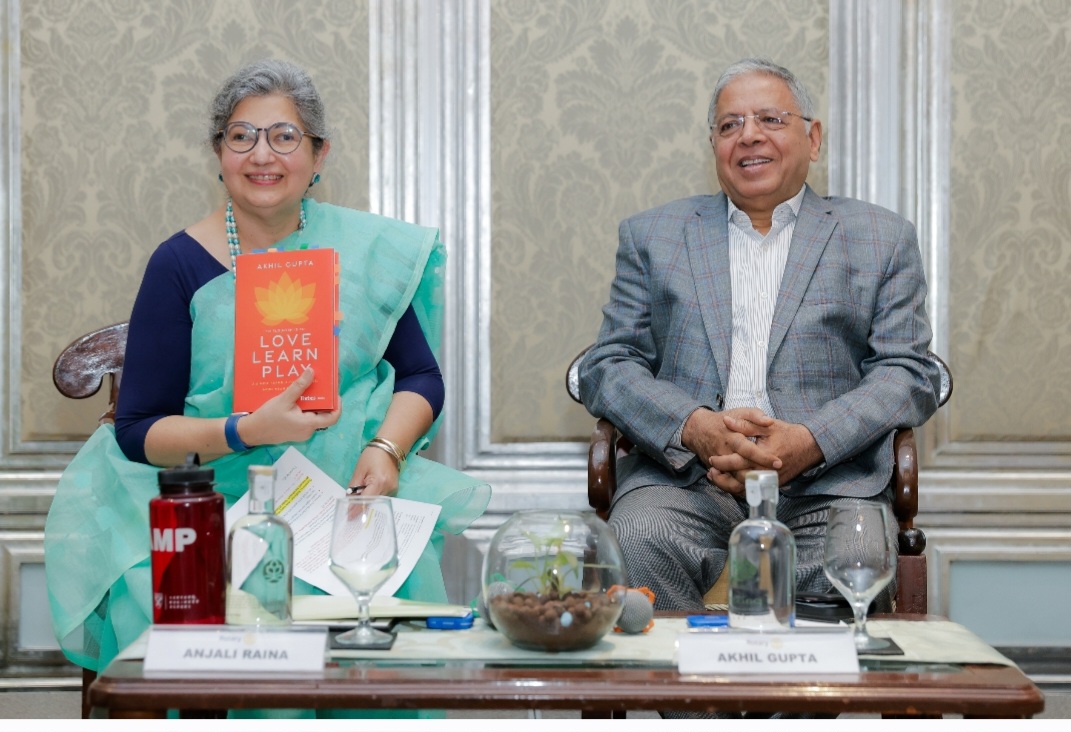
From Achievement to Fulfilment: Love, Learn & Play
From Achievement to Fulfilment: Love, Learn & Play
A conversation between Akhil Gupta and Anjali Raina
From Achievement to Fulfilment: Love, Learn & Play
A conversation between Akhil Gupta and Anjali Raina
Anjali Raina: Good afternoon to everybody. So I’m going to start by saying that, Akhil, we just heard that you’re from Harvard, from Stanford, from IIT Delhi. You worked with Reliance. You founded and set up Blackstone in India. You initially worked with Levers, which is the crucible for leaders not only in India but all over the world. So you should be writing a book on 10 tips to be rich, successful, achievement-oriented, a global brand. What on earth are you doing first writing a book on bridges across humanity and then the second book on love, learn and play? What motivated you?
Akhil Gupta: So, I think there were a couple of catalysts, inspirations and serendipities. The catalyst was that I was exercising at this hotel’s gym, and they were kind enough to give me privileges to exercise there while working in Blackstone’s office. And I was travelling. I was supposed to have dinner with the CEO whom we had just hired for CMS. So Matthew Cyriac was an MD dealing with the deal. He said, “You have to have dinner with him. He’s been waiting here. You have to welcome him.”
So, I said, “Matthew, I really don’t want to do it.”
He said, “You must do it.”
We made a reservation at Tiffin at 8.30. So, on that day when the terrorists struck, everybody who ate at Tiffin died. How come I’m here? I’m here because something inspired me to say, and this is serious, I never change my appointments unless I have to, but something inspired me to say, “Hey, can you just have drinks with me rather than dinner?”
He said, “Oh, that suits me better because I didn’t change the plans. I’ll have dinner with my friend.”
So, at 8.30 we left, and at 8.35 they came and killed everyone. And that really shook me up, that life is so unpredictable, anything can happen. So, I must focus on what is more important in my life.
Seriously, that was a turning point. Otherwise, I was sleepwalking through life like most of us do, earning more money, becoming famous, having power, fame, all those three or four things that society teaches us to do.
So, the first thing was my duty was to Blackstone, and Blackstone was a fledgling institution at that point in time. By 2010-11, Blackstone became the leading firm in India for private equity. So, in 2012, on my 60th birthday, sorry, I’ve given you my age, I told my boss that “Look, I want to leave and do other things.”
And he said, “Oh, Matthew and Amit are not ready. We want you for at least two more years.”
So that’s how I stayed. But I stayed, and I was just thinking about what I wanted to do.
The second impression was when Stephen Schwarzman first came to India. I came to receive him from the airport. So, as you know, there are a lot of slums near the airport. So he was watching outside and asked me to slow down. He became very silent. And when he came to the office, people said, “Steph, tell us about what’s happening in the world and Blackstone.”
And he said, “Before I say that, let me share an experience that has really hit me.”
And he’s a beautiful narrator. Sorry, I can’t do justice to the way he narrated the story. He said, “Here were these 10- to 15-year-old children. They had torn clothes, hadn’t had a bath for a month, but the quality of their smile was quite amazing.”
And he contrasted that with the smile that he faced from his 24-year-old associates, who, he said, “I’m paying $400,000 a year. They don’t deserve it.” And they had long faces.
So when the king of capital, I mean, he was the king of Wall Street, completely capitalistic, says something like happiness is not related to wealth, it affects you. So it stayed with me because previously I used to think it was my socialist upbringing that made me think about wealth and happiness and not equate them.
And then I went to Harvard. I’ll share with you that I could have continued to make lots of money, become more famous, gain more power. But once you have all this stuff, there was a feeling of lack in my life. And I had no idea how I was going to address it.
I had several paths, and the most likely path was that I’ll become an impact investor. I had a little money from Blackstone and would use that money to invest.
So, I went to Harvard. There’s a programme called the Advanced Leadership Initiative, where Ishan Raina was one year behind me. That’s where I met Anjali and Ishan. And there they teach you how to transition from being a Type A personality seeking money, fame, power and all those material goods to giving back to society.
And one of the interesting things was that you could take classes anywhere you wanted. So, I was like a kid in a candy store. I took 40 classes in two years, and dots started to connect.
So there were two paradoxes that I kind of uncovered. The first was that in Germany, one-third of the country was wiped out because of fights between the Protestants and Catholics. And I said, “What? My book is about the commonality of religions. My mother, on my 10th birthday, took me to feed people of all religions. How can you have the same prophet who teaches ‘love thy neighbour as thyself’ and still have people killing each other?”
So I wanted to get to the bottom of it. So I took 12 classes on religion. And obviously, the question I was asking was, what is the commonality? So that’s how that book came about.
When I went to my Divinity School professors and said, “I’m writing this book,” they said, “Oh, 10 or 15 commonalities won’t really be sufficient for a book.”
There were 54 commonalities, and on my website I have 108. So please go to my website, uef.org. This is what the world needs today.
The second paradox, which is obvious to all of us, is this: the richest country in the history of the world, America, guess where it ranks on the wellness index in the world? It’s 20th. It’s number one in the consumption of antidepressants. Twenty per cent of women use antidepressants, and so on and so forth.
I won’t spend too much time on that. But that was another turning point. And the worrisome part to me was that as the technology and culture from the US are coming here, we will be making the same mistakes. So that’s really what the second book is about.
And why did I write the book? The third inspiration came from the President of Harvard. Her signature campaign was cutting through the silos of different departments. So she worked hard, but it didn’t work. It remained a slogan because faculty are what they are. They won’t do anything different.
But I got the inspiration, saying, look, given my background, being born a Hindu, a very broad-minded Hindu, having worked here and worked in very different organisations culturally, I had very broad exposure. And I had an amazing two years at Harvard.
Most of you will not have the time or the opportunity to do that. So I said, this is a problem that I think I can contribute to, given my background.
And the book is about happiness. Hundreds and hundreds of books have been written on happiness. So I didn’t write the book on happiness casually, because I read every single book on happiness.
And in 2023, I went again for a year at Harvard to take all the courses on happiness at Harvard, Stanford, MIT, Yale and one more, which I forget. And I found that all of them had a very Western outlook and very Western frameworks.
I came across Sir John Templeton, who says, “The wisdom of the East is wider than the sky and deeper than the ocean.” And I had so many thoughts that we could put into the book.
So I wrote an outline and gave it to a friend of mine. She was a teaching fellow for 150 Harvard students on happiness.
So I said, “Sarah, do you think I should be writing this book?”
She said, “Oh my God, I wish I had that book with me. There are so many questions they asked me for which I had no answer.”
So that was the reason I wrote the book.
Coincidentally, I’m not an author. In fact, I have great difficulty writing text. I’m a chemical engineer and then a businessperson. And by the way, for the last 40 years, I’ve been presenting to people. I never wrote anything.
Anjali Raina: So thank you very much for sharing that, Akhil. So how many of you here today would say that you are 100% happy?
Akhil Gupta: They won’t be here if they weren’t happy.
Anjali Raina: So, would you like to know some of the pathways?
Yes, you would. Okay, so I’m going to start by unpacking this, and the first question I’m going to ask you, Akhil, is that you make a distinction between happiness and flourishing. So what’s the difference?
Akhil Gupta: This distinction is as old as the Kathopanishad’s distinction between Shreyas and Preyas. Preyas is what pleases you, Shreyas is what’s good for you. And in Greek literature, there is eudaimonia versus hedonia. Eudaimonia is flourishing, and hedonia is all pleasure. So that’s the difference between the two.
One of the key messages of the book, and from our Hindu Eastern philosophy, is that happiness, actually true happiness or flourishing, comes from inside, not from outside. If you’re looking for it from outside. I think I went through this stage, all of you must have gone through this stage, saying, “When I get this, I’ll be happy.” And then you get that stuff and you’re not happy. So Dil Maange More keeps working on us, which is the Western concept called the hedonic treadmill. So when you reach that stage, you want something more. And that never ends.
Whereas flourishing is basically aligning yourself to the larger world order. And my conclusion from all the learnings that I did is that our true longings are only three: loving, learning and playing. And no matter what you do, if you do it with the mindset of loving, learning and playing, you will flourish in the secular world, or God will come to you in the religious world.
And I have to tell you a nice tale here. My mum once went to my dad and said, “Oh, I’m very worried about my son.”
“What happened?”
“He doesn’t sit in pujas any more.”
So my dad said, “Is he doing anything he shouldn’t be doing?”
“No, no.”
“So, is he not doing what he should be doing?”
“No.”
For my mum, if you are a good person and you are helping others, that was enough. She used to say, “He helps so many people, he doesn’t tell me, they come and tell me.”
So Dad said, “Then you don’t worry about him. He doesn’t have to find God, God will find him.”
And that really, maybe it looked like something simple then, but my dad, by the way, did all the pujas, and he was also very learned. Coming from him, this sentence became another inspiration when writing the book.
I believe that we will never know the truth with a capital T. And anybody who thinks they know the truth with a capital T is fooling themselves. Your belief gets converted into “as if I know”, and we are prepared even to kill for that.
So, my question was, and this comes from business training and the value of imperfect information, that if we do not know what the truth is, how do we live a life? So, without knowing what the ultimate reality is, whether it is God or natural selection or whatever our nature has told us, these three longings remain: love, learn and play. So, through that, we can flourish.
Anjali Raina: Thank you. Thank you very much.
So, in some ways, the Harvard Advanced Leadership Initiative was like the Vanaprastha, the third phase of our life. When we go away and we have a chance to reflect after being a Brahmachari and a Grihastha, we have a chance to reflect. And obviously you got some really deep learnings and the time to reflect, and you developed this framework of love, learn and play.
And you talk about the fact not only that there’s inner flourishing through love, learn and play, but also that there is a synthesis between Eastern and Western philosophy. So how does the framework of love, learn and play synthesise that?
Akhil Gupta: So first I want to tell you how this came about. It’s very important.
So I was playing with my grandniece once I got time after leaving Blackstone. So her Mum says, “Mamu, can you hold her while I prepare lunch for you?” And obviously she was displaying her culinary expertise, so she’s taking two hours to prepare lunch. I’m playing with this baby for the next three months.
And I’ve just come from Harvard learning psychology, where most of the psychological insights came from doing experiments on children and baboons. So here’s my guinea pig, and I’m doing experiments on her.
And I asked myself the question: before the social norms take over her life, what does she want to do?
And my answer was: she wants to learn, she wants to love, and she wants to play. She starts with play, and obviously she’s learning. Every time she’s playing, when she gets tired, then she wants love.
So that’s how this came about.
And I started thinking about it. So if you look at our Hindu religion, there are three yogas: Karma Yoga, Bhakti Yoga and Jnana Yoga. So my dad used to say, “Beta, there are three paths, but for you, Karma Yoga is the thing.”
My conclusion, and this is my addition, is that everywhere people say either this, or this, or this. But for me, it’s not either/or. It’s all three together that we need.
So Karma Yoga and the way it works, Anjali, is that no matter what you do, when you’re doing something, ask yourself the question: are you doing it out of love? If you’re producing a product, is it going to help society or not?
And that’s why I’m sitting in this building where the vision of, by the way, I’ve compared this in my book, the vision and mission of the Tatas versus Milton Friedman, who says the business of business is only making money, versus the Tatas saying that society itself is the very reason for existence. So those are two very different paths.
So I took the opportunity to mention that.
Now, last time Anjali asked me a question: out of love, learn and play, what did you do the least?
And just three or four days back, I was thinking about it. I said, completely wrong. Because if you look at the Nishkama Karma yogi, the consciousness of a Nishkama Karma yogi is the same as that of a child.
Let me explain. They are both involved in the process so deeply that they don’t care about the outcome, and they’re doing the best they can.
So I said, my God, I’ve been playing more than learning and more than loving. The playing is the most important thing.
So that’s not in my book, but it just came to me last week from the questions of the audience. You keep thinking about it and you get better and better.
Anjali, if you don’t mind, I just want to request you, because this is my mission in life now. I’m going to focus only on commonality and love, learn and play. I’m sending four reels a week, and I’m sending a letter to 1.3 million people every other week.
So any thoughts you have after you read the book, if you send them to me, I will include your thoughts and ideas, along with your name, in that material. So let’s all share the flourishing together.
The other thought that came to me the other day was that initially I was going to name my book The Triple Helix of Human Flourishing. And seriously, just like the double helix decoded biology, my submission to you is that the triple helix actually decodes human flourishing.
Anjali Raina: Sadhguru. Wow. So I learn a new thing every day when I sit with Akhil. As you can see, I love his books. And this one has got all the Post-its and notes. And if you open it, you’ll see all the highlights. So I think I’ve got some of it, but you always give me something more. Now I have to go back to the triple helix and learn that too.
But there was another concept, apart from love, learn and play, and the fact that play is Karma Yoga, which is Nishkama Karma, which is what your grandniece showed you. Apart from that, you also introduce a concept of means-ends inversion, which I found fascinating. So will you tell us a little bit about that?
Akhil Gupta: Yes, so again, this distinction between means and ends is ancient. Aristotle talked about means and ends. And Kant talked about means and ends. He said all human beings should be treated as ends, not as means. That’s especially true for corporations, where we often treat people as means to whatever goals we have.
Gandhiji talked about means and ends. And they never came to the conclusion of means-ends inversion. Actually, why it is logical today to conclude that is because, just as I mentioned, when a child is busy, they don’t need to know anything about loving, learning and playing. Instinctively they do that. But the means they use are very limited, and I’ll call them beautifully limited means because they’re so focused on doing what they’re doing. With a cardboard box or a crayon, they can imagine the whole world.
So as we get into the adult world, our means become more complex. Right now we have money, we have status, we have so many other things. And especially in the modern age, these means have exploded like crazy.
Look at communication. Previously it was just one-to-one. Then phones came in, then TV, and then e-mail. I have five e-mail accounts. It drives me crazy. Sometimes people say, “Oh, you didn’t reply to my message.” So I have two phones, a US phone and an India phone, two messaging systems, two WhatsApps, five e-mails. You get crazy. And I think it’s happening to all of us.
So basically, we end up losing the signal in the noise.
Now there is a structural problem also. The structural problem is that the way our society is structured is into so many hierarchies: social hierarchy, financial hierarchy, this hierarchy, that hierarchy. And because of all those hierarchies, we are constantly trying to achieve and achieve and achieve.
So the reason I call it inversion, which nobody called it before, though obviously I’m standing on the large shoulders of people who separated means and ends, is that I think this kind of complexity was not there before. So people may have crowded out the ends with the means, but never inverted them.
Today, we start with money seeking happiness, but money itself becomes the goal. We start defining ourselves by how much money we have.
So I think that’s again a very original thought that came to me. I don’t take any credit, but when you sit in a classroom with these youngsters, with their rock-star professors teaching you at the age of 62, without having to worry about jobs, grades, security, girlfriend, boyfriend, this or that, then you get something very different out of the class.
And all my contribution to this comes from synthesising between different schools and different colleges. As Joseph Schumpeter said, “The mother lode of all invention is the recombination of existing ideas.”
So that’s what I’ve done in this book, frankly speaking. Nothing is completely new, as you can see, but the way the ideas come together gives us a very different perspective.
Anjali Raina: Thank you. Thank you for sharing that.
And Akhil is one of the best listeners I know. And being able to listen to other people is part of this ability to take in and combine ideas.
So one other idea that Akhil has introduced in his book, if you said that you would like to know and unpack the route to happiness and flourishing, is living consciously. And he’s mentioned 11 ways in which to live consciously. Read the book, you’ll find them. The book is available, everybody. But which is your favourite? And first, tell me, what does living consciously mean?
Akhil Gupta: Yes, so between stimulus and response, there’s a space. And most of us do not capture that space.
And again, I want to be kind to ourselves. The reason that happens is because the mind is structured to save energy. The moment you make any effort, it consumes energy. So if you want to save that energy, you just go on auto mode. Whatever the world is telling us, when the stimulus comes in, you go there.
So I think that’s what it means: that you don’t automatically respond to a stimulus.
I want to share a very nice story. A very famous thought leader was giving a commencement speech, and he told a story to the students.
The story was that there were two young fish swimming in the ocean, and the mama fish comes and swims the other way. And she asks, “Hey boys, how’s the water?”
Obviously, they don’t answer. And they both swim a little further, and one fish asks the other, “Hey, what’s water?”
This is such a deep message, that we are swimming in what I call false narratives. And by the way, this book gives you a good list of false narratives. You can’t be comprehensive, but there is a practical list. For example, capitalism as an end is a false narrative. Capitalism as a means is the most wonderful social invention we have created to create wealth.
So there are a lot of false narratives.
That’s the whole point. Living consciously means that you are aware of why you’re doing something. Is that aligned with your values, or are you living somebody else’s life? So that’s what living consciously means.
Anjali Raina: I love the narrative about the fish in the water because you don’t even know what narratives you’re swimming in. So opening that eye, the third eye, to actually figure out what that environment is, is so critical.
But of all these aspects of living consciously, from illusion to enlightenment, from egocentricity to interconnectedness, from self-doubt to self-love, so many, 11 of them you’ve listed, which is your favourite?
Akhil Gupta: My favourite is humility. And if you ask me, second would be gratitude. I relate to people who are humble and grateful.
Anjali Raina: That’s a big one. That really is a big one. And you’re the author, so I’m not going to disagree with you. But my favourite is fear transformed into curiosity.
And that’s what we do at the Harvard Research Center. My colleague Rachna, who’s sitting here, and my team, write case studies where we are not fearful of the past, or fearful of the present, or fearful for the future. But we see the past as prologue for the future, and we’re curious about what’s happening.
So we can agree to disagree, and all of you can…
Akhil Gupta: No, actually, if you look at the Gita, the highest divine quality is fearlessness. So to that extent, you’re right. But what I would say is that fear is what we have to overcome, whereas humility is what we have to develop.
Anjali Raina: They’re together. They’re all from your book. They’re all from your book. And one is a way of being. Humility is a way of being, and curiosity is an act.
So there are many things to unpack in the book, and living consciously is only one of them.
Akhil Gupta: Can I just mention here, since you brought this up? Just like when you’re thirsty, you want water, I’m sure all of you have felt lonely. Why do we have that feeling of loneliness? Nature or God has created it because we need connection.
Why do we get curious? Because we need to keep learning.
And why do we have imagination? Because we need to play.
So that’s another justification or substantiation of this framework.
Also, you can love infinitely, you can play infinitely, and you can learn infinitely. And by the way, anything divided by what you don’t know is zero, and that’s why we need humility.
Anjali Raina: So basically, you’re saying that when you’re humble, you are in a state of gratitude.
Akhil Gupta: Yes, and it opens your mind constantly. You want to learn all the time.
Anjali Raina: Thank you.
We have a little time, so we can take a few questions from the audience, if there are any. Do we have time or do we have to end? Okay, any questions? Okay.
ROTARIANS ASK
Q1. Thank you, Akhil. You have worked at the highest echelons, where you have dealt with people with outsized egos and monster-like personalities. How have you maintained your curiosity or the love, learn and play attitude despite dealing with all these difficult situations?
Akhil Gupta: Yes, I was blessed with wonderful parents, and the values they instilled in me were so strong that…
I mean, the organisations I worked with had very powerful personalities. But ego is not the right word for that. Actually, most of the successful businesspeople I admire, not love but admire, have big egos.
The way I maintained myself was, firstly, I had a very strong core, which, as I said, came from my parents. And right from childhood, I was different. I can tell you that when my colleagues were chasing women, I was reading books on psychology and philosophy because I was curious. That’s why I’m still single.
So part of the reason these books exist is that if I was married, probably you wouldn’t have these books here.
So I think it’s really just curiosity, and that’s the key word.
Fortunately, my job also required me to keep learning all the time. All the businesses and verticals that I started at Blackstone involved constant learning. And one of the good things about Blackstone was that every single company that came and presented to you became a learning experience. Most of the industries, I knew nothing about. And that was the joy of being at Blackstone.
So I would say it’s just the DNA that was shaped by my parents.
Q2. Can you elaborate a little bit more on this meaning-making that you’ve written about?
Oh yes. Actually, the most important class I took at Harvard was on meaning-making. And my rock-star professor, Bob Kegan, his class had about 500 people. Obviously, you had to bid points to get in, but he gave a few slots to the ALI people, so I got into the class.
And he says that it is the act of meaning-making that is life itself.
Obviously, he gave wonderful lectures. He would show a picture, and everybody in the room would interpret it differently. And he came up with the idea of the five orders of mind.
There is the order of a child, then as an adult you become what he calls a socialised mind. So you’re thinking exactly what the rest of society is thinking.
The fourth order is when you start distancing yourself a little from society and begin forming independent views. So that’s where I am. I have a lot of independent views. Sometimes I feel very lonely because on some issues I disagree with all my friends.
And then there is a fifth order, where some people are, where you see the interconnectedness of everything there is or ever was, which is, by the way, also the message from our scriptures. And where you see that black and white are actually shades of grey.
So why is that relevant? That’s relevant because, let’s take my mum. My mum is third order. I’m fourth order.
So I used to believe, like my mum, that Lord Krishna personally comes and looks after her. Today I do not believe that because I have gone to the fourth order.
But my fourth order is not superior to the third order. My mum is a much better human being than I am.
The parallel I can give you is this: when you look into the sky, you feel the sun is going around the earth. Then you get a telescope and realise, no, it’s actually the other way around. Now both people are speaking the truth based on what they’ve experienced.
And then you send a satellite into the cosmos, and you can see 12 billion years back. So that’s the idea of the orders of mind.
What became important for me, and how this book was born, was that I said: look back at religions 2,000 years ago. The order of mind was very different then. Most people were illiterate.
In fact, Christ said that he could teach in one way, but he had to use stories and parables for the masses. Buddha said the same thing. So they were speaking metaphorically.
Now look at how much the orders of mind have changed. But if you keep interpreting these things literally, that’s where all the crises in religion come from.
So when I see somebody with different behaviour, firstly, I was always curious because of my upbringing. But now I can clearly see something else as well. One of the things is this: when somebody believes something, don’t react to what they believe. Ask them why they believe what they believe.
And suddenly you’ll see that they have the same deep longings that we have. They were simply born in a different context. Their experiences are different from yours.
And most of us become intellectually lazy, not because of anything malicious, but because our minds want to conserve energy. We want to believe what everyone else believes because it’s easy for the mind. Don’t waste your energy.
Q3. I want to know who has been your role model. Is there someone you looked up to or drew inspiration from at the workplace, considering you’ve had such a distinguished career throughout?
I would say my biggest insight in life is what I call demystifying greatness.
So I was inspired by lots of people, but the more I read about them, the more I realised something. Dhirubhai Ambani was larger than life. Mukesh Ambani is larger than life. Stephen Schwarzman is larger than life. But they are people like you and me, seriously.
So I won’t say there’s one single person, whether from the scriptures, business or psychology, with whom I completely agree. But there’s something I learn from every single human being.
And that’s the beauty of diversity. That’s the beauty of keeping your mind open. That’s the beauty of humility, that I can learn from every single person.
It’s like saying I should admire Gandhiji. I should admire Nehru, who is still my favourite person. When I read his books, what a wonderful writer he is, and what a magnanimous worldview he has. But he had his faults too. Everybody does.
So I would say, please don’t think less of yourself because somebody else is great. Demystify greatness. You are just as good. You are sufficient. You are enough. That’s my message to you.
Be who you are meant to be.
That’s really what happened to me. After having all the things that society tells you to have, I came back to where I already was before. I didn’t have to go through all that to become who I am today.
So that was really thought-provoking.
Q4. Have you thought of presenting this book to President Trump? And if you present it to him, how do you force him to read it? Because he’s doing exactly the opposite of what you’re saying. Can you explain that?
Akhil Gupta: Yes, so Deepak Chopra said, “We are all dealing with President Trump incorrectly. He’s behaving the way he’s behaving because he hasn’t had enough love in his life.” So I think we need to show love to him rather than books.
PS, by the way, I’m not a citizen, so if I didn’t answer that well, I probably won’t be allowed to enter.
Q5. I have one comment and one question. My comment is that you mentioned you are juggling a lot with e-mails and WhatsApp messages, and you do reply back to every single e-mail. Have you ever thought of using AI to help you do that?
And the question I want to ask is: what would your message be to the Gen Zs and Gen Alphas of today that you think would be very relevant for them?
So, by the way, I use AI enormously.
This book has 54 themes because the person who was helping me was from Harvard Divinity School. He had a job but was committed to completing the book. He left, and there were a few themes that he did not complete.
So then ChatGPT came in. I said, “Let me ask ChatGPT.” It was about kneeling. I had gone with a Christian friend to a church, and I saw him kneeling on a pew. So I went to ChatGPT and asked, “Tell me the importance of kneeling in all religions.” Then I took that output and fed it into Gemini.
And in three hours, I had a whole newsletter ready, one of the hundred newsletters. So I have personally created 54 newsletters because of AI.
Now I still have to check and verify, and that’s why I use three different systems.
And I think this is like nuclear energy. It can be something wonderful, but it can also destroy us completely. Those are the same fears I have about AI. It’s a wonderful tool.
When I was at Blackstone, I replied to each e-mail. What I did was that over a two-year period, I created 10 categories of answers, and my assistant knew which category to use in replying. So every e-mail was answered, and anything important would come to me directly.
Now, regarding Gen Z, people keep asking me, “Who’s your audience?” So I say my audience is people who have not yet gone on to the treadmill, which is Gen Z, or people who are already on the treadmill and, after being there for a long time, are feeling the lack that I felt. That’s my audience.
So Gen Z is actually perfect for this book, and they’re hungry for it.
In fact, I teach a class at Stanford Business School on finding spiritual meaning in business, and I’m a Hindu exemplar there, teaching about Nishkama Karma. Forty students come every year, and by the way, there are only 400 students and 100 elective options, so you can see the hunger they have for this. They may not technically be Gen Z, but they are close.
I would say, by the logic I’m giving you, the younger you are, the closer you are to following your longings of loving, learning and playing. So that message is much more relevant for them, and they listen.
Q6. How important is forgiveness in your life? And I love this beautiful golden lotus on your cover, so I’d like to know how you thought of that.
One of the biggest teachings in my life came from my father, and it actually answers both your questions. Thanks for asking that.
“Beta, you have to be like a kamal ka phool, a lotus flower, which derives all its nourishment from the mud but stays above it.”
And frankly speaking, if you look at my career, some of you may wonder why I am who I am despite the kind of career I had. It was that kamal ka phool analogy.
So for my publisher, this image was immediately right. In fact, it was already on my website. He created this design, and I didn’t have to say, “Give me more options.” This was it for me.
So business… actually, there’s a very nice chapter in the book on how you implement love, learn and play in business. And I argue that your workplace is like a gym. It’s where you build the muscles to stay engaged with loving, learning and playing. There’s a very nice chapter on that in the book.
Q7. I have one last question for Akhil. So you’ve talked about Sat-Chit-Anand and the fact that our nature is happiness. So then why does everybody search for it outside?
Yes, so Sat-Chit-Anand, we all know what it means.
There’s a nice Sufi story. Mullah Nasruddin was searching outside in bright light, and a neighbour asked, “What are you looking for?”
“I’m looking for my keys.”
“Do you remember where you left them?”
“I think I probably left them in the house.”
“So why are you searching here?”
“Because there’s more light here.”
So that’s what happens to all of us. The light is outside. Do magazines or TV channels talk about what a wonderful human being somebody is? No. They say this person is so handsome, this person is so rich, this person is so powerful. That’s where the glamour and the light are, and we all get hooked on to that stuff.
Our true nature is really inside us.
For those of you who’d like to know about flourishing, Harvard University and the Human Flourishing Programme, where Akhil studied, has a questionnaire which you can go to the website and fill in for yourself, or you can get your team to fill in. The details are at the back, along with Akhil’s book. So you can just look at the website and take the flourishing questionnaire for yourself.
- Akhil Gupta: It’s free, and I’m really serious in requesting you that if you have any ideas after reading the book that should be conveyed to the world, please send them to me. I’ll be very grateful.