

INAUGURATION OF IVD IN PIMPURNA
On June 19th, 2025, battling heavy downpour and traffic, President Satyan Israni, IVD Co-chair Pulin Shroff, and donor representative PP Framroze Mehta were determined to reach their destination, Pimpurna, a remote village hidden among the hills in Jawhar. Their visit wasn’t just ceremonial; it was a celebration of hope, resilience, and transformation. What greeted them was not the Pimpurna of the past, but a community glowing quite literally with renewed life. Just a few months ago, Pimpurna’s 186 families, totalling over 830 villagers, were living in harsh conditions. Despite the presence of the nearby dam, power outages were a daily reality. Nights fell in darkness, roads were unsafe, and homes were dimly lit, if at all. Clean drinking water was scarce, exposing the villagers to waterborne diseases. The Anganwadi was crumbling, no longer a safe space for children. The Zilla Parishad (ZP) school lacked even the basics, no proper lighting, no functional blackboards, and no digital tools to enhance learning. The result? Poor hygiene, low student attendance, and an overall sense of neglect.
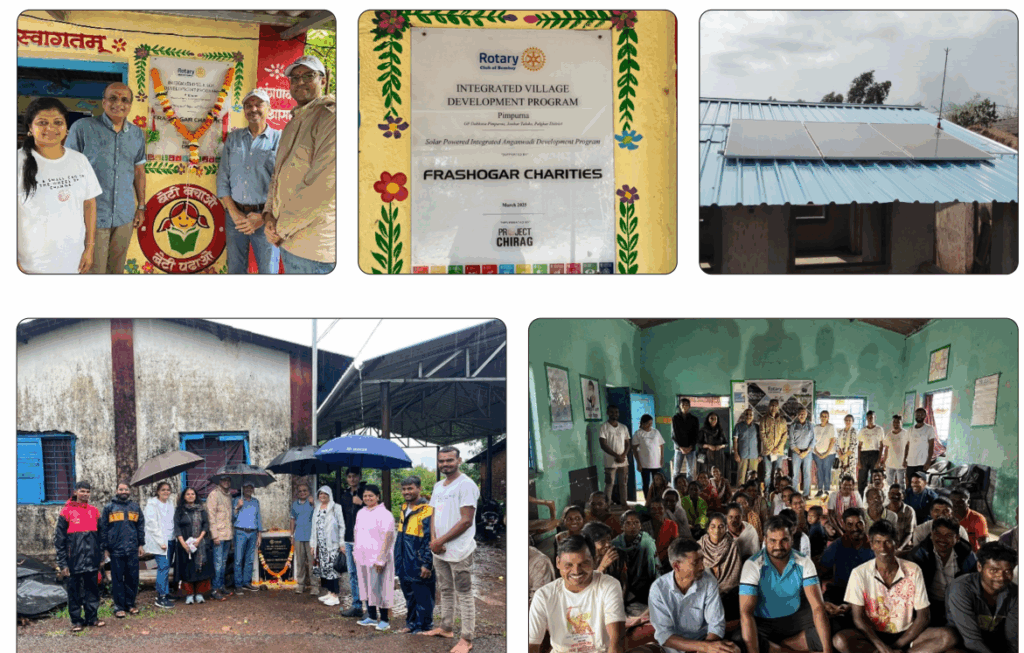
But change was inevitable. With the support of Rotary Club of Bombay & Frashogar Charities and implementation partner Chirag Rural Development Foundation, a sustainable, community-led solution was put in motion. Every household in the village received a solar lighting kit, a tripod-mounted solar lamp with a mobile charging port for home use and a portable lamp for the remote “Jhaaps” where families work during the farming season. Along with the lights, families received water filters, bringing clean drinking water into their daily lives, many for the first time.
The transformation didn’t stop at homes. Nineteen solar-powered streetlights now brighten village pathways, lighting up Pimpurna’s evenings and making movement safer after dark. The Anganwadi was repaired and equipped with a 1.8 KW solar system, a Smart TV, and a library stocked with multilingual storybooks, toys, and learning tools. A clean, safe toilet was also constructed especially to support young mothers and children offering them dignity, privacy, and a healthier start to each day. What was once a neglected space is now a vibrant centre for early childhood learning, operating under the BALA (Building As Learning Aid) model.
The ZP school too got a fresh start. A similar solar system now powers fans, lights, a Smart TV, and educational content that engages its 79 students and re-energizes their teachers. A handwashing station with integrated water storage was constructed, encouraging better hygiene and ensuring cleaner, safer school environments. All of this was not simply installed… Villagers were trained, and local committees were formed to manage, monitor, and sustain the new infrastructure. Ownership was embedded in the process from the beginning.
And so, when the RCB team stepped into the newly restored Anganwadi and school, lights on, children laughing, and a palpable sense of pride in the air, they didn’t just witness a successful project. They witnessed a rebirth of possibilities for an entire village. In that moment, under the monsoon skies, Pimpurna stood tall, illuminated not just by solar energy, but by the power of collaboration, community, and care.