
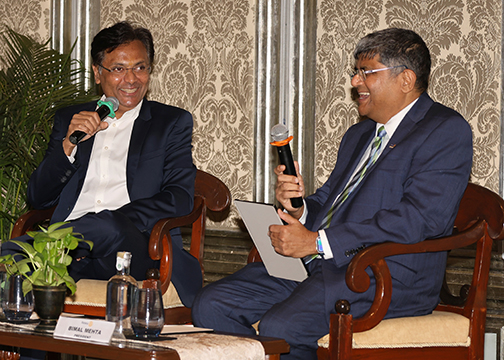
Mr. Hital Meswani in Conversation with President Bimal Mehta on ‘From the World’s Largest Refinery to the New Energy Frontier: Lessons in Scale, Innovation, and Transformation’
President Bimal Mehta: So, as I had said before, Hital is one of my closest friends. But this is my first conversation with Hital before an audience, a microphone in my hand, and a tablet here. Most of our conversations have not been for public consumption, so, I’m quite excited to have this chat. Today, we’ll try and understand a leader who has built and operated the world’s largest refinery, and how he thinks about scale, innovation, transformation, and the future of energy.
Without much further ado, let me begin asking questions. Sorry, I’m just going to…
Mr. Hital Meswani: So, I’m starting with a disadvantage here straight away. Bimal, first, knows everything I know about myself. He knows every single thing. I think I know pretty much half, or more than half, of many of you, if not most of you. So, you all also know me, and you know most things about me. It’s going to be quite challenging what I’m going to share with you today, but we’ll see how it goes.
President Bimal Mehta: Hopefully, we’ll keep it interesting. So, Hital, I remember the first weekend you came back after graduating from Penn. I remember that afternoon very vividly. That was Sunday, and on Monday morning you were on the Gujarat Mail to Hazira. Can you tell us about your early days of setting up Hazira Petrochemicals and the Jamnagar Refinery? What was it like?
Mr. Hital Meswani: This was a long time ago, back in May 1990. I think the task was quite well cut out for me, which was a good thing. I graduated from Penn and was fortunate to get a good academic background in engineering and business, which gave me the footing to do what I was about to do.
The task ahead was to get involved in setting up one of the largest petrochemical complexes at the time, at a place called Hazira. I don’t know whether any of you know where Hazira is. It is an industrial town outside Surat. Back then, Surat was not what it is today. It had the reputation of being the dirtiest city in India, and you had to actually go there to find out what it was like.
Hazira wasn’t very well connected. There were no flights and not that many trains. So, as you correctly pointed out, it was the 5.45 a.m. Gujarat Mail. They used to have these second AC chair cars, and that’s what we travelled by.
I think it was during the monsoons and, as luck would have it, it was raining and trains had been cancelled. They had cancelled all the AC compartments, and I was downgraded from second AC to second class. There was nothing there. It was quite a packed compartment, and we said, we’ll see how it goes. But it wasn’t so bad eventually.
We landed there, and that’s how it all started. There was virtually barren land. I was fortunate to get involved right at the very beginning. I must say it was three to five years of extremely rich learning for me in my formative years.
I used to be a weekender. I would go there every Monday morning and come back on Sunday morning. In fact, I used to take the Saturday night train and arrive on Sunday morning, then hang out with all my friends, and then Monday morning it was back to work. So it was a seven-day week in that sense.
There was lots of learning. There was no infrastructure there. We used to stay in a place downtown in Surat. I think it was called Kapadia Guest House. There was no hotel there, nothing. We used to commute about one and a half hours to the site. Then we built a container at the site that became a small guest house. Then it became a larger guest house, and so on and so forth.
Beyond all that, it was a large petrochemical complex, and I had the opportunity to work on it. I was fortunate to work with many high-quality people at the time, from whom I learned immensely. They were stalwarts.
Some of my lessons were about how you deal with people who are three times your age and still get the most out of them. I was given very strong advice from none other than my mentor and guide, Mukeshbhai. He told me, “You have to listen to everybody, but ultimately you have to do what you think is right.”
That was obviously easier said than done. I was dealing with someone who was 60 years old, another person who was 57, with 40 years of experience, and here I was, a kid out of college, trying to find my feet.
It was different in many ways, with lots of lessons learned. If I can cite one of them, it was a massive construction site. We had some 10,000 people there, which was a pretty large number. There was a diverse set of competencies and contractors.
I used to feel that these contractors wouldn’t mobilise and work just wouldn’t get done unless I went there myself. Nothing happened otherwise. So I used to go there every day. An eight-hour day became a ten-hour day, a ten-hour day became a twelve-hour day, and so on and so forth.
Then one of my guides told me, “How long will you keep doing this?” He gave me a very simple lesson, which was that a General never goes to the battlefield. A General always knows, while sitting in his room, where the problem is, so he or she can fight the battles that need to be fought, or guide others appropriately.
There was nothing more important than having a very powerful information system, finding out where the problems are, making people feel responsible for their tasks, and not taking on every responsibility yourself.
We all have this habit of taking notes. Every time there’s a meeting, we take notes. I still do. But then I was told that if you go on taking notes, that’s not good enough. You need to make sure that your people in the meeting are the ones taking notes, and then you hold them accountable.
Such basic and simple things are what I learned in my formative years.
Apart from, of course, the technical chemical engineering aspects, there was learning how to promote safety and operational excellence, how to deal with scale and EPC execution, how to handle plant and machinery, how to deal with complex assets and bring them on stream, how to unload ethylene at minus 100 degrees in the middle of the sea and still do it safely, and so on and so forth.
It was a series of such learning experiences, and that’s what has stayed with me throughout my life ever since.
President Bimal Mehta: From Hazira, you went to Jamnagar. Today, Jamnagar processes 1.4 million barrels a day from a single location. When you set out to build this refinery, did you imagine it would become the largest refinery on earth, or did it scale up step by step?
Mr. Hital Meswani: Jamnagar is a very significant asset. It processes 1.4 million barrels of crude oil every single day. Just to put things in perspective, it represents 2% of the world’s crude oil processing capacity.
When you say 2%, a useful way to look at it is that two out of every 100 cars on the road, two out of every 100 aeroplanes that take off and land, or two out of every 100 trucks on the road are actually using fuel produced at the Jamnagar refining complex.
Jamnagar is not just for India; it also serves the export market. Whether the fuel is being used in India or abroad, it may ultimately be branded under any name, but it is a product manufactured at Jamnagar. So, it is very large in scale and extremely complex as an asset. It also produces almost 35% of India’s LPG from a single location. So, it has many scale-related accolades attached to it.
You asked whether we envisioned it from the beginning. Jamnagar was built essentially in three phases, although there were two phases for the refining asset. The first phase was between 1996 and 1999, and the second phase was between 2005 and 2008.
From 1996 to 1999, we started with the idea of building a refinery. In fact, if the story is told properly, we were advised not to build a refinery at all. Several reputed management consultants told us that refining was a bad business and that we should not enter it. That was supposed to be the end of the matter.
So, it was decided that because some management consultant had said this, we would do exactly the opposite. We would go ahead and build the refinery.
Of course, that was Dhirubhai’s call in those days, and he took the decision that we would swim against the tide. He asked, “What does it take to become profitable?” We decided to swim against the tide and build the asset.
It started as a 12-million-tonne refinery. Somewhere along the execution journey, it was decided that 12 million tonnes was too small. So the capacity was increased to 18 million tonnes. We thought 12 to 18 million tonnes was perhaps manageable, although we were all very nervous because it was already enormous. At that time, the largest refinery in India had a capacity of about 4 million tonnes, and here we were building 12 million tonnes, which had already become 18 million tonnes while the project was still under execution.
By the time we finished, we decided to increase it further from 18 to 21 million tonnes. Eventually, when it started operations, it was running at 33 million tonnes. That was the journey of the first refinery.
Even at 33 million tonnes, it was the largest refinery in the world at the time, and we were quite overwhelmed by the scale and enormity of the task. It was built over about 30 square kilometres. Those of you who have visited it can probably appreciate the scale it represents.
That was the first tranche, and it was really a refinery designed for the Indian market. We believed India had a significant demand-supply gap, as the country was importing almost 60% of its petroleum products, including diesel, gasoline, LPG and many others.
We saw a one-time opportunity to close India’s demand-supply gap, and that’s exactly what we did. We never imagined we would end up repeating the exercise. We were all quite satisfied.
However, as luck would have it, the global market was also growing. In 2005, we decided to build another refinery, this time for the export market. That was the vision.
What we did was an intelligent repeat of the existing refinery. It was like having one building and deciding to construct another right next to it, although, of course, it was far more complex than that.
So, we built another refinery. It was completed in about 30 months, and that’s how capacity increased to 66 million tonnes. Today it operates at 74 million tonnes, which is equivalent to 1.4 million barrels per day, representing 2% of world refining capacity.
That is how the scale evolved.
There was also substantial petrochemical integration to improve profitability. That journey continued from 2015 to 2018 and, in many ways, continues even today. So that’s the evolution over time.
President Bimal Mehta: I’ve had the privilege of visiting Jamnagar on three occasions, and it is an absolute marvel of engineering. The refinery, the integrated complex, the housing colony, the mangroves and the port are all world-class and highly sophisticated. Congratulations to you and the entire team.
When you rolled out projects on such a massive scale, what were the core principles and strategies that worked for you? Could you walk us through some of them? You’ve built Hazira, Jamnagar, and now New Energy. These are all large-scale projects. What have you learned from that experience?
Mr. Hital Meswani: This could be quite a long discussion, but let me try to put it succinctly.
There are really two aspects to it. One is how you strategise and what core principles you follow in conceptualising and operating a business. The second is what is involved in actually executing it. Those are two distinct aspects.
If you look at our philosophy, it is based on five or six core principles that apply across everything Reliance does. It is a common theme. You can test it in any business, and you will find it consistently applied.
The first principle is to always think on a global scale. Never settle for something smaller.
For example, if you’re building a refinery and the largest refinery worldwide is 12 million tonnes, then building something significantly smaller means you’re not even competing in the same league. The advantages that come with scale are enormous. Scale itself becomes a source of competitive advantage. It gives you economies of scale, pricing advantages, and many other benefits.
So never compromise on scale.
Second, never compromise on technology. Whatever we do must use best-in-class technology without exception. Whether it is our own technology or licensed technology, it must be the best available.
You must have the ability to produce the highest-quality products. If you compromise on technology, quality suffers, and that is simply not acceptable. These are fundamental requirements. They are your licence to remain in business. Without them, you simply cannot compete.
Third, always focus on life-cycle cost.
Life-cycle cost is the combination of capital cost and operating cost. Very often, decisions are made based purely on the lowest bid. You have three bids, and people choose the lowest-priced option.
We almost never do that.
We evaluate both capital cost and operating cost. We assess what provides sustainable value, where the technology stands today, where it is likely to be three years from now, and what we are ultimately betting our future on. That is how decisions should be made.
Fourth is configuration and flexibility.
Configuration and flexibility mean being able to process any type of feedstock and produce any type of product. That is the kind of flexible asset we strive to create.
Take our refinery as an example. We can process crude oil from Australia, Venezuela, Iraq, the United States, Russia, West Africa, Nigeria, and many other regions. Virtually any crude oil can be processed.
At the same time, we can produce products tailored for the Indian market, the US market, the European market, the most stringent Scandinavian standards, the California market, or virtually any market in the world.
In other words, you can take any feedstock and convert it into any product because you have built a highly flexible configuration.
COVID provides a good example.
During COVID, travel stopped almost overnight. Gasoline demand dropped by about 40%. Air travel came to a standstill, and ATF demand collapsed. Diesel demand remained relatively stable because goods still had to move.
How do you survive under those circumstances?
We redirected production into petrochemicals. We increased the production of propylene, which is used to manufacture polypropylene. Polypropylene is used in medical applications such as surgical gowns, gloves, syringes and other healthcare products.
We changed our product slate virtually overnight.
At the same time, India was facing an acute shortage of oxygen. We are among the largest producers of oxygen, so we shut down some operations and supplied almost 15% of the oxygen required by India during COVID. That oxygen came from the refinery complex.
These are examples of the flexibility that helps during periods of business disruption, social need, or national emergencies.
The same principle applies today. When geopolitical disruptions arise, such as the current situation involving the Gulf region and Iran, many companies struggle to secure feedstocks. We are able to manage because of the flexibility built into our system.
So flexibility is the name of the game.
Another principle is to always play across the value chain. We never like to enter a business where you buy feedstock from outside, convert it into something, sell the products, and then find that somebody else controls the feedstock prices, somebody else controls the product prices, and you simply get squeezed in the middle. We would never do that.
Let’s take the refining business as an example. The refinery buys crude oil from outside, but after that we make naphtha, convert naphtha into ethylene, ethylene into ethylene glycol, ethylene glycol into polyester, and polyester into fabrics. We participate across the entire chain.
If one segment is not working, another may be. So we always play across the entire value chain, never just one part of it. That’s a core business strategy.
The last principle is to always use technology as an enabler. Whether it is information technology, which has evolved tremendously over the years, the internet, or now artificial intelligence, technology must always be deployed at scale. That is what enables operational excellence.
What does operational excellence mean? It means executing projects on time, on budget, or ideally ahead of schedule. In the case of the refinery, the global norm was about 50 to 60 months. We completed ours in 33 months. That immediately gives you an advantage in entering the market.
Thereafter, the assets must run at full capacity. They should operate with 99.9% availability. They must achieve target yields at target costs, with a razor-sharp focus on operational excellence. Everything has to work like clockwork.
That is operational excellence, and it is how you achieve flexibility at scale. That’s really what it is all about.
President Bimal Mehta: Absolutely amazing.
Let’s move to New Energy. Firstly, what is New Energy? What are the components, and how are they all related? I’m a little confused, and I’m sure the audience is as well.
Mr. Hital Meswani: Let me start with the vision for New Energy, what it consists of, why it exists, and the role it can play. I think that would be relevant in this context.
New Energy obviously has a close relationship with the environment and sustainability. We announced our goal of becoming net carbon zero by 2035. There is also the broader ambition of transforming Reliance into a sustainable energy and sustainable materials company.
It’s about addressing what we call the energy trilemma: sustainability, availability, and affordability.
How do you make new energy? Whether it is solar, wind, hydrogen, batteries, or perhaps all of the above, that is where New Energy begins.
Ultimately, energy can be divided into two categories: energy used for stationary purposes and energy used for mobility.
Mobility includes cars, motorcycles, scooters, trains, aeroplanes, trucks, and anything that moves. Stationary energy refers to electricity used in homes, offices, appliances, mobile phones, lighting, and so on.
Until recently, these two categories were largely separate. Mobility was driven by diesel, petrol, gasoline, and similar fuels, while stationary energy was driven by electricity.
Today there is increasing convergence between the two because cars can run on electricity and, in the future, may also run on hydrogen. Resources are becoming increasingly interchangeable.
Electricity itself can be generated from many different sources. There is coal-based power, nuclear power, gas-based power, solar power, wind power, geothermal energy, and several others.
Among these, coal remains the dominant source globally. However, solar energy is growing rapidly. Costs have fallen dramatically, and solar power is emerging as the key growth vector.
So there is significant convergence taking place.
If you look at New Energy, it really focuses on solar power, wind power, batteries, and hydrogen. There is also bioenergy, where organic waste materials are fermented and converted into biogas. That biogas can then be used for cooking, transportation, and other applications.
These are all sustainable, clean energy sources. Thanks to technological advances, they are now available in abundance and at increasingly affordable costs.
We have decided to embrace this entire vision of New Energy using the same Reliance execution principles that I described earlier, implemented at scale.
That is where the New Energy business comes in.
The first step is creating the supply chain. There is a solar supply chain, a battery supply chain, and a hydrogen supply chain.
When I say solar supply chain, most people think of rooftop solar modules because that is the visible end product. But the rooftop module is only the final stage. The real determinants of quality, cost, and supply-chain security lie much deeper in the process.
It starts with sand, specifically quartz sand. That sand is converted into polysilicon. Polysilicon is silicon purified to approximately 99.999999999% purity.
Polysilicon can be used for solar applications, but it is also the foundation for semiconductors. All the chips used in computers, phones, appliances, and countless other devices are made from polysilicon. Semiconductor-grade material requires even higher purity levels.
The polysilicon is melted at around 800 degrees Celsius to produce ingots. These ingots are large cylindrical blocks of silicon.
The ingots are then sliced into wafers. The closest analogy is slicing a loaf of bread, although the process is far more sophisticated. These wafers are approximately 100 microns thick, about as thin as a sheet of paper. They are so delicate that they can easily break if handled improperly.
The wafers then move into a complex manufacturing process involving chemical vapour deposition, eventually producing solar cells. Each solar cell is roughly the size of a person’s palm. These cells are then assembled into modules. Polymer layers, glass, frames, electrical connections, and other components are added to create the final solar module.
That finished module is what ultimately appears on a rooftop.
Today you can buy modules from outside suppliers, just as you can buy crude oil from outside suppliers. But that does not provide supply-chain security.
If you start with sand available in abundance in India and convert it all the way into solar modules, you create a complete domestic supply chain capable of producing high-quality modules continuously. We have adopted heterojunction technology, which delivers some of the highest-efficiency solar modules in the world.
In simple terms, if a conventional module generates 700 watts from a given area, a higher-efficiency module may generate 750 watts from the same area. Greater efficiency means capturing more energy from the same amount of sunlight.
Then there is the battery value chain.
At its simplest level, every battery consists of an anode and a cathode connected through an electrical circuit. The anode is made from graphite, while the cathode is made from lithium iron phosphate.
Those materials are processed and assembled into battery cells. Most people are familiar with AA or AAA batteries, which are small cylindrical cells. Electric vehicles use much larger cells. There are also prismatic cells, pouch cells, and several other formats.
These cells are assembled into battery packs. Those packs can power vehicles, or when deployed at scale, they can become stationary energy storage systems for homes, businesses, and utilities.
Then there is hydrogen. We are also manufacturing electrolysers. Electrolysis is the process of producing hydrogen from water, which we can discuss later if time permits.
All of these components eventually come together in Kutch, Gujarat, where we are developing almost 500,000 acres of land. The area is extraordinarily large, roughly three times the size of Singapore.
The solar modules will be deployed there to generate electricity. That power will then be transmitted through transmission lines to Jamnagar and other industrial locations, enabling them to operate using clean energy.
That is the overall vision and platform. You may ask what exactly we are doing within this ecosystem.
The answer is: we are participating in every part of it.
President Bimal Mehta: That was my question.
You’ve invested $10 billion in a green energy mega-complex. Why are you doing everything together rather than making separate bets?
Mr. Hital Meswani: It only makes sense if it is all done together.
Let me explain.
Batteries are a critical component because, without them, solar power is only available when the sun is shining. If I tell you to install solar panels without battery storage and simply use electricity when it happens to be available, most people would say that the power supply is unreliable and therefore unacceptable.
So that approach does not work.
Solar power is growing rapidly today because of two factors. First, it is environmentally friendly, which is important. Second, costs have fallen dramatically due to technology.
Battery costs have also declined significantly.
When you combine solar generation with battery storage, you can store electricity generated during the day and use it at night. As a result, solar power can provide the same reliability as conventional electricity sources.
If that electricity can also be supplied at an affordable cost, then you have a compelling value proposition.
That is one reason for doing everything together.
The second reason is scale and self-reliance.
We do not want a situation where one component must be imported from China, another from Russia, another from Australia, and so on. In that case, our future remains dependent on someone else, and that does not align with our business philosophy.
That is why we call it the “factory-to-foundation” platform, or the “sand-to-module” platform.
We start with sand and end with solar modules. Along the way, we also manufacture glass. In fact, we are investing in a glass factory at Jamnagar as well.
These facilities are what we call gigafactories. A gigafactory is simply a manufacturing facility operating at gigascale. Many people became familiar with the term through Tesla.
What is being built at Jamnagar is approximately 40 million square feet of gigafactory space. That is equivalent to roughly 850 football stadiums.
Compared with some of the world’s largest gigafactories, including Tesla’s, it is around three to four times larger than their biggest facility.
The development consists of approximately 15 different gigafactories located at a single site. They will all feed into one another using robots and automated guided vehicles.
It is a completely different world.
At Jamnagar, on one side of the complex, you will have the world’s largest refining ecosystem. On the other side, you will have one of the world’s largest green energy ecosystems.
Both will coexist side by side within the same integrated complex.
President Bimal Mehta: So I have to make my fourth trip to Jamnagar very soon to see this. I’ll try and wrap up because I’m sure there are questions. My last question is this: energy has always been at the mercy of geopolitics, wars, sanctions, shipping disruptions, and we’ve seen this with the latest conflict involving Iran.
How does Reliance manage geopolitical risk across its energy business? And how do you think about energy security for India?
Mr. Hital Meswani: It’s certainly a hot topic right now.
I think it is pointless to think about geopolitics and energy only after you have already built the business. What I mean is that you must think about these aspects when you are investing, not after investing and then wondering where you have landed.
When we invested in our businesses, we had already thought through the fact that geopolitical disruptions, sanctions, and supply interruptions could happen. The entire oil industry has always known that the Strait of Hormuz could create all kinds of disruptions. It was never a secret. Thanks to the media, everybody else is now aware of it as well.
That is precisely why flexibility was built into the asset from the beginning. If demand collapses in one market, I should be able to sell elsewhere. If one feedstock source dries up, I should be able to source it from somewhere else. You have to think about these things from day one.
Second, you need technology to help you navigate these challenges. Even if you have flexibility, without the technology to switch from one option to another, it becomes very difficult to deal with geopolitical disruptions.
When we were building these assets, one of the key mantras we gave our people was that we wanted to build a dinosaur that could fly.
What does that mean?
It means creating an asset that is so large and so complex that nothing can easily stand in its way. That’s the dinosaur. But if it becomes too large and cumbersome, then by the time it moves, everyone else has already gone ahead. So imagine a dinosaur that can fly. Then nothing can really stand in its way.
If you build an asset that is nimble through technology, capable of switching rapidly from one mode of operation to another, then you gain the flexibility required to cope with geopolitical events.
The long-term answer, however, is clearly what our Prime Minister calls Atmanirbharata. We need to become self-sufficient in energy. India is already moving in that direction through renewable energy. India is one of the fastest adopters of solar energy in the world, second only to China. We are heading down the right path.
With technological advances in solar, batteries and hydrogen, the future is very bright.
Hydrogen is often described as the Swiss Army knife of energy. You can produce hydrogen and then convert it into almost anything. You can convert it into ammonia and make fertilisers. You can convert it into methanol and use it as a shipping fuel. You can make olefins and petrochemicals from it. Cars can run on methanol, and they can also run on hydrogen.
Hydrogen is an extraordinarily versatile molecule.
This entire trajectory of taking photons from sunlight, converting them into electrons, and then converting those electrons into molecules is the future. If India pursues this pathway at scale, then we can provide ourselves with lasting immunity against many of the geopolitical uncertainties that exist in the world today.
President Bimal Mehta: Before I open this up to the audience, I’m going to lighten the mood a little and ask you a few rapid-fire questions. Don’t worry, they’re not about hydrogen and molecules.
These are just some fun questions. You can answer in one or two sentences.
Mark Knopfler’s last concert or Roger Federer’s last match?
Mr. Hital Meswani: That’s a tough one. Federer’s last match, with Mark Knopfler playing in the background.
President Bimal Mehta: Oh gosh, diplomatic as always. An Austrian ski holiday or a Wimbledon final?
Mr. Hital Meswani: I think it would be an Austrian ski holiday.
President Bimal Mehta: If you could listen to one piece of music for the rest of your life, what would it be?
Mr. Hital Meswani: Let me put it another way. If I had the choice of listening to only one piece for the rest of my life, whether you call it a song or a prayer, I don’t know what category it falls into, it would be the Vishnu Sahasranamam rendered by M.S. Subbulakshmi. That’s what I would listen to.
President Bimal Mehta: Wonderful.
A movie or a book that inspired you the most? I know there was one movie we used to watch a lot in the 1990s, but you don’t have to mention that one. So, a movie or a book that inspired you the most?
Mr. Hital Meswani: I’ll go with a book.
The book that inspired me the most is actually the Bhagavad Gita and the snippets of the Mahabharata that it contains. That is what inspires me the most.
President Bimal Mehta: Shyam Balsekar, who is in the audience, may think differently.
Your leadership style?
Mr. Hital Meswani: Very detailed and structured. That would be my leadership style.
And demanding, of course. But detailed and structured.
President Bimal Mehta: One habit that contributed to your success.
Mr. Hital Meswani: I think it would be two things. First, trust and verify. Second, always challenge conventional wisdom. If an idea comes to me, I will never believe it until I have done my own research. I need to challenge it, turn it upside down, and examine it from every angle.
That approach has worked well for me.
President Bimal Mehta: And the last one.
If you weren’t in business, what would you be doing?
Mr. Hital Meswani: As you may already have figured out, I would probably be teaching at a university. That’s what I would have done.
ROTARIANS ASK
Q1. Hital, I know you’re incredibly efficient, and I can say that within Reliance you are one of the biggest assets behind creating structures that the world looks up to. Renewable energy includes waste as a major resource. In India, why don’t we view waste as renewable energy? Waste is everywhere across our country, and nobody seems to care. We’re talking about all the renewable energy sources but not waste. We don’t seem to have a proper plan to deal with it.
Would Reliance look into this? Because if Reliance got into it, India would be a developed nation. We wouldn’t have waste littered all over our country.
Mr. Hital Meswani: You’re absolutely right about the waste issue.
Waste is a very large source of energy.
Let me break your question into two parts.
Waste is broadly of two types: agricultural waste and non-agricultural waste. There is plastic waste, food waste, and many other categories. Agricultural waste and food waste fall into what is called biomass waste. Today there are technologies available where this biomass can be processed through biocatalysis or, more simply put, forms of fermentation, similar to the way gas is produced in villages.
This biomass can be converted into biomethane or biogas. Biogas can be used for cooking, heating, and even transportation. The vehicles that currently run on CNG could just as easily run on CBG, which is compressed biogas. This is a significant source of energy, and it is already being developed in India.
We ourselves are actively involved in this sector. We already have more than 50 operational plants across the country where we procure agricultural biomass from farmers.
For farmers, the priority is to clear agricultural waste quickly so that they can begin the next planting cycle. If nobody takes the waste, they burn it. That burning contributes to air pollution, which we see not only in Delhi but increasingly across many parts of the country, including Mumbai. So we are actively pursuing this opportunity and scaling it up.
The second category is other forms of waste. Much of this waste can be recycled. We are among the largest mechanical recyclers of plastics. Many PET bottles and other products are made using recycled materials. In addition, waste can be processed through what is called pyrolysis. Pyrolysis involves heating waste to high temperatures, converting it into oil. That oil can then be refined and reused to produce fuels. We are pursuing waste management and waste-to-energy opportunities at scale, and I believe such initiatives can benefit India in multiple ways.
They improve agricultural productivity, strengthen energy self-sufficiency, and help the environment simultaneously.
Q2. The first is: why were you advised not to set up a refinery, and what made you go against that advice? Not only did you build a refinery, but you built the largest refinery in the world.
The second question, if you’d like to answer it, relates to geopolitical risk. You’ve spoken about risk mitigation built into your facilities. But what about the physical risk? Most of your investments are concentrated in Gujarat, close to the border, and now you’re moving even closer towards Kutch.
Given what we’re seeing in the Middle East, where relatively inexpensive drones are causing significant disruption, how do you mitigate that type of risk?
Mr. Hital Meswani: This goes back to the mid-1990s.
Management consultants typically analyse industries over ten- or twenty-year periods. They look at historical returns and evaluate whether businesses have generated attractive returns over a full cycle.
At the time, the data suggested that many oil majors had not earned particularly strong returns. If a refinery generated a return of 6% or 8%, while bank interest rates were around 10%, then on the surface it seemed better to leave your money in the bank than invest billions in a refinery. When those statistics were presented, refining did not appear to be a particularly attractive business. However, our approach has always been to challenge conventional wisdom.
The next question we asked was: Why are returns low?
Are companies producing low-value products? Are they dependent on a single crude source? Are they unable to switch feedstocks? Are they making only fuels rather than petrochemicals? Are there structural limitations?
We examined each factor systematically, one by one.
Eventually, we concluded that we could do many things differently. If you can identify a better business model and a better way to create value, then you must have the confidence to pursue it, even if others have not succeeded.
That is exactly what we did.
As for your second question, the risk from our neighbours is not simply a risk for Reliance. It is a risk for India. Approximately 70% of India’s crude oil imports arrive through the Gulf of Kutch. Whether the crude lands at Jamnagar, Kandla, Mundra, or nearby ports, it then moves through pipelines to destinations such as Bathinda, Delhi and many other parts of the country. This region is therefore a critical energy hub for India.
The Government of India has done a phenomenal job in protecting these strategic assets because they are in the national interest. From our perspective, we do not see any significant incremental risk beyond the broader risk that India itself faces.
In today’s world, given advances in technology and the changing nature of warfare, risk factors have evolved considerably. Frankly, location alone is no longer the defining factor it once was. That was the main consideration.