
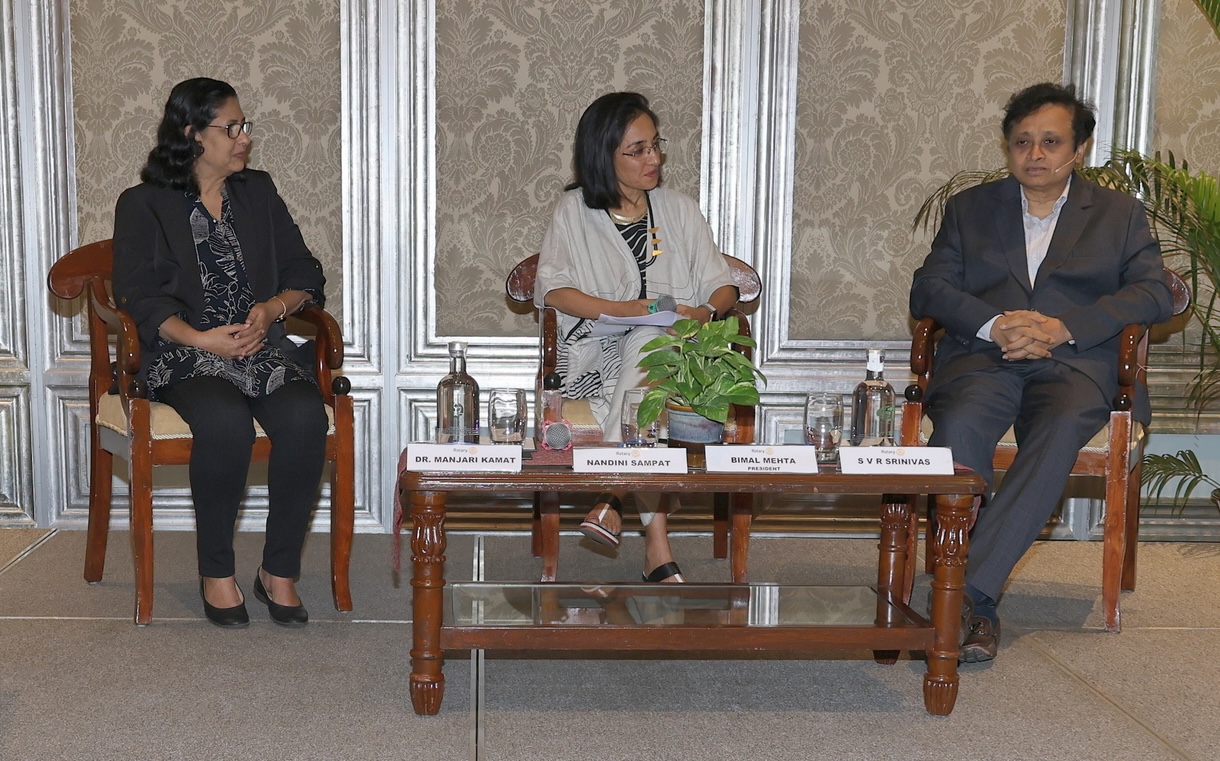
Mr. S.V.R. Srinivas, Dharavi Redevelopment Project CEO, IAS, and Dr. Manjiri Kamat, Professor of History, University of Mumbai, in conversation with Rtn. Nandini Sampat on Progress with Purpose: Balancing Mumbai’s Rich Heritage with a Sustainable Future.
Rtn. Nandini Sampat:
First, let me say it is our absolute pleasure at the Rotary Club of Bombay to welcome you both this afternoon for a thoughtful and forward-looking conversation that explores the possibilities that emerge when heritage and development are not at odds, but in meaningful dialogue.
To set this panel off, a bit of background: by 2050, Mumbai is projected to become home to over 40 million people, driven largely by the steady migration of those seeking opportunity in the city. This demographic surge will dramatically alter the urban landscape, expand the built environment, shrink open spaces and wetlands, and place unprecedented pressure on housing, transport, and civic infrastructure.
At the same time, it opens up opportunities to rethink how we grow — to catalyse economic dynamism, create more inclusive urban systems, and build a resilient city for future generations. Yet, amidst this transformation, Mumbai’s soul — its historic architecture, cultural traditions, and richly layered neighbourhoods — must not be lost. From colonial-era institutions and industrial precincts to chawls, markets, and cosmopolitan ethos, the city’s heritage is not a burden, but a foundation.
The question before us is not whether we grow, but how we grow. Can we design a future that safeguards our past? Today, we are privileged to have two exceptional minds with us — one who understands the city through the lens of its past, and the other who is actively shaping its future. Welcome, Dr. Kamat and Mr. Srinivas.
I’ll start with a question for both of you. It’s a combined question. Migration has always shaped Mumbai. As we look towards 2050, how do you both see the city’s character evolving with another major demographic shift? As the city prepares to absorb these millions of people, what must we preserve, and what must we anticipate?
Dr. Manjiri Kamat:
Thank you very much for having me here, and congratulations to the Rotary Club, which is celebrating its 96th year.
Mumbai has been a city of migrants right from early times. If one looks at the subsequent censuses during the colonial period, we see these bursts of growth at certain intervals. So, this isn’t the first time we are facing the challenge of migration — and space has always been limited, which remains a reality even today.
How we prepare for it, and what lessons we can draw from the past, is the question. Historically, with every major spurt of migration or crisis, there have been developments in policymaking. For example, after the bubonic plague at the end of the 19th century, the Bombay City Improvement Trust was formed. It focused on affordable housing for the poor, road widening, and East–West thoroughfares — just to name a few initiatives.
After World War I, the city saw a tremendous influx of migrants due to job opportunities in the cotton mills. At that time, the Government of Bombay took the lead in starting the Bombay Development Directorate, which planned housing projects — what later became the BDD chawls — and housing for the police. There was also an effort to encourage people to move northwards due to congestion in the island city.
Post-World War II, there was a major influx of refugees due to Partition, which again necessitated a rehabilitation plan. So, this is not new, and since Independence, we’ve seen a continuous increase in population.
What’s needed now is for the government and various policymaking bodies in the city to come together and coordinate. For instance, Charles Correa’s plan for Navi Mumbai aimed to reduce congestion in South Mumbai by promoting industrial and residential development across the harbour. But even today, congestion persists, and that vision hasn’t fully materialised.
We had another golden opportunity during deindustrialisation, when mill lands became available. There were struggles by mill workers. Correa’s plan reserved some land for open spaces, some for affordable housing, and the rest for profitable redevelopment — but unfortunately, that too did not materialise.
So, the lesson for us today is to think holistically: Who are we planning for? Indiscriminate redevelopment — bulldozing the city’s fabric to build towers — is not the solution. The way forward is to plan collaboratively, as has been done in the past, so the city can cope with the pressures of migration.
Mr. S.V.R. Srinivas:
Good afternoon to all of you, and thank you, Nandini, for your kind introduction. I’m happy to be sharing this stage with a historian, because Mumbai’s story begins with history — it was given as dowry to Catherine of Braganza by the Portuguese, valued at 1,000 pounds. That was the “net worth” of Mumbai at the time. Today, of course, we think of it in terms of five-star hotels, but that was their valuation then.
Coming to the current context, migration is an inexorable phenomenon, with its own internal logic. We have an empirical example in China, where attempts were made to stop migration under Chairman Mao, but they failed miserably.
Migration is inevitable. It happens at the rate of 250 families per day. By the time we finish this session, 20 families will have settled on Mumbai’s footpaths or in slums. Mumbai is uniquely distinguished by having an institution called the ‘slumlord’ under the Act, officially recognised. It is the only city in India where this is the case.
So, what is to be done?
As Dr. Kamat rightly mentioned, we can’t just bulldoze our way into the future. Contextualisation is critical when approaching development. One solution I’ve long supported — but which has yet to materialise — is affordable rental housing for migrants.
Globally, cities like London and Singapore have robust rental housing systems for migrants, managed not by governments but by Section 8 companies. This should be implemented here. It would help ensure that the city remains liveable while also supporting economic growth.
Cities are engines of economic growth — urban areas today generate 60–70% of GDP. 70% of electricity consumption and product consumption happens in cities. Look at infrastructure — bullet trains, airports — all are focused on cities, not rural towns.
So, migration cannot be stopped. We need to manage it. Regarding the earlier question on high-rises, there is indeed a serious academic debate. Many planners and architects argue that high-rises are a necessary solution for megacities. Books have been written by senior scholars on this subject.
A similar debate occurred in mid-20th-century New York, between Robert Moses and Jane Jacobs — how should cities be built? It’s an ongoing debate, and I welcome it. I think this is a great starting point. Thank you.
Rtn. Nandini:
Thank you. I think both of you raised important points about how we take on the challenge of accommodating millions of new residents. Migration has always shaped this city.
Dr. Kamat, I’d like to return to you. You’ve written about Mumbai’s chawls, markets, and mixed communities, which truly embody the city’s spirit. In your view, what risks does rapid development or redevelopment pose to these living heritage spaces? How can we avoid creating a city of just memories?
Dr. Manjiri Kamat:
Thank you. That’s really the challenge for all of us — how do we maintain that delicate balance?
Mumbai’s identity is deeply tied to its markets, festivals, and the organic fabric of the city. As Mr. Srinivas mentioned, this requires discussion and debate, as indeed took place in the 1930s and 40s among architects. Professor Mariam Dossal has written about this in her book Theatres of Conflict, City of Hope.
There was an active debate, which appeared in the Journal of the Indian Institute of Architects, but somehow, since then, we don’t seem to have that kind of discussion anymore. It’s important to maintain these identities. It’s not to say that we must preserve every chawl, but some buildings can be repaired. For instance, in Mumbai Central, there is a Parsi colony with verandahs that a distinguished conservation architect has restored, maintaining that sense of history and heritage.
One of the issues we face now is that, irrespective of whether a building can be repaired, there is a push towards redevelopment and the construction of high-rises. Of course, in a city like Mumbai, where space is limited, high-rises are a way forward. But what’s concerning is that this is being seen as a homogeneous solution across all neighbourhoods.
That’s where we need to be careful. Precincts like Khotachiwadi or the villages of Bandra are part of the city’s heritage and history. For tourism as well, we may not be able to retain such precincts if redevelopment is indiscriminate. That’s where my concern lies.
If you look at New York or any major city, there are proper avenues and guidelines where high-rises are planned. But what we’re seeing here is haphazard development. I live in the Opera House, and from my balcony, I can see buildings coming up in all directions with no coherent plan. This affects the skyline and poses enormous risks — especially in the event of a natural calamity.
What’s necessary is dialogue, as Mr. Srinivas has said — among policymakers, but also involving citizen groups. There needs to be holistic development. There are spaces where high-rises are appropriate, but there are certain heritage precincts or housing societies, such as those in Bombay Central, that should not be indiscriminately demolished. Doing so brings its own set of problems — pressure on land, ecological impact, water usage, traffic, and parking — all of which must be considered. A more holistic approach is the answer.
Take markets, for example — Crawford Market, now Mahatma Phule Market. With restoration, we can preserve and still admire the heritage of such spaces rather than getting rid of them altogether. Adaptive reuse of spaces is a viable way forward. Take the Lalbaugcha Raja — the Ganpati that is globally known. It’s a part of Mumbai’s heritage and culture. Festivals like this, which are intrinsic to the city, must be preserved as well.
Rtn. Nandini Sampat:
As we know, old buildings have embodied energy, and there are so many ways to adaptively reuse them for what they can become.
Coming back to you, Mr. Srinivas — looking at this balance, and knowing you’ve done extensive surveys and conversations with people during the Dharavi Redevelopment Project — can you talk to us about how that process has been? How are you balancing the idea of Dharavi as an economic engine, a social network, and a cultural landmark?
S.V.R. Srinivas:
Yes. First, on the question of heritage, while we must preserve it, I like the neo-classical economics sometimes, it offers useful insights. It’s functional and utilitarian. If I asked 100 people here, “Would you prefer ₹10 lakhs or ₹10 crores?”, everyone would choose ₹10 crores.
So, if I own a heritage building and it’s at risk of being declared as such, I may want to demolish it as soon as possible and rebuild. That’s a classic example of what economists call market failure — markets don’t naturally work in favour of preserving public goods. In economics, a public good doesn’t mean charity — it means something whose benefits are shared broadly.
This is where government intervention is critical. It is already happening, but needs to be more robust. Buildings must be declared and graded for heritage value. That’s ongoing and needs to be revised and enforced thoroughly. Heritage precincts must also be preserved.
However, there’s a generalisable market logic. Even private individuals sitting here — if you own a two-storey building and it’s retained, how are you compensated? There must be a mechanism, perhaps in the form of heritage incentives. Some things, like the façade of the Taj Mahal Hotel or Marine Drive, are invaluable. There’s no price you can place on them — they must be preserved at all costs.
Regulations must be comprehensive. At the same time, we have to consider the interests of stakeholders, including property owners. There needs to be a trade-off between those who own the buildings and the public that benefits from preservation.
Another point is the haphazard nature of current development, like in Tardeo. Whenever we give additional FSI or allow high-rises near heritage precincts, there needs to be a price tag. That isn’t currently built into the rules.
Functional arrangements are often lacking — for instance, parking. We continue approving buildings without adequate parking provisions. That’s an urban planning issue now, but in time, it will become part of the city’s history.
Coming to Dharavi — continued dialogue is essential, at different levels. We’ve set up grievance mechanisms. That’s what we’re trying to do in Dharavi. It’s a separate project and deserves a longer discussion, so I’ll focus just on the dialogue aspect for now.
Dialogue is happening through media, social media, digital outreach, and physical outreach. Dharavi is the largest slum in Asia with a highly complex fabric. It’s not an easy situation. While we must address it, we also need to ensure maximum stakeholder onboarding. Dharavi is what I often call a “city within a city.” Such a project cannot succeed without participation from residents, the government, the public, and investors.
To make that possible, outreach is being done at multiple levels and through various forms. We know that a project of this scale and complexity — possibly the brownest of brownfield projects — cannot be implemented without broad consensus. I often say it’s like the donkey on the Pedder Road — now we have the Coastal Road — but that donkey could have stopped the whole city! So even something that seems minor must not be underestimated.
We’re also initiating engagement with urban planners and architects. That’s where many ideas will emerge and can be embedded during the planning stage. Recently, we created a conceptual master plan for Dharavi. Detailed planning is about to begin.
Rtn. Nandini Sampat:
That’s what we want to understand. There’s a master planning process and an ongoing dialogue. We’ve also seen extensive surveys conducted across Dharavi, and I believe a lot of technology has been used as well?
S.V.R. Srinivas:
That’s right. This has been the largest survey in India conducted in a single slum — by far the largest. We also created what we call a “digital twin” of Dharavi — for the first time in India. Using technology, we captured master data. GIS, GPS, videos — all embedded. It’s an end-to-end digital solution. You can click on any house on the map and find its background — the people living there, their relationships, their occupations. You get millimetre-level measurements of the structures. It’s a comprehensive database. That’s why we call it a digital twin.
Rtn. Nandini Sampat:
So, looking at and talking about precincts — as both of you have — how do we ensure that the human scale, the cultural practices, and the lived experiences of these historic precincts are preserved? Perhaps you could give us a little insight into how these precincts developed in Mumbai and the importance of their diversity and evolution?
Dr. Manjiri Kamat:
Yeah. So some of these precincts — of course, there are many — I can just mention maybe one or two and how they developed. When we talk of precincts like Khotachiwadi, they are mainly of the East Indian community, and they date back to a much earlier time. Before the British, there were the Portuguese who were ruling the city. So many precincts — even in Vasai or in Khotachiwadi — bear that kind of influence.
Interestingly, if you go there today, there’s a reminder of the plague of 1896, where the Christian community came together and erected a cross. That’s a reminder again of Mumbai’s history.
So, when you talk of culture and cultural practices, it’s not only Saint Teresa’s Church but also the neighbourhood people coming together in a time of crisis and building that, in Khotachiwadi. Again, it’s a distinct type of architecture that you can still see. Getting rid of it and building uniform buildings is going to spoil the whole precinct because it’s rooted in history.
And not just that — there were also places like the Anant Ashram, which is an eatery many of you may have heard of, that served coastal cuisine long before it became so popular. Those things don’t exist anymore.
So when we talk of heritage, it’s not just the stone and the built structure, but, as Nandini rightly said, it’s also the people inhabiting these spaces, the memories they’ve created, as well as the food and the cultural aspects.
That’s just one example. The other is, of course, if you look at the chawls, as she mentioned — and on which I have done some work — they came about as a result of the development of the cotton textile industry.
Nineteenth-century Bombay grew mainly through the trade of cotton and opium, which generated a lot of money. But later, it was mainly maritime trade, the port, and the mills. With migration, people came here from the Konkan, from the Deccan, and later from the United Provinces. There was a need for housing. People didn’t want to travel long distances because it was costly. So they preferred to stay within 10 or 15 minutes of the mills.
That’s how the chawls came up in the mill areas — whether it was Sassoon Mills or Morarji Mills, and many of the big industrial mills. The chawls were in the surrounding areas, which is why that place came to be known as Girangaon.
So one part of heritage is the built heritage. The other part is the cultural heritage. There was a sense of community living. Mumbai saw some of the biggest strikes in India’s and world history right in Girangaon — one of them being the 1928 strike, which lasted six months, and the 1982 strike, which is the longest in global history. That was the last strike.
Yes, the last strike — because after that, the whole fabric of Girangaon has changed. And while we see development making way for the future — a post-industrial landscape, as Mr. Srinivas rightly mentioned — there are aspects, like the community living that Nandini talks about, which we do not see in the gated communities of today. We have lost that.
Along with Girangaon and the chawls, the khanawals were developed. So the companies used to go and have fish cuisine and other local foods. All that, in the wake of the 1982 strike, gradually disappeared.
So, along with the mills and the chawls, there’s community living, the labour movement — and I think we can’t just dismiss that. What Mumbai represents, or what it became in the 19th century, is not just the result of business but also the hard work and sweat and toil of labour — whether in the docks, the port, or the mills. And afterwards, many did not get adequate compensation. Now, of course, we have malls in their place.
But what one is trying to say is: as you rightly said, we need to move forward, but we can’t just dismiss the past.
A textile museum — which I believe is already in process — is going to be important. How are our children going to understand the city’s history? Even if we cannot preserve all the khanawals, we could at least have something as part of this museum, so that people can see it today.
And when I talk about chawls, it’s also about the cultural fabric. I mentioned the Ganeshotsav or the jalsas that took place. Some of the biggest names in Marathi theatre came out of these neighbourhoods — Annabhau Sathe and the poetry of shahirs like Shahir Sable.
So when we talk of Mumbai and its heritage — it is this as well, and not just the stone structures. I think that’s an important aspect which, I now feel, is being pushed under the fabric. But one of the things that could be done — and in some places has been done — is the preservation of some of these chimneys, which are still being maintained in malls.
Now in a few places — I think in central Mumbai, like at Lalbaug — there is again a re-adaptive use of spaces where old mill lands are being converted. Like the ice factory you see here. So I think one of the ways to preserve this heritage is through adaptive reuse. These spaces could be used for restaurants or cultural centres. That would keep the history alive.
Rtn. Nandini Sampat:
Yes, it’s a layering of the city. We see this wonderful historical layering, but also the future being layered. And how do we balance that out?
There’s a wonderful biography from the 1800s, where a young migrant comes to the city of Bombay and narrates his walk through the city. He talks about hearing the tanki wala, the vegetable seller, and the doodh wala. It’s amazing that even today, you can still hear some of those same sounds in Bombay. So there is this auditory transition of memories and history that comes through.
But looking also at some of the technological advances — Mr. Srinivas, I wanted to talk about what you had said earlier: that Mumbai is constrained by history. The history is that it is an island city. But that will be a thing of the past, and now it will connect to the mainland. This was a very exciting project — the Mumbai Trans Harbour Link. Just to understand that — with the historical soul of Mumbai — there is also this engineering marvel which has come up. Can you share with us some of the complexities and the vision of that project?
Mr. S.V.R. Srinivas:
That was once a present when I was working on it — now it’s history. But it opens up a future for Mumbai. In fact, that is by far my most favourite project — until Dharavi came. Now I find Dharavi even more complex, but this was the most complex project I had ever handled. I feel happy to have been a part of it.
About the MTHL — Mumbai Trans Harbour Link — it was done in the record time of four and a half years. Let me give the context. Because good planners and architects always talk about context. Let’s compare it with China’s latest bridge, which is much smaller — about 4.5 km — but it took 21 years to build. Twenty-one years! And this was done in 4.5 years, on the high seas. So that’s the context.
Although it was planned way back in 1967, once the work was awarded, it took only four and a half years to complete. I would have mentioned it even if you hadn’t asked, because it’s related to today’s conversation. It gives me a lot of hope for Mumbai.
As Nandini mentioned, Mumbai’s carrying capacity limits have been reached. By 2050, we are expecting 40 million people. So how many more can the city carry? The real problem was that Mumbai, being an island city, had no scope for expansion. But that is now a thing of the past. Now we have the mainland of India getting attached directly. About two kilometres from here, and in 10 minutes, you’re in the mainland.
That gives me a lot of hope because I see, in the next 5 to 15 years — not very long — maximum development taking place there. Whether it’s commercial, industrial, or residential, that is good for Mumbai.
There is a narrow way of thinking that because the mainland will develop, Mumbai won’t. No — it’s not like that. This has opened up vistas, so to speak, for the development of a new city.
In fact, south of Panvel — that’s what I look at. Mumbai still has its advantages, vis-à-vis Panvel and south of Panvel. This bridge connects two major infrastructures — on one side, the port, and on the other, the airport. And right at the landing point of the Trans Harbour Link, there’s also a Balaji Tirupati Temple coming up.
Yeah. So, the airport is going to start in October, they said. In any case, this is going to start this year, so now you will be travelling much more on that side. So what is going to happen is, as I see it — subject to correction — that a lot of activity, commercial and residential, including office spaces and logistics, is going to come up. And those people of South Mumbai are lucky in that sense, not so much the people of the Western suburbs. South Mumbai, definitely — including Western suburbs — once the new bridge from Worli to Sewri comes up, they can also benefit from this. So the north-south commute will become more or less east-west, which is good for the city, I think.
So that is going forward. There is the transportation mobility part. And the third is, of course, the economic growth of the city. The economic growth of the city will continue, but having reached having mainland of India, the mainland of the state — attached directly, I think it’s definitely going to be a tailwind for the city.
Rtn. Nandini Sampat:
And there was an interesting fact about the amount of steel used, Sir.
Mr. S.V.R. Srinivas:
There are many such facts. See, for instance, the amount of steel wire used in the sea — you can go around the Earth four or five times, you can go up to the Moon and come back. So much steel has been used.
More important is the technology used — it’s called an orthotropic steel deck. That technology is being experimented with in India for the first time. I was worried because there were no parallels in Indian construction history. People were coming from Japan, Korea, and parts of Vietnam.
For the first deck launch, in fact, I was really worried because the size of the bar to carry that — it is equivalent to, or a little bigger than, a football field. That was about 4,000 to 5,000 tonnes. And each of these decks was almost 1,200 to 1,500 tonnes in weight. One fall into the sea of any single one of them — there were 70-80 we launched — would have delayed the project by another 3–4 years.
It was so critical because making it itself was tremendously time-consuming, and the technology was new. Even as I speak, even L&T — India’s largest company — doesn’t have that technology yet.
So there’s a new technology being used, a lot of adjustments. The amount of steel and concrete used — we could have built maybe 10–15 large buildings or bridges. I can quote examples if you want.
It’s a humongous thing. But more than a technological marvel — because see, it’s no longer a technological marvel in that sense — other advanced countries have built similar things. China has built a 33-kilometre bridge. When I went there about six years back, the US had also built a long one.
But the impact it would have — more than that of the Brooklyn Bridge in New York — is huge. Because it has never happened that a city has been connected to the mainland at this scale. The impact it will have on the economic growth of the city is going to be humongous, and in a very positive way.
This project also had a historical connection. The Tata Committee — J.R.D. Tata was appointed by Mrs. Indira Gandhi when she was Prime Minister to evaluate whether the Atal Setu should be built. This was way back in the early ’80s, and he gave a report saying it should be built.
But India is a country where even if the Prime Minister wants something, it doesn’t just happen — because we are such a complex nation. Same with the Dharavi project. It goes back to when Mr. Rajiv Gandhi was Prime Minister. He went to Dharavi and said it should be redeveloped. That was back in 1985 when the Congress party celebrated 100 years. Now it is 2025 — and it is just starting.
So perhaps everything has its time.
Rtn. Nandini Sampat:
So before we close, let’s just lighten things up with one last quick-fire round.
- Chai or cutting chai?
Dr. Manjiri Kamat: Cutting chai.
Mr. S.V.R. Srinivas: Oh my God, coffee. - One building in Mumbai you wish everyone could experience once in their life?
Dr. Manjiri Kamat: The Rajabai Tower and University Library.
Mr. S.V.R. Srinivas: I think Oval Maidan, one should say. - Auto, BEST, local train or metro — your preferred way to get around the city?
Dr. Manjiri Kamat: Metro.
Mr. S.V.R. Srinivas: BEST. - If Mumbai were a person, what three words would you use to describe them?
Mr. S.V.R. Srinivas: It’s beautiful. It’s complex. And it’s cosy.
Dr. Manjiri Kamat: Old is gold. - Complete the sentence: “You’re not a true Mumbaikar until you have…”
Dr. Manjiri Kamat: Experienced the beaches and the bhelpuri.
Mr. S.V.R. Srinivas: Unless you’ve eaten vada pav.
ROTARIAN ASK
I thought Bombay congestion is becoming a bigger conversation. My question is to follow up on what Amitav Ghosh said in his book The Great Derangement. He wrote that due to climate change, sea levels are going to rise and Worli and Marine Drive will be underwater by 2040. Where is the water going to come for these buildings? Are these considerations going into it, Sir? We are happy that slums are getting removed and they are getting proper housing — but what about water? Both inundation as well as usage?
Mr. S.V.R. Srinivas: First, about drinking water — because that is more important immediately. I want to shock you with a fact: Mumbai actually has surplus water. Let me explain — just give me 40 seconds.
We pump about 4,000 million litres per day (MLD). That is how much BMC supplies. The calculation of water requirement is done in LPCD — litres per capita per day. The global norm is 135 litres, and for slums it is 70–80 litres. But even if we take 135, it comes to about 1,600 MLD.
Then industrial and commercial use is about 10%, which is 160 MLD. Add that, it’s 1,760 MLD.
Add wastage — about 10–15% — that’s another 200 MLD. And then add floating population, another 10%. So, maximum requirement is about 2,700 MLD.
But we are supplying 4,000 MLD. So for drinking water, Mumbai is blessed.
What we need for 24×7 water supply is some cross-connections and ESRs — elevated service reservoirs. Water is not a problem for Mumbai.
Rainfall data for the last 100 years shows Mumbai has a 99.999% rainfall assurance. That’s based on 100 years of data. If rainfall patterns change due to climate change, we’ll have to adapt — but in the predictable future, drinking water is not a problem.
The real problem is twofold. I’m not even talking about storm water, because Mumbai is lucky — it has coast on three sides. So it’s easy to get rid of waterlogging, if you have a proper agency. The government is already doing this.
The issue is invert levels — but that can be technically managed. We have tunnels, world-class tunnels built by the British. Their invert levels have to match rising sea levels. So don’t worry — this city will not go under the sea. It can be managed.
But the more serious issue is traffic and roads. If you have 20 FSI, how can the roads take the pressure? You can’t create new roads unless you demolish, which isn’t a solution — it just attracts more traffic. I’m now talking as an independent voice — not a government official. This is going to be a more serious issue. China experienced a gridlock once in Shanghai — we must avoid that.
The key is what Madam said she prefers: Metro and public transport. When I headed BEST, and earlier Mumbai Metro — these two are most important. If that’s done, Mumbai can happen. And again, I come back to Atal Setu — that will help decongest a lot of things.
Dr. Manjiri: Very quickly, I think it’s a very pertinent question that you have asked. Mumbai has one of the largest reclaimed land areas in the whole world. So, while we are doing all this development — and I agree that it’s going to be beneficial for Mumbai — we have to look at its ecological impact, because we saw what happened on 26th July, and we don’t want that happening again. Lastly, I would like to end by saying that the Sealink — or the Atal Setu — is, of course, the pride of the city. But how many Mumbaikars can go there? Can they afford to pay, for example? Now a taxi without a FASTag has to pay ₹200 just to go from this side to Bandra or to the Atal Setu. So, one of the questions to take home today is: the city and its development are very important, and we are proud of it — but it has to be inclusive.