
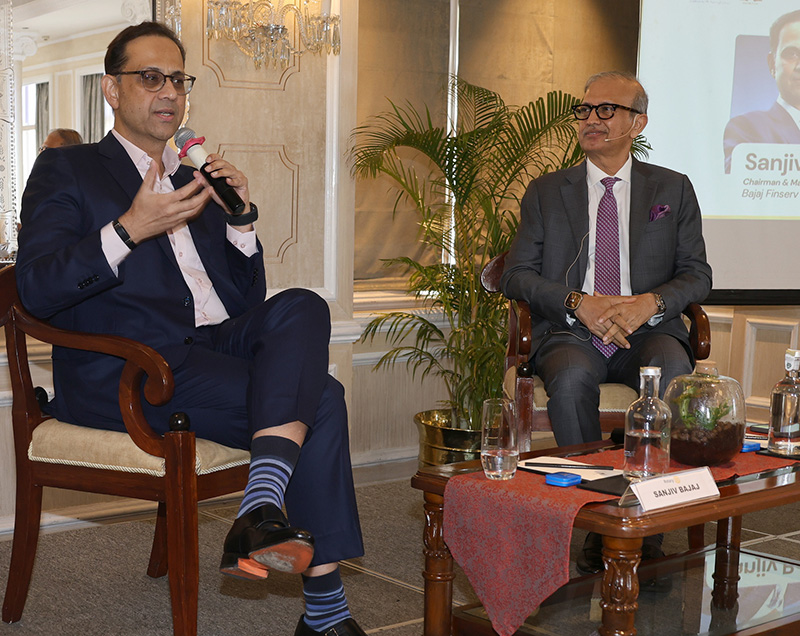
Mr. Sanjiv Bajaj, Chairman & Managing Director of Bajaj Finserv, in conversation with PP Vineet Bhatnagar
PP Vineet Bhatnagar:
So, we’ll start with family businesses. We are seeing that many next-generation heirs prefer to manage family investment offices rather than run family businesses. You have a long history of a family-run business house. How do you think business families can change the scale and scope of their traditional businesses, or even set up new businesses in India?
Mr. Sanjiv Bajaj:
So, Vineet, Uday made this statement a couple of months ago, right? It became a bit of a buzz for a while. I think the more important issue for us to recognise is that about 30 years ago, in a country like India, if you had a significant family business or you came from wealth, access to capital automatically gave you a significant edge over others — people who may have been great entrepreneurs with a great idea, but who had to wait six months outside a bank branch to get a loan to start their business. We were losing out on the entrepreneurial ability of Indians. The venture capital world, private equity and private credit have opened this up dramatically, and you know it from your own business.
To me, India has opened up, as we can see. Look at the current generation of start-ups. You have a Zomato, which is a start-up; you have a Zerodha, which is a start-up by first-generation entrepreneurs; you also have a Bajaj Finserv Asset Management, which is a start-up by an older group. We are on a much more even playing field, which didn’t exist earlier. That is something to be recognised and celebrated, because it is a huge opportunity to unleash millions of Indian entrepreneurs, not just a few business houses that, for whatever past success of earlier generations, had capital.
Now, in such a situation, you can invest in other businesses and give them a lease of life. There’s nothing wrong if a next-generation individual says, “I don’t have it in me to spend 14 hours on the shop floor, deal with the GST authority, run around to get land clearances, or bribe five others to get things done on the ground. I have the capital, and there are ten other people showing the energy — I will support them.” Nothing wrong with that, as long as those ten people exist.
At the same time, you see enough older businesses where the younger generation — myself being already the fourth generation in my family, with the fifth generation having started working — still exhibit the same hunger as those first-generation entrepreneurs.
We’ve had a great era. Forget the current tariff situation — that’s an unfortunate distraction and a reality we have to deal with. Perhaps that’s a separate question. But I think, where India is poised right now, the next 20 years are ours. They won’t come automatically; we have to work to make sure they do.
Well said. So I guess this entire thing of family offices having built reserves, with the next generation looking to reinvest that in other businesses, has the capacity for a multiplicative outcome.
Absolutely.
What are the two most important values or lessons that you must have learnt from your late father, Shri Rahul Bajaj?
Well, many things. There are many things you observe in elders, and you pick up some of those. I’ll tell you what I didn’t learn from him — his aggression and his ability to speak for 30 minutes on an issue that took three minutes! Arunji is here; I’m sure he was a victim of that as well. But more seriously — not only his hard work, but he was a perfectionist in everything he did.
It didn’t matter to him whether it was a small issue or big. I remember once, I must have been in college — a teenager — when I got back home late at night, around 11 or 11:30, at our factory campus in Akurdi, outside Pune. My parents’ room and my brother’s and my room were opposite each other. I could hear a hum later in the night and was wondering about it. As an inquisitive kid, I put my ear to the door and heard him singing something. The next day, my mum told me he had gone to Bombay to be the chief guest at the 125th anniversary of Cathedral, his school, and he was remembering the anthem to make sure he could sing it without a paper the next day.
So, he was very much a perfectionist. What does that mean? He was prepared. One of the things anyone who interacted with him learnt, was: if you were in the room with him, presenting an idea or defending a point of view, you had better be thoroughly prepared — because he was. He never went to bed until he had finished all his reading for the day, and never before 2 a.m. He never left the office until his table was clear of all documents.
Being thorough is something people can tell you about, but when you see it day in and day out, it influences your own methods.
The other quality was humility. While many of the younger crowd may have seen him on television as a very outward, aggressive speaker, he dealt in the same manner with a security guard, a driver, a friend, a politician, or the Prime Minister of any country. He would converse equally with all.
I remember, from the Bajaj Auto days, a small Gujarati restaurant called Mayur nearby, famous for its thalis. We used to go there for dinner once a month. One evening in the 80s — before mobile phones — we finished dinner early, but our driver had gone for his meal. We were wondering how to get home and the restaurant manager was trying to call the factory to arrange another car. Suddenly, my father appeared, having hailed a rickshaw. We all got into it, and he was happily chatting with the driver: “How much do you earn? How is the rickshaw,” because it was a Bajaj rickshaw. He thought nothing of it while the rest of us were still trying to get a car to get home.
The third quality was his openness to listening. As much as he had a strong point of view and spoke aggressively, he loved to discuss and debate. In my case, I listen first, then speak. In his case, he spoke first, but he did listen. Listening is a very important trait, one many of us forget as we get into senior positions.
I see this with many friends and peers — if you get reasonably successful, you often make the mistake of associating that success entirely with yourself, forgetting how much the world conspires in your favour. If you have humility, work hard, listen, and involve others, you are in a stronger position to succeed. These were all learnings that came not from him telling us directly, but from absorbing them.
So these have indeed shaped you and your ways of thinking? Excellent. Let’s move into the most important part of your journey — Bajaj Finserv. With deep roots in manufacturing for the Bajaj Group over multiple generations, what made you pivot to the services sector? We would be very happy to hear your journey with Bajaj Finserv as the largest NBFC in India. I noted in the statistics that it is two-and-a-half times bigger than the next one, with a market capitalisation of ₹5.5 lakh crore. It’s a fabulous story — we’re waiting to hear it from you.
I worked ten years in Bajaj Auto before moving to our financial services, between 1997 and 2007. Around 2005, you could see glimpses of the new India. The economy was growing at 8-9.5%, there was tremendous hope and opportunity. We knew our time had come. Even then, we had seeded a few businesses through Bajaj auto. Bajaj Finance, as it is now called, was then Bajaj Auto Finance, started in the late 80s by my uncle, Deepak Bajaj, to finance our own motorcycles, scooters, and three-wheelers. At that time, banks did not do consumer financing.
We had also started two insurance companies with Allianz in 2001. We saw that if the Indian economy grew at 8–9%, financial services typically grew at two to three times that rate, because you have a much wider reach — your customers are not limited to one sector.
My older brother Rajiv was very much in the saddle at Bajaj Auto and remains passionate about the motorcycle business. I had worked six to seven years there, so I volunteered to do something entrepreneurial and different. Fortunately for me, at least those first couple of businesses were small — Bajaj Finance in 2007–08 had a profit after tax of about ₹25–30 crore — so I could take them and scale them.
Sometimes it is just as difficult to change the engine of a car while it is moving as it is to start something from scratch. Both paths have challenges and opportunities. We saw a big opportunity to be part of India’s larger growth.
We built a simple narrative: can we be the financial life-cycle partner to every Indian, from the time they leave college and start their first job, needing a loan for a home or car, through to buying assets, taking insurance to protect them, arranging health cover, saving for the future, and managing investments? Can we create a set of businesses that, while operating under different regulators and meeting their requirements, still deliver transparency, quality of service, and innovation across the customer’s financial journey? That is what we have been doing for the last 17-18 years.
It’s almost like a Fintech story — the way you started it and the way you embraced and embedded technology into the entire life cycle of a financial services product. Never before had it been done with the rigour and intensity that you applied. It was always at the back of your mind that you had to reach millions and had to use technology.
So that was very consciously done in 2007 when a small team and I moved to financial services. I had come from the motorcycle business, where we had successfully launched our first indigenously designed sports motorcycle, the Pulsar, and were selling it in different parts of the world. I came from an industry where you could have a nicely styled, attractive motorcycle and, when you started it, the roar of the engine — like the roar of a Harley-Davidson — was such that a section of customers were happy to pay a 10% premium for that differentiation.
I could never get that same kind of excitement from rolling out an insurance policy or a loan document. We were minors in a field with large banks, other big NBFCs, and large insurance companies. We were effectively start-ups. The question was: how do we differentiate? We couldn’t do so on pricing because the big players could always undercut us, and price is never a sustainable strategy.
We decided to differentiate on customer service. In 2007, if you were a middle-class family wanting to buy a television, you went in the evening to one of the stores — by then Tata Croma and similar organised stores had just started opening. Credit card penetration was very low, and even those with cards often had very low limits, which they kept for emergencies. So you either had to pay cash for a ₹25,000-₹30,000 television — plasma TVs had just come out — or you needed a loan.
Most people tried, but the store representative, or someone from XYZ Bank, would take your details. The next day, they would send someone to your home to check your risk profile — asking neighbours questions such as does Vineet stay here? What kind of house he has, what car you drove, etc? The information would be compiled into a document, sent to a head office, and two days later you might get a call saying your loan was approved. Then you would return to the store. It was a terrible process.
Technology had just started developing. We realised we could leverage it, and at that time India’s first credit bureau CIBIL was about 5-6 years old, with a database of 20-30 million customers. We knew that in the top 7-8 cities, a large number of customers would be in that database. We decided to check credit against that, and as we built our business, to develop additional tools.
So, from the beginning, we invested in technology and established processes. It took about 18 months to do that. We also realised we didn’t want to be a niche player, so we had to expand across India. Either we had to invest heavily into our own technology platforms, or partner. Very early on, in 2008, we identified an American company called Salesforce — which is today a $250 billion company. They had a cloud-based CRM platform. We worked with them to convert it into a cloud-based loan origination platform, enabling any salesperson, anywhere in the country, to evaluate a customer and offer a loan from their computer or handheld device.
We used technology to improve the customer experience, bringing loan approval times down from three days to three hours in 18 months, and within two years, to 30 seconds. Today, approvals are instantaneous. We approve over 150,000 loans a day, which means over 200,000 applications. During online sales events like Amazon’s or Big Bazaar’s midnight sales, we can receive 100,000 loan requests within 30 minutes.
Building the capacity to handle that volume all the time wouldn’t make sense, so the cloud gives us a huge advantage. All of this started much earlier as a way to offer a superior customer experience, giving people a reason to come to us instead of going elsewhere.
I absolutely agree — never before could you walk into Vijay Sales and get a loan approved for white goods in minutes. Nobody had experienced that earlier, so kudos to you and your team. Now it’s becoming clearer — whether talking about the Pulsar or Bajaj Finserv—the management style, work culture, and human resources required to run a manufacturing company are significantly different from those needed in the services sector. It’s not just entrepreneurial spirit or availability of capital; you had to reinvent how you run Bajaj Finserv in a very different way. Some say you have a distinct management style compared to your father, Rahul Bajaj, and your brother, Rajiv Bajaj. Is that an advantage or disadvantage?
Well, that’s for the world to decide and judge. We are all different individuals, so we have different styles. Some people here, including Arunji, knew my parents well. My mother was very different from my father in personality — he was very outward; she was very reserved. But she could hold an intellectual conversation in the same manner, if not deeper, than he could, and she was very well-read.
I guess each of us developed our own personalities as we grew up under those influences. Whether manufacturing or services, I think in today’s world any business must be globally competitive. We are all consumers — we want the best. Most here probably have an Apple iPhone, maybe some have a Samsung or something else, but you wouldn’t buy something just because it’s Indian, however proud you are of it. We are proud to buy Indian, but it must match the quality of the US- or China-made iPhone.
So you have to be competitive. For Rajiv, my father, or me, more often than not, our goals were the same. Our paths to those goals could differ, based on our experiences, challenges, teams, and personalities.
Nice. And how would you describe the work culture at Bajaj Finserv? Is it levelling up for Gen Z and Gen Alpha talent, who seem obsessed with work-life balance, reject the idea of a 70-hour work week, and sometimes prefer a hybrid or work-from-home format? Are we measuring up?
I would challenge that. I think what we’re talking about is a very small subset of Indian youth. Every start-up is being created by young people working 20 hours a day, and nobody is forcing them — they want to do it. My colleague here funds many of these start-ups, and you’d be amazed at their energy levels. Even Elon Musk, to this day, often sleeps on the shop floor on a sofa.
There are people who are driven and people who are comfortable with their lives. You can choose to be either. COVID presented a unique challenge with a communicable disease requiring isolation for a period. I think Western economies took work-from-home to the extreme for a very long period. At the end of the day, we are social animals — whether at work, with family, or with friends in the evening.
You need social contact. And as much as computing aids — our iPhones — provide us with tremendous news, information, entertainment, and movies, it’s unbelievable. I remember watching Star Trek in the 70s — “Beam me up, Scotty” — and you had those things. OK, now, it doesn’t beam you up, but it does everything else.
These are tremendous aids, but for example, growing up, my wife and I were very clear that every evening, while we could still control them till they were late teenagers, our kids had to be out playing sport with their friends for at least a couple of hours. They couldn’t just be sitting here. They had time-controlled devices. They didn’t have a phone till they went to college — you didn’t need one.
So as parents, it’s for us to draw the line, firstly in what’s acceptable and what is not.
Coming to work, the culture we have tried to create is one where we get the brightest individuals, create an environment where we can support them with the tools, infrastructure, and ideas for them to build business lines, technology solutions, and risk models — whatever they love to do — with a very high level of empowerment.
Across our financial services companies, we are about 105,000 people, and 97% of them will monthly have a set of tasks they have to do. If they do that, they get not only their fixed compensation but also their bonus, broken down 1/12 each month. It’s a very open environment, with mentoring and guidance, but we create a platform for people to do their best.
I have always believed that if you can be an entrepreneur — if you can arrange the capital and have great ideas — that’s the best thing you can do for yourself and your country. If you cannot, then the environment we create is an entrepreneurial one, making sure we get the best out of individuals, and they get the best out of work.
Certain roles allow you to work a few hours a week from home. Certain roles require you to be there, as they are heavily collaborative. I think that depends on the particular role.
One of the things on my mind was how you manage to attract young talent despite being a traditional business house, especially with the entrepreneurial and startup options available. But you answered that by mentioning some of those things.
The published data shows that about a third of lending last year was carried out by NBFCs which means the asset base for NBFCs in India is growing faster than that of scheduled commercial banks. According to you, do we need more NBFCs or new banks for greater credit penetration in India?
Firstly, the reason NBFCs have grown so much is simple — India has grown, so the need for financing has grown. The RBI doesn’t easily give bank licences but gives NBFC licences more readily. That’s why people have taken those licences and grown them.
Today, as Bajaj Finance — an NBFC — we are larger than most banks in the country. We do 80% of what banks are allowed to do, with some lines restricted, and we compete with all banks in the country. To the RBI’s credit, the supportive environment they’ve created for NBFCs allows good, disciplined NBFCs to grow.
As the economy grows, we need to channel our domestic money into financial flows to support it. In the developed world, it is common for long-term projects to be funded by insurance and pension monies, because that’s long-term money collected for long-term deployment. Banks don’t usually do that — they take care of short-term needs, first-time borrowers, SMEs, and youth.
Once you are an established business, you go to the corporate debt market. But those markets still need to develop in India. Our big challenge is that as the real economy grows, the financial services economy must grow to support it. Otherwise, we risk a repeat of what happened in Southeast Asia in the late 90s — tiger economies growing mostly on foreign capital, which disappeared one day, leading to a decade-long slowdown.
We don’t want to be in that situation. Hence, yes, we need many more banks and many more NBFCs. And when I say that, people think we want a bank licence — we don’t. We are perfectly happy being an NBFC. But the country needs more high-quality lending institutions.
Insurance companies are a good example. When insurance opened to the private sector in 2001, you had four government general insurance companies and one life company LIC, each with about ₹10,000 crore turnover. Now that number is close to ₹300,000 crore. Their market share now has fallen by about 40%, but their absolute size has grown dramatically in 20 years compared to the first 50 years.
Competition and a growing economy do that. We must ensure our domestic financial services sector is not only robust but also large enough to keep pace with and support the real economy.
Is it true that — though I’m not sure about the other NBFCs — Bajaj Finance has come up with a proprietary CIBIL-type score for assessing an individual’s creditworthiness?
Very much so. We use multiple sources of data, including our own. We process four to four-and-a-half million loans a month, with 65-67% going to existing customers. We have about 80 million customers on our app, each with between one and 40 different financial products — not just loans, but also insurance, mutual funds, fixed deposits, and payment products.
We invest significantly in data analytics and AI at the back end, which supports our ability to evaluate risk and offer these financial products. Remember — it’s very easy for risk to say “no.” Lending and insurance are risk businesses. It’s also very easy to give money away. But in consumer loans — say an 18-20 month loan of ₹30,000-40,000 — you don’t make money till the last payment comes in. One missed payment can turn that into a loss because of how competitive it is. That’s why risk assessment must be robust. We tell our risk teams: their job is not to say no — it’s to evaluate and find the best way to say yes.
I remember when I first went to college from school. My friends were getting ₹600 a month pocket money, and in school, I got none. My mother started me at ₹200. I asked for more, and she said, “OK, give me a statement of expenses each month.” After months of trying, I was never spending more than ₹250. She taught me to study my expenses.
Similarly, we focus on studying risk and creating our own models. For each of those 80 million customers, we have a unique risk assessment model.
You were the CII president in 2022-23, so you’ve seen corporate India up close. Do you think India has what it takes to be a world-class product company rather than just a global capability hub?
We already have many examples. The motorcycles Bajaj Auto makes, or TVS, are world-class. We compete with the best Japanese and the cheapest Chinese products globally. Bajaj exports, between rickshaws and two-wheelers, almost two million vehicles a year — nobody is subsidising those vehicles in those countries. They don’t have to.
Go and buy them. I ran exports for four years for Baja Auto before I moved to financial services, so I have some insight into that business. There are so many other products. Look, today for example — Apple — OK, it’s a foreign company, but there are Indian workers there assembling those Apple iPhones. Look at what Pixel is doing with electronics: in seven or eight years, we’ve become a huge electronics manufacturer, not only for India but for the world. Now, a lot of people criticise that and say, no, it’s only assembly, you’re not doing part production. Naturally, it takes time to build the supply chain, but the end quality is the same. Look at my friend Salman, who makes Zodiac shirts — Zodiac shirts are as good as any shirts in the world.
So we have enough examples of Indian companies very competitively making world-class products, and we need many more to have the confidence that we can do that.
Do you foresee any challenges?
There will always be challenges, but ahead of every dark tunnel there is a light. Believe in the light.
I like the optimism. Your wife, Mrs. Shefali Bajaj, is very closely involved in the CSR activities of Bajaj Finance. What is the focus of the Bajaj Group as far as charitable and social activities are concerned?
As a group, of course, we’ve been involved for many decades in a number of social charitable activities. We’ve stayed low-key, but in recent years we have faced some pushback from people saying, “You guys do nothing,” because we are low key. We don’t talk about it, and it’s become a disadvantage.
So now we publicise it a little, but we are shy about doing that. About four years ago, as a group, we said — OK, can we focus on one big thing? Because India needs support in so many areas, and we don’t want to disperse our attention and money over too many things.
We had a team evaluate a set of support areas and we narrowed it down to skilling, saying this is a very important need. As someone mentioned earlier, we have enough youth coming out of colleges, but most of them are not equipped to work in a decent company, on a shop floor, or in an office.
So we knew skilling was a big option for us and we’ve taken that as a significant focus across the group — across our companies, our charitable initiatives — and we committed last year, over a five-year period, to skill 20 million youth and invest up to ₹5,000 crore to do that.
We are doing this in various ways. Each of our companies is doing it — Bajaj Auto in its own way, and through Bajaj Finserv, where Bajaj Finance, our insurance companies, and others come together, pooling resources. Shefali, and a team of 40-50 people, with a very bright, energetic CEO, Kurush Irani, run this effort.
We’ve decided to break down our skilling effort into four areas.
The first, which we started independently a few years ago, arose when we realised that as we expanded our businesses into Tier 3 and Tier 4 towns, the local youth were not trained to do the jobs we wanted them to do. From the cities, nobody wanted to go to these small towns. If they went, they did so for a promotion, and within two years would find an excuse to come back.
So we created, for financial services — covering lending, insurance, and asset management — a 100-hour programme: 80 hours of skill training in financial services, 10 hours of spoken English (because many students, while they learn English, don’t speak it at home and are unused to conversing in normal English at work), and 10 hours of attitudinal training.
We realised youngsters needed the right attitudinal mindset; otherwise, when they joined an office and the boss barked orders, they’d be scared and leave in a few weeks.
We now run this programme across 23 states in about 500 colleges, in the final year of study. It has accreditation from NCVT, the government’s skill training body, so students can get credits for taking it.
In small towns, when recruiters come to campus, the hiring rate for students is about 35%, but for those who have taken our programme, it jumps to 65-70%. Interestingly, 70% of participants are girls, and we’ve heard many stories of girls returning months later saying their household income has doubled or tripled and they finally have a voice at home — an unintended but fantastic consequence. So we are expanding on that.
The second thing we decided to do — through our close association with CII, which runs centres of excellence in areas like quality, water conservation, and green building assessment — is to set up the Rahul Bajaj Centre of Excellence in Skilling, in my father’s name. We are building a centre that will house capabilities, knowledge repositories, and programmes.
We already have about 50-75 smaller spoke units around the country, and plan to build 200. These will train people locally, on both the manufacturing side — where, for example, a truck or engine manufacturer will provide equipment for training and jobs — and in services. We’ve tied up with one of the largest hospitality colleges in Switzerland for a centre in Goa, and another outside Mumbai in Thane, to train for the hospitality industry and IT services.
The third area is with NGOs. We’ve identified NGOs working in skilling — particularly for women and people with disabilities — to make them independent, along with another vertical.
We have decided to focus in these areas and build skilling. That is the big focus for us. The second major area we’ve taken up in financial services is around children’s primary health, primary education, and shelter. Our focus has been the youth of today, through skilling, and the youth of tomorrow, who are the children of today.
Brilliant. Brilliant. Outstanding. OK. I have a lot of questions, you have answers for many more, so we’ll do a rapid-fire round quickly. After that, I’ll open it up to the floor. One word, one-line answers are enough.
One hobby you wish you had more time for?
Photography.
Wimbledon or Roland Garros?
Wimbledon. I’ve watched it many times, but never been. The French Open and Wimbledon are two different experiences.
A 27-year-old young talent or a 47-year-old experienced hand?
Whoever has greater hunger and attitude.
Gym or yoga?
Both. One is strength training, the other is flexibility and balance. You need both.
Big parties or a small group of friends at home?
Always a small group of friends.
Engineering or MBA?
Both – that’s what I have.
One book that changed your life?
There is no one book, but I enjoy reading biographies. There are so many great stories from around the world and from all fields — from people in the armed forces to politicians to business leaders. You pick up something about the character of the person and their life. At Harvard Business School, after going through 650 case studies over two years, you enjoy listening to or imbibing a story — that’s what I enjoy through biographies.
Music or movies?
Both. Movies whenever I get the chance. Music is easier to enjoy for shorter periods. These days, when I’m in the car, I’m often listening to podcasts — either an audiobook or something informative — so I don’t get as much chance to listen to music.
Hollywood or Bollywood?
For technical mastery, Hollywood. But when you want to relax — Bollywood. Not to take anything away from Bollywood.
ROTARIANS ASK
Mr. Bajaj, lovely to have you with us and listen to your insightful views. In India, there was no credit or credit card culture 15 years ago, which is now becoming well embedded. The common man is borrowing much more. With a lot of NBFCs, NPAs are increasing. Where do you see this going?
I guess it’s economy-dependent — when the economy is robust, it’s fine, but when it’s stressed, you see more defaults. What is your view on this credit culture and how it’s going to affect life?
I always say that the less debt you take, the better. But the reality is that if you’re running a business, you need a certain amount of debt — you reach a particular size and can redeploy capital.
Secondly, in a growing country with our kind of young demographics, aspirations often run ahead of actual ability or affordability. So a small amount of debt is manageable. That’s why, as part of our risk assessment, we check how much debt the individual already has before we lend, and we monitor that so they have enough money to pay their regular expenses.
Overall, as a country, our consumer leverage, while growing, is still very low compared to the developed world. There will always be cycles: times of exuberance and times of tightness. But overall, NPAs in India are significantly lower than in most parts of the world because we are still a society with a culture of wanting to pay back.
If you go to Western markets, people often feel they are right not to repay. In our case, for example, home loans are typically for 20-30 years, but on average in India, they are repaid in 7-8 years. People don’t want to take debt unless they need it for a specific purpose, and then they want to pay it down quickly. So our repayment models remain very strong.
Sanjiv, thank you for meeting us and, more importantly, for the phenomenal wealth creation by your companies. I’ve been an investor in Bajaj Finance since 2010 — it’s been my best investment so far, and also I’ve been a customer for the last 10 years. The quality of service is amazing. My question — how are you getting your HR right? Because with most banks, RM turnover is high, but with Bajaj Finance, I’ve dealt with the same person for 10 years.
What he hasn’t told you is that if he’s been invested since 2010, his investment is up 400 times. [everyone laughs]
The environment and culture we’ve built focuses on creating leaders for the long term, providing empowerment along with accountability. We push for innovation, focus on saving every rupee for the benefit of customers, employees, and shareholders, and align objectives and rewards for the long term.
As a promoter with adequate control, we can ensure short-term profit chases don’t destroy that culture. But we’re always on a treadmill in a competitive market. Fortunately, in a growing country, the pie is getting bigger every year, which gives us the opportunity to keep growing and to attract people who want to build great businesses.