
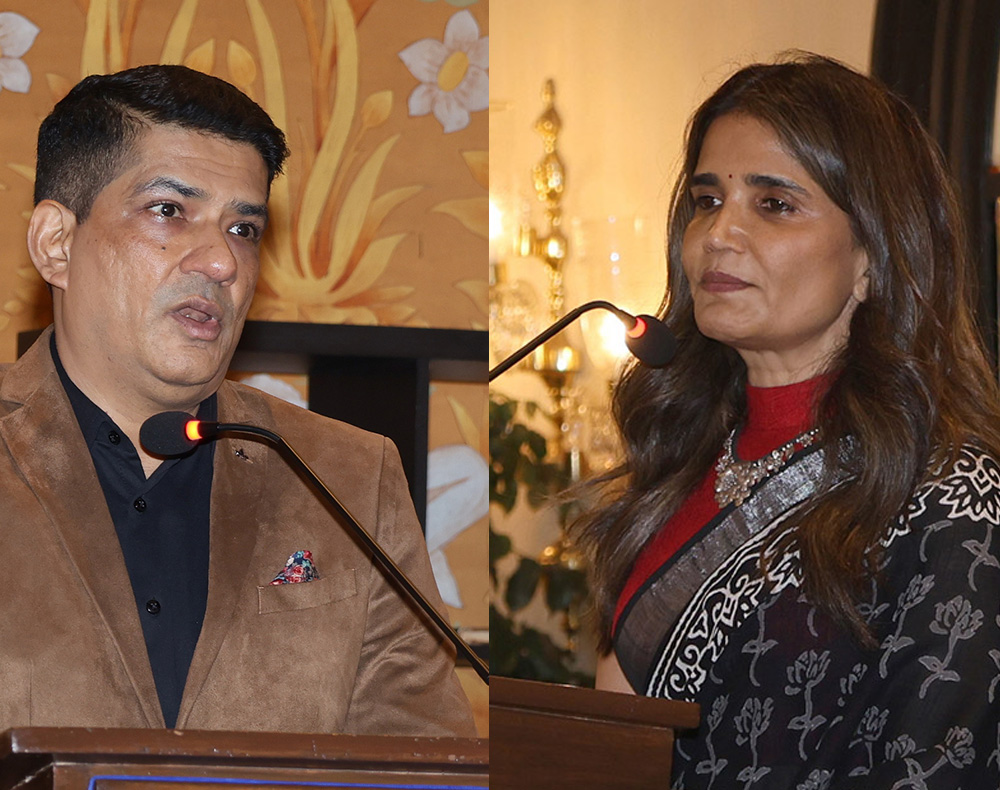
Mr. Yashasvi Yadav, Additional Director General of Police, Maharashtra Cyber Department and Dr. Sheetal Gagrani, founder of Brush of Hope will address the Club on Cyber shield: Protecting your digital world. Click smart, stay secure.
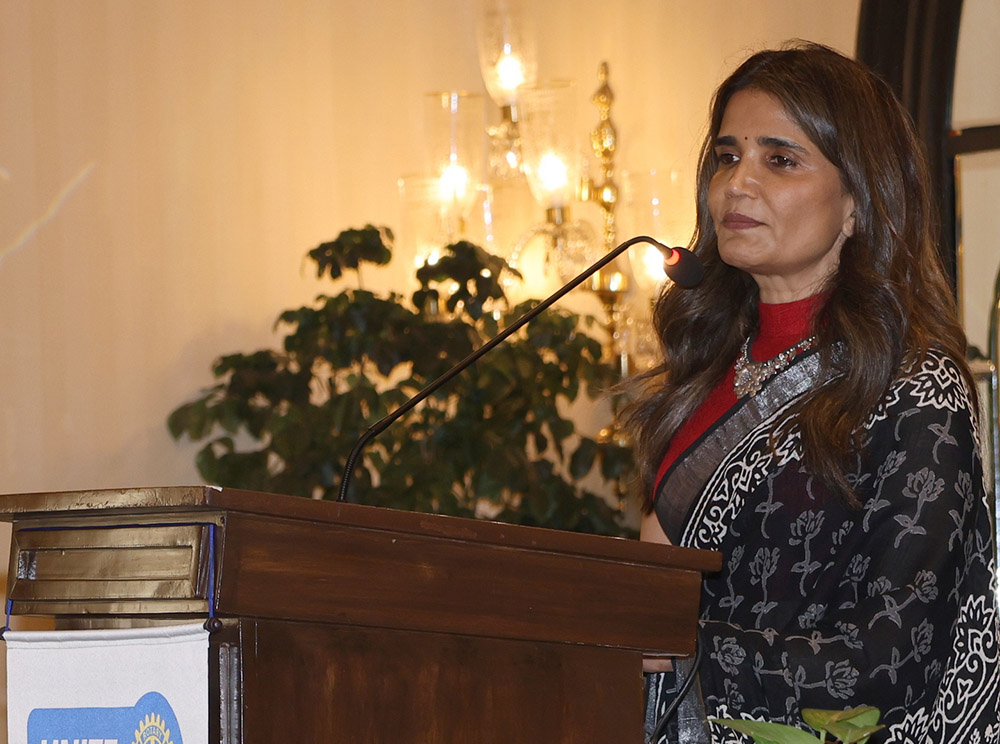
Dr. Sheetal Gagrani, Founder of Brush of Hope
Good afternoon, everyone. Firstly, thank you to the Rotary Club of Bombay for inviting me to this Cyber Shield session, and also for the wonderful work that you all, kind souls, do in serving communities across so many causes.
Cutting straight to the course, we live in an era where our lives are deeply intertwined with the digital world. Our children study, communicate, express, and even define their identities online. But with this connectivity comes a darker reality: the rise of cyberbullying, sextortion, and online abuse. Unlike physical bullying, there are no visible bruises, only silent suffering. And if we don’t acknowledge it now, it could become one of the most serious social epidemics of our time.
My niece, Swara, was a doctor and a COVID warrior. She was a bright and joyful young girl whose laughter could light up a room. But in the digital world, she faced cruelty — the kind that hides behind anonymity. We didn’t know anything about what was happening. She became a victim of cyberbullying and sextortion. Despite being surrounded by love, she felt trapped and alone. We lost her to that darkness.
That pain became the purpose behind Brush of Hope—to give victims of cyberbullying a voice, support, and guidance. Swara was a gifted painter, and she used to paint a lot of hopeful artwork during the time she was tormented. I would like to share something very close to my heart—a documentary by NDTV that highlights the larger issue of cybercrimes in our country, both financial and non-financial. It also features a small part of my story, Swara’s story, showing the devastating impact of cyberbullying and reminding us of that compassion and timely action are essential.
As I mentioned, Swara was a doctor. On the 15th of March, her NEET-PG results came, and she did very badly. We were consoling her, saying that it was just an exam and not the end of the world. And on the 20th, she left us. After she left us, I saw a strip of lithium in her room, and I thought that perhaps… we had the worst experience of our lives. It was a case of cyberbullying and sextortion. It was a dark case — a series of fake accounts, fake IP addresses. The perpetrator was an educated person, doing an MBA from a prestigious institution, yet committing such a crime.
As I often say, a crime is a crime, regardless of who commits it. India is, unfortunately, becoming the sextortion capital of the world.
These are our raw wounds laid bare before you, and from them Brush of Hope was born.
At Brush of Hope, we bridge the gap between awareness and action. We connect victims with counsellors and legal advisors, ensuring that no one faces this trauma alone. Our helpline — 022-653-66666 — is the heart of our initiative: a safe and confidential space where everyone can reach out for help or simply to be heard.
The Brush of Hope call centre was launched on 7th March 2025 under the able guidance of Mr. Yadav. Many of you witnessed the launch of our helpline number then. I repeat — 022-653-66666.
At the Brush of Hope call centre, we function on the ethos of empathy from the very beginning. Every call is answered by trained psychotherapists who know how to communicate with care.
Since the launch of the helpline, the impact has been remarkable. We have connected with over 4,500 individuals, handle around 13 calls daily, and have successfully resolved 43 critical cases, including two FIRs and 12 cases of police intervention.
Our school and college awareness programmes have reached over 20,000 students, teaching digital empathy and online safety. These sessions are conducted by my co-founder, Rupal Kanakia, in collaboration with Maharashtra Cyber, under the leadership of Shri Yashasvi Yadav. Together, we ensure timely and holistic support, combining emotional, digital, and legal assistance.
I would like to sincerely thank Shri Yashasvi Yadav for his constant guidance and unwavering support since the inception of Brush of Hope. He was one of the first people to tell me, “Madam, you should come out with this story and do something about it.”
As our journey progressed, I realised that support must not only exist — it must also be accessible to all. That’s how the Brush of Hope digital ecosystem was created — a space that connects technology with human care.
At its centre is the Brush of Hope app, where anyone can reach out instantly for emotional, technical, or legal help. Our AI-powered chatbot, Hopebot, offers 24×7 guidance, and our revamped website serves as a one-stop destination for awareness, reporting, and assistance. You can scan the QR code on the screen or find the app on the App Store and Play Store.
Everything we have built — from our helpline to our awareness programmes and digital ecosystem — has been possible because of people who believe in this mission. But there is still so much more to do. With your encouragement and support, we can reach more schools and expand our support system for victims of cyberbullying and online abuse.
You can visit our website, brushofhope.line, to support us and be part of this journey.
Cyberbullying cannot be fought by one organisation alone. It needs a collective effort built on awareness, responsibility, and compassion. As parents, educators, and professionals, we must talk about it — at home, in schools, and in workplaces. We must teach our children that empathy online matters as much as kindness offline.
If we remain silent, the problem grows louder. But if we speak, act, and support — we save lives.
Thank you.
Mr. Yashasvi Yadav
A very good afternoon to all the ladies and gentlemen present h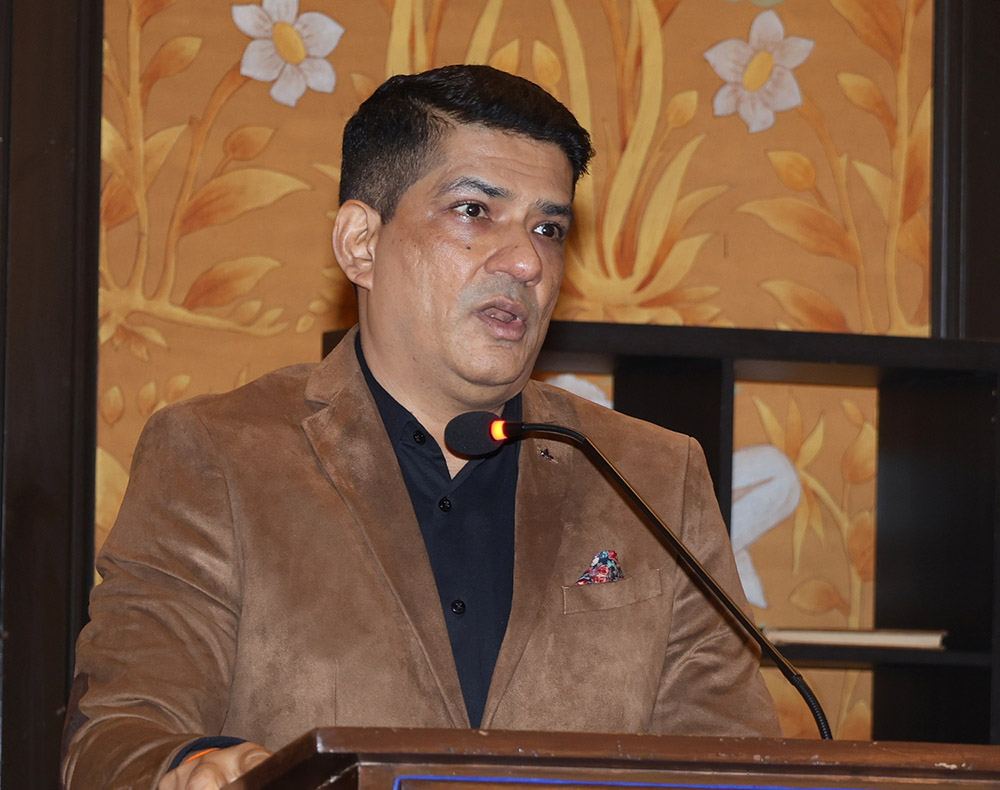 ere. When Mrs. Deora came to me requesting this presentation, I had only one request for her: call as many people as possible, because cyber awareness is the best defence against cybercrime.
Cybercrime is looming large, as we just heard in the poignant tale of Swara from Mrs. Gagrani. Cyber awareness could have saved her life. This presentation, therefore, can save lives, money, and reputations.
A few days ago, Mr. Akshay Kumar attended our police function and recounted a story similar to Swara’s. His own daughter was subjected to sextortion. However, they handled it privately, and the case was never reported. That means the cybercriminal is still somewhere in cyberspace, trying to scam, attack, or exploit netizens — and that is the real worry.
I also want to tell you that cybercrime today is the numero uno organised crime syndicate in the world — nothing else comes close. You might think of narco-trafficking or films like Narcos, but they are not even in competition. Cybercriminals are laughing their way to the bank. Why? Because we, the so-called elite and educated section of society, are still not fully aware of cybercrime.
To make this interactive, I’ll ask a few questions. Are you aware of the Cosmos Bank Heist? How many of you have heard of it? Only one or two? About ₹100 crores were siphoned off by criminals with just a click. Imagine if a gang of armed robbers stormed a bank physically with guns or AK-47s — the government would fall, and officers like us would lose our jobs. But in the cyber world, this happens regularly, with impunity and little awareness.
Let me give you another example. All of you must have nice smartphones — Samsung, iPhone 16, etc. Do you know how many features a modern supercomputer-based phone has? About 1,11,000. Yet, as netizens, we use on average only 50 to 60 features — almost negligible utilisation of the supercomputer in our palms. This large, dark, unexplored area is being exploited by cybercriminals.
Today, I’ll show you two demonstrations. The first is about deepfake videos. Who’s the volunteer? Oh, she doesn’t even know! With just a few seconds of work, the video will be transformed — she will be made to speak anything, with perfect lip-syncing and other realistic effects. This is what we call a deepfake video, and it is troubling law enforcement agencies a lot. Recently, we had a case involving actress Rashmika Mandanna, where a fake, obscene video was circulated. It was a deepfake, and when we issued her a certificate verifying that, it provided her some relief.
The second demonstration will be even more interesting — live hacking of a phone. Any volunteers? Ah, we have one. Can you please give us your phone for a few seconds? You’re a brave man, I must say. This is just a demonstration to show how dangerous it is to hand over your phone to anyone, even for a few seconds. Criminals can take your phone briefly — maybe for 10 seconds — and gain access to all your private information.
Now, let me talk about a malware called Pegasus. I’m sure most of you have heard about it. It’s one of the most dangerous, sophisticated, and expensive malware programmes ever created. Why? Because it’s a zero-click malware. That means you receive a missed call, and without doing anything, the virus gets attached to your phone. Everything — your photographs, messages, WhatsApp, FaceTime — gets copied to the criminal’s system.
How much does it cost? Around ₹8 crore. So, if your private data is worth ₹8 crore, then you’re under threat — provided someone manages to procure it from Israel, where it’s made. However, a one-click malware (which activates when the victim clicks on a link, photo, or message) is available for free. Yes — free of cost. So please, don’t be careless. Don’t click on unwanted links or attachments. A free malware can infect your phone or computer instantly.
Let’s take another example — passwords. They are the most important safeguard for your phone. Even if your phone is seized by the police, if your password is strong, it’s very difficult for anyone to crack it, provided it’s a reputed brand like iPhone or Samsung.
For instance, one of the longest words in English is supercalifragilisticexpialidocious. If you use that as your password, thinking it’s safe, it can actually be hacked in less than one second. Why? Because it’s a dictionary word — no matter how complex or rare. On the other hand, if you create a five-character password like “A*B!x”, it could take around 60 years for brute-force software to crack it. That’s the strength and robustness of a strong password — one of the simplest yet most crucial steps in cyber safety.
Now, I stand here as a representative of the Maharashtra Cyber Police — an organisation that provides a facility no other police department in the world offers. We have two numbers: Dial 1945 and Dial 1930. Why are these numbers important? That’s best explained by one of our brand ambassadors, actor Pankaj Tripathi, in a short film I’ll show you.
He beautifully explains how Maharashtra Cyber has evolved into one of the finest organisations in the world for combating cybercrime. And mind you, I’m not saying “in India” — I mean globally. If you are a victim of cybercrime, all you have to do is dial 1930 or 1945. No other police department in the world offers such a facility. Sitting at home, you can lodge an e-FIR immediately.
Somebody asked, “Kaha par jaye hum cyber crime?” The solution is that while your local police station is there, you need technology, tools, and expertise because this is a highly professional and technological crime. You cannot fight it with conventional means.
This dilemma or perplexity has now been removed with the launch of the helpline numbers. You just have to sit at home. Our brand ambassador, Mr Sharad Kelkar, said it perfectly — “Given that all facilities are available at your fingertips, like ordering food or pizza, why not police facilities too?” It’s so pertinent. We have now brought the police to your fingertips through this number.
So now, we had two demonstrations. One volunteer was unaware herself — this is a deepfake video. It was created in just a few seconds. The purpose of this demo is to show that your data is the new oil. Whatever data you post on Facebook or Instagram is stored forever on some server.
When we do activities like AI art, we give away our facial data, which tomorrow can be used to unlock your phone through face recognition. So, you must be very careful about your data.
Now, what China has done with its Great Firewall of China is significant — they have banned all social media, the darknet, cryptocurrency, everything. They have built their own engines and software, gathering data from around the world, but protecting Chinese data. Ultimately, they will dominate because they have access to the world’s data.
Every Tom, Dick and Harry has data about Indians. I’d suggest you visit a website called Have I Been Pwned. Just type your email address there — it will show how many times your password has been exposed on the darknet. Try it.
Okay, please show the demo in five minutes — I have to finish. It’s a strict instruction. Can you first show the deepfake, and then the live hacking of the phone? Nobody else would have shown you this till now.
Good afternoon. I’m Reena Deora, Programme Chair of the Rotary Club of Bombay. We are really excited to have our ADG, Mr Yashasvi Yadav, who is in charge of cybercrime in Maharashtra. This is such an important topic for all of us today, and we’re eager to hear what he has to share about cybercrime. I’m also curious to know more about the 1945 and 1930 helplines.
“Hi, I’m Reena. Today, I’ve come here to tell you all about a very exclusive deal where you’ll get double returns for your investment. I’ve already received my double returns — now it’s your turn. Don’t forget to click the link to grab this limited offer.”
You are an investment specialist — that’s how data can be manipulated with precision. This is a very basic tool we’ve used. Use more sophisticated and expensive tools. The voice quality will be identical, the lip-sync will be perfect, and very few people apart from experts like us would be able to tell whether it’s a deepfake or a real video.
Give your phone to a hacker for ten seconds, and he can hack it within that time. If he has Pegasus malware, he can do it without even touching your phone.
ROTARIANS ASK
I really enjoyed watching this, though I’m a bit nervous. I bought a phone yesterday from Croma. They took my old phone and offered money in exchange. They kept saying they couldn’t clear all my data and have kept it overnight in a locker. How do I know whether anything has happened to it? Is there any way to check, or should I contact your department?
Mr Yadav: Did you factory reset it before giving it to them?
No, I don’t know what that means.
Mr Yadav: Then you’ve given them the keys to your tejori (safe). If they are conscientious or good people, they may not misuse your data. Otherwise, it can be taken or exploited. I hope the Croma team are good people. But if you suspect anything, come and register an FIR with us — we’ll take action.
How do you make teenagers aware of cybercrime, especially neurodiverse children? And secondly, how would you address a situation where a victim has suffered a cybercrime involving a small amount, but is more concerned about security issues than the monetary loss?
Mr Yadav: Excellent questions. Actually, you’ve asked two. I’ll answer them briefly because I’m getting stares from my panellists!
Firstly, on awareness — that’s exactly why I requested Mrs Deora to invite as many people as possible. These are the forums through which we spread awareness. I’m not being paid for this; it’s simply part of my duty. The more people attend, the wider the word spreads. Social media has a tremendous contagion effect. One of my videos had around five to ten million views — that’s how awareness grows.
We are active on social media. Anyone can reach us. I often ask a difficult question: when you apply for a driving licence, you have to take a test to prove your basic driving ability. But when you buy a powerful supercomputer — which your smartphone effectively is — you don’t need to prove anything; you just pay and start using it.
You must have a basic understanding of cyber hygiene before using it. Otherwise, it’s a ticking time bomb in your hands.
What are the sources for this awareness?
Mr Yadav: All are online. We’re available to conduct courses. The key is desire, willingness, and awareness that these things exist.
Regarding your second question, dial 1930 — earlier we had both 1945 and 1930, but now we’re merging everything under 1930. Dial that number and all your small or big cyber issues will be addressed.