
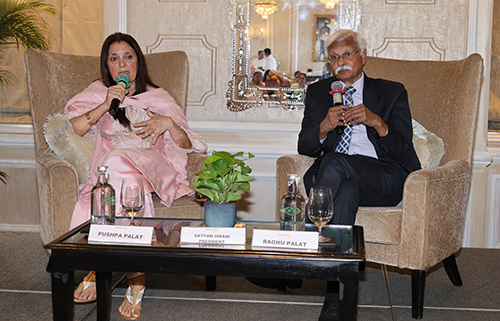
Raghu and Pushpa Palat, renowned authors and historians, on their book: The Case That Shook the Empire: One Man’s Fight for the Truth about the Jallianwala Bagh Massacre
Raghu and Pushpa Palat, renowned authors and historians, on their book: The Case That Shook the Empire: One Man’s Fight for the Truth about the Jallianwala Bagh Massacre
The Case That Shook the Empire has been adapted into a movie by Karan Johar’s Dharma Productions starring Akshay Kumar Madhavan and Ananya Pandey.
RAGHU PALAT: Thank you. Yes. How did it all begin? As was mentioned, we write in different genres. So how did we come to write a history? It so happened that Pushpa wanted to go and pray at the Golden Temple. So we went to Amritsar and we prayed — we went to the Golden Temple, we prayed — and when we were on our way back, I saw a sign: Jallianwala Bagh. I was drawn to it. I wanted to know a little more about it. So we went in. We saw the bullet-pocked wall, we saw the Martyrs’ Well, we saw everything there was to see. Then we went to the museum and as we were going through the exhibits, Pushpa came to me and said, “See this plaque, honouring Sir Chettur Sankaran Nair.” I was quite overwhelmed. I was delighted because, 1) Sir Chettur Sankaran Nair is my great-grandfather, and secondly, it was a South Indian being honoured in Punjab — when not many people even in Kerala knew about him.
So I read about him, and then when we came back, I said, I need to know a little more about him. After all, he is my ancestor. And I started writing about him — because I tend to write — and I wrote not only for myself but for my two children, Divya and Nikhila. I wrote a fairly sizeable article and then showed it to Pushpa. And then Pushpa said, “No, it cannot be restricted to an article — it should be a book.” That’s how it came.
PUSHPA PALAT: Yes, that’s how we started, actually. That was our first attempt at writing together. It isn’t easy, I assure you — working as a husband-and-wife team — but it was our first attempt and our first historical work.
The reason I felt that we needed to write a little bit more about Sir Nair is, well, let me tell you. He was born in a tiny speck of a village called Mankara. I myself had never heard about it. He’s born — and he doesn’t speak. They kept on praying, and finally, the parents went to Palani, and then at five, the boy starts speaking. His first words. He speaks, but he cannot pronounce the sound “R” — and his name has an “R” in it: Sankaran. He couldn’t pronounce it. And that fault in his speech remained all through his life. All very well — you manage. But this person goes on to join a profession that requires effective speaking, that is dependent on speech. He becomes a lawyer. Not just an ordinary lawyer — he is brilliant. He becomes the first Advocate-General of the Madras High Court. He also becomes the youngest President of the Indian National Congress. And, as Sir C. P. Ramaswami Iyer at that point said, he was the most powerful Indian of his time.
Then that’s not enough — he goes further and becomes a member of the Viceroy’s Council. Now, this is the highest he could possibly get, I guess. So, he does all this, with all this effort — and he gets right up there. And then he decides — that’s it. I don’t want it. I’m resigning. And he resigns from this position of power, this high echelon of the government. The reason he does so is because he hears about the Jallianwala Bagh massacre.
Now, when the massacre occurred, the borders of Punjab were immediately sealed. Nobody could go in or out of Punjab. Not just that — all press was banned. There was no press, except for one English newspaper — and obviously it put out British propaganda. So no news came out. And he’s in what might be termed the Central Government of India at that point — and he didn’t know. Slowly, people started escaping Punjab, and he got to hear about this. The minute he got to hear — he didn’t waste a minute. Literally, he resigned. He resigned as a member of the Viceroy’s Council. And the reason he resigned is because he said, “I cannot be part of a government that treats its people in this manner — in this atrocious, cruel manner.” So that’s why he left. He decided to resign.
RAGHU PALAT: And when he resigned, it sent shockwaves through the entire country. Because here was a person — the only Indian in the Viceroy’s Executive Council — resigning voluntarily, in disgust at what had happened. And the effect was immediate. Within two days, press censorship in Punjab was lifted. Within a week, martial law was lifted from Punjab. And the shock of this resignation even reverberated in the halls of Whitehall in England. The Secretary of State for India, Sir Austen Chamberlain, instructed the Viceroy, Lord Chelmsford, to find out what had actually happened in Punjab. And that was how the Hunter Commission was instituted.
The result was: Major General Reginald Dyer was found to be unfit for office and was made to resign from the army and go back to England. And the Lieutenant-Governor of Punjab, Sir Michael O’Dwyer, was also dismissed and sent back to England. So, both these people were sent back.
PUSHPA PALAT: Yeah. Then, now he’s done all this. But that is not enough for Sir Nair. He now goes and writes a book called Gandhi and Anarchy. And here he documents that he holds the Governor, Sir Michael O’Dwyer, responsible for the massacre. And the reason he says that is because if the Governor had not supported and backed General Dyer, there was no way General Dyer could have had the audacity to massacre these innocent, unarmed men, women, children — babies — with such impunity. The Governor was in charge of the Punjab. The buck stops with him. So he blamed the Governor, Michael O’Dwyer.
Now, Michael O’Dwyer at this time was in disgrace. He had been sent back to the UK, and he was there in disgrace. And then he got one copy of this book that Sir Nair had written. And he decided that maybe this was an opportunity for him to gain back his reputation. So, he files a defamation case against Sir Nair. And then says that if you apologise, then I will withdraw my case. Now, if you’ve read the book or you’re going to read the book, you’ll realise Sir Nair wasn’t one to apologise. He refused to apologise. So, Michael O’Dwyer files a case — but not in India. He files it in London, with a British jury and a bigoted English judge. He goes ahead and files the case.
And this gentleman, Nair — who had not thought twice about giving up his position in the Viceroy’s Council — thought nothing of fighting a case which took five and a half weeks and cost him, in today’s terms, what would be about half a million pounds. He didn’t bother. He just went ahead and fought it. And because of that, well — you know about the Jallianwala Bagh.
RAGHU PALAT: And the case was stacked entirely against him. The jury — it was 12 Englishmen. When the case was about to take place, Sir Nair had retained a very eminent barrister called Sir Philip Hastings. For some reason — no one really understood — he was elevated and made the Attorney General, and as a consequence, Sir Hastings said, “I cannot represent you.” Immediately after that, he retained another very, very eminent barrister — Sir John Simon. And Sir John Simon read through the brief and the case details and said, “You’ve got a very, very strong case.” But then, the night before the case was supposed to open, Sir John Simon sent him a telegram from Paris, regretting and indicating his inability to represent him. Was there a coincidence? I’m not really sure. Nobody has a clear answer to this.
So, as a consequence, Sir Sankaran Nair was forced to take on another barrister who was not as capable or erudite — Sir Walter Schwabe. Sir Michael O’Dwyer had, during the case, eminent witnesses — witnesses who were generals, former viceroys, and very high officials of the British kingdom — who came in their regalia and uniforms, with their medals etc., to give evidence for Sir Michael O’Dwyer. The people who showed the details and shared their testimonies for Sir Sankaran Nair were poor peasants from Punjab. So, he had to resort to depositions from these people. He did get hundreds of depositions, but the judge — being very bigoted — said, “We don’t have the time to listen to all these depositions,” and only 125 depositions were permitted to be read out.
Apart from that, the judge — his name was Justice McCardie — was incredibly bigoted. He would argue on behalf of Michael O’Dwyer and tell Nair’s counsel, “How can you say that this was an atrocity? General Dyer was trying to save the King, the Empire, and he was fighting for the British Empire. You cannot say this is an atrocity.” And he even summed it up by saying, in his opinion, this was not an atrocity.
PUSHPA PALAT: Yeah, but he did all that. And the thing is, those depositions — there may be only 125 of them — but they had collected many, many more. And they actually spoke not only about the massacre but about the amount of cruelties, the atrocities they had to suffer. Now, there are lists and lists in our book — I mean, there’s so much that when we released our book the first time round, people from Punjab, especially from Amritsar, called us, and spoken to us to say they had to stop reading because they were crying. They didn’t know that their ancestors — their grandfathers, their fathers — had gone through this.
I’ll just mention a couple, and you would realise how atrocious the British were with us. You know, there was forced recruitment for the war — alright, a war which India was not even interested in. They made Indian women naked. The women had to sit naked on bramble bushes — thorns — and they sat there under the hot sun in Amritsar. You know, for the whole day — sometimes nights — until some male members were recruited and became part of the army. OK, but there are many, many more. If you read the book, you’ll realise how sad it was.
But the worst of the lot, I feel, was the Crawling Order. Now, the Crawling Order was instituted by General Dyer. And he meant that — there was this very busy lane. There were shops, there were residences, but everybody kind of had to use that lane to do anything — even if you needed to see a doctor. Now, everybody — old, young, sick — it didn’t matter. They had to crawl that whole lane. Crawl it — not on all fours — but on their bellies, like reptiles. And you know what Dyer said? How he justified this? He said, “Indians crawl before their gods. I want them to realise that a British woman — an English woman — is as sacred as their gods.” So they crawled like this.
And there was much, much, much more that was done in Punjab. The movie — I don’t know how many of you’ve seen it — but it’s a very good movie. It focuses on the massacre of these poor, innocent people at Jallianwala Bagh, where they had come to celebrate Baisakhi. So they’ve concentrated on that, and I think everybody who’s gone to see the movie will realise that the first bit of the movie — the massacre — is difficult to see.
Now, if you notice, the movie has been given an ‘A’ certificate. They were informed that if they reduced the brutality, children could come and see the movie — it would be ‘U’. They, in their face, would not do that. They cut out half their audience — and yet the movie is doing very well. But they cut out half the children — half the audience — and they cut it off because they said they did not want to compromise on what you see in the movie in the first few scenes. Because it will make the audience realise at least this much — just a fraction of the pain that those people, those martyrs, went through that day. So therefore, they just absolutely refused to cut that.
Another thing which we were very, very, very happy about is that if you see the movie, you will see that the story — the Jallianwala Bagh incident — and Sir Nair, Raghu’s great-grandfather, has been given all the importance necessary. In so much as the actors — Akshay Kumar is a big star, Madhavan is a big star — their names come at the end of the movie. Normally you will see “starring” first, you know — in this movie you will see it right at the end. That’s the kind of impact the story has had on the actors, the producers, and the scriptwriters. And they have given it this kind of relevance. And that, I think, we’re happy about.
RAGHU PALAT: And I think, you know, as Pusha mentioned, the movie focuses only on the Jallianwala Bagh and not on the Punjab atrocities. And it was directed by a Harvard-educated lawyer — it was his debut production. His name is Karan Singh Tyagi, and he’s done a brilliant job at bringing out both the character of Sir Sankaran Nair and also the impact. And the impact is enormous.
The persons we need to thank for Dharma taking this movie are our daughter, Divya, and our son-in-law, Aditya, who took it to Dharma and pitched it to Dharma. And they — loved the script — and they were all very, very involved. They pitched the movie. They loved the story.
Yes, right through the two and a half years of the making of the movie, they also involved us in the release of the trailer in Delhi, in paying homage to the martyrs in Amritsar, in the making of the movie, music releases — it was a tremendous and wonderful experience. And Karan Johar mentions that this is one of their best productions.
PUSHPA PALAT: Yes, he says it is his best film to date and that Akshay Kumar has performed his best till today. So that is the kind… So, we were very happy that Dharma took it on, and I think it’s a great movie. If you haven’t seen it, try and catch it. It’s still in the halls. It won’t come on OTT until it moves out of the halls, but it’s doing very well — I believe it’s crossed 130 now, which is not bad for a movie which is an ‘A’.
RAGHU PALAT: And I’m really happy that everyone knows Sir Shankar Nair. Even Mr. Prime Minister.
ROTARIANS ASK
Q1: That’s a great movie, Sir, and Pushpa. And from an even greater book. He may have lost the battle, but he won the war. I saw the movie, and it was superb. My question is: how difficult was it to do the research? And is this book going to be rolled out for all school students to read? Because we don’t know about this — this history is so tragic. Yeah. And in the movie he was arguing in Britain, but just now you said that some British counsel was arguing in Britain.
Answer:
RAGHU: First, as far as research is concerned, it was not that difficult. Of course, as a family member, I had access to various people to talk to — plus his two sons-in-law: one is C. Madhavan Nair, who was a Privy Counsellor, and K.P.S. Menon, who was an ambassador to Russia and various other countries. They had written biographies of him. Sir Chettur Sankaran Nair had written his own autobiography, and also the book on which the case is based, Gandhi and Anarchy. The Hunter Commission Report was available. The Congress reports were available. And the case was so sensational that every newspaper had reported it, and so we were able to access newspaper reports from 30th April to 6th June, 1919. Those were the case reports. But we didn’t restrict ourselves only to Indian writers. We read Michael O’Dwyer’s India as I Knew It, and various other books written by English authors — so that we gave a totally balanced view. That was the intent.
PUSHPA: Yes, we knew that he was moving the movie to India. This was to get through to Indian audiences. They had gone and looked for locations in London and those people who helped them also believed that, you know, the two of them, Dyer and O’Dwyer, were well… dash, dash, dash! (laughs) But they decided that in order to have it in Hindi and to reach an Indian audience — and now it’s also in Telugu — they needed to have it here. So they took the whole story but adapted it for, I guess, an Indian audience. And it seems to have worked. It seems to have worked.
RAGHU: And we really hope that everyone in India will read about him and his exploits. You see, up till now, history has been written by the victors. Now we are — that’s what we are trying to do — we’re trying to bring out the Indian perspective and what actually happened. That’s all. Our history books are now being based on that — from an Indian perspective.