
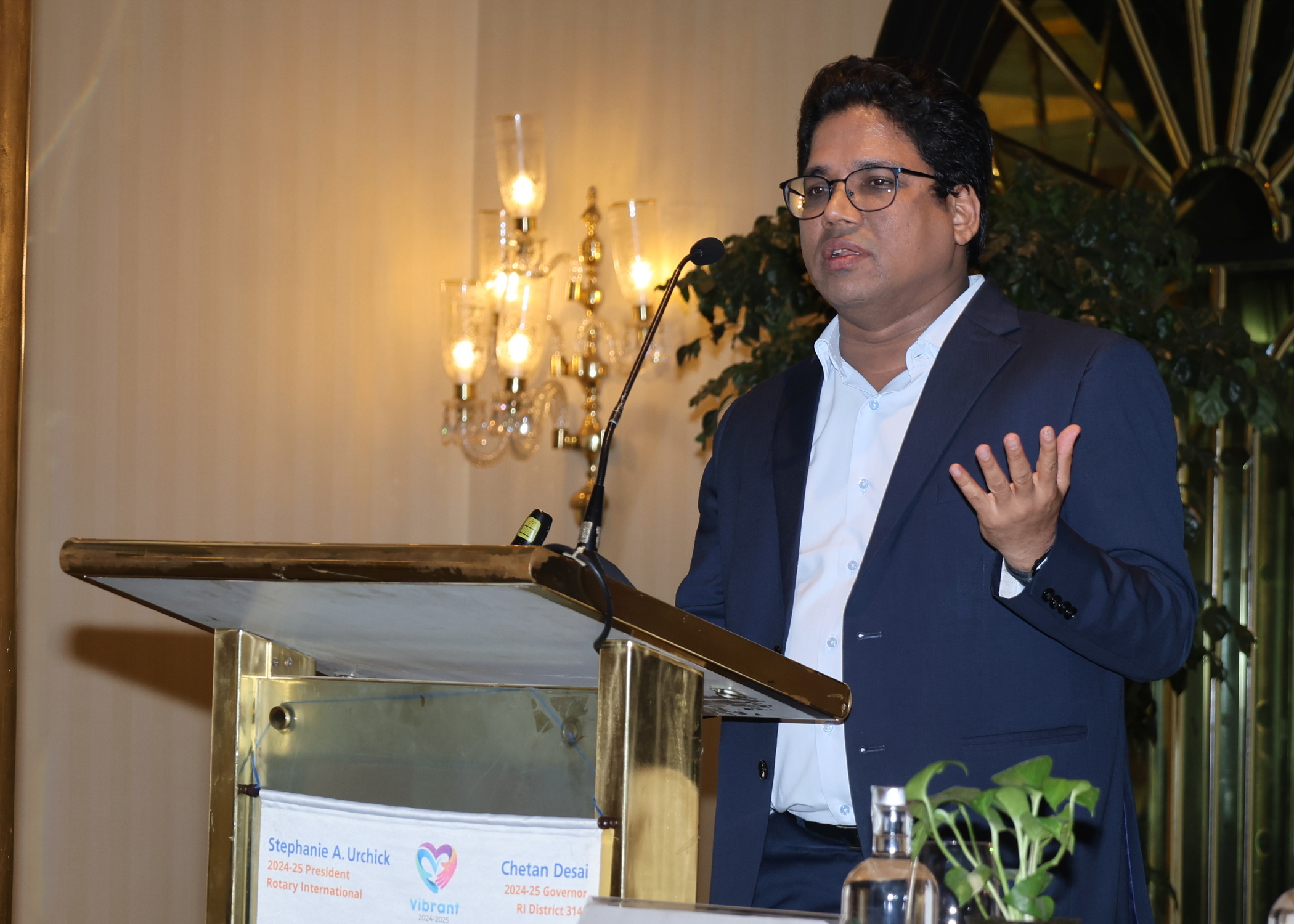
Subahoo Charodia, President and Head of Real Assets Funds Business at Edelweiss Alternative Assets Advisory addressed the club on Energy Transition
Subahoo Charodia, President and Head of Real Assets Funds Business at Edelweiss Alternative Assets Advisory, on Energy Transition
Thank you, everyone, and it’s my pleasure to be here. One of the topics that was chosen and suggested to me was energy transition, and I think the first question that comes to mind — and I thought I’d start from there — is: what does energy transition mean? The world is talking about climate change, but what does energy transition mean? As the word transition suggests, it is moving from the older way of generating and using energy to a newer way of generating and using energy. This involves transitioning from fossil fuel-based energy generation to more renewable sources.
India consumes $1,800 billion of electricity every year, and our energy consumption, due to the growth of the economy, grows by about 6.5% on an annual basis. Our annual consumption of energy, which grows, is equal to the annual consumption of energy in the US. So, on an incremental basis, we are at the same energy electricity consumption rate as the US in terms of annual growth. Their base is much higher — three times what we consume in terms of electricity—but the growth is smaller. So, we are talking about very high growth in energy consumption, and the question is: where is this energy going to come from? Because I think, as the government is focussed on saying, “Let’s not do more nuclear power plants across the world,” or “Let’s not do thermal power plants,” so, where is this energy going to come from? Therefore, it is leading to a lot of opportunities to look at investing. However, I think investing needs to be cautious.
So, a lot of things will look exciting in the energy transition space, but some of them are more like venture capital. There will be venture capital investments in energy transition, where new technology is being developed. There are growth opportunities in energy transition, where there is already established technology or a manufacturing player looking to grow further. There is asset-based energy transition such as renewable power or storage which has long-term contracted cash flow. So, there are various modes of how to participate in energy transition growth opportunities. It can be a venture capital route, a private equity route, or a classical yield play, where you buy assets that are revenue-generating and cash flow-generating. So, there are various ways to participate in the energy transition space.
The next slide talks about how various policy initiatives are being implemented for energy transition across the world. Initially, a lot of subsidy was being given by the government to make this viable. But over time, the commercial viability of many of these initiatives has come into its own. We’ve all heard about the PLI scheme of the Government of India, which has been provided if you set up a solar manufacturing plant. But this is what happened in China. The Chinese Government provided a certain incentive for solar manufacturing, and that industry flourished a lot. Now it has become a globally competitive industry. This PLI scheme will make India also competitive in the solar manufacturing space.
So, that is one way to participate: there are some listed companies out there that are doing solar manufacturing and solar EPC as an equity play. But I think we are now at par in terms of the cost of production. Some of these companies are also exporting solar modules to Europe and the US, competing with Chinese solar modules on pricing now. Just to give an example of that, there are other policy initiatives the government has taken.
One of them is that renewable power is being encouraged for generation. The cost of renewable power has now come down. It is actually cheaper than fossil fuel-based power. So, if you were to set up a thermal power plant in India today, renewable power is much cheaper in comparison. And India, being a warm country, has a peak demand during the day unlike Europe and the US, where the demand peaks at night. In Europe and the US, it’s called the duck curve in terms of demand, as demand rises at night and is lower during the day. In India, the demand curve is a peak curve — it rises during the day and comes down at night. Solar, therefore, naturally fits the Indian environment both in terms of where we are located on the equator and also in terms of our energy demand consumption, which aligns with our climate conditions. The same is true for Japan. That’s why there is a stronger focus on wind energy in Europe and the US, while India focuses more on solar, because wind generates more during the night and solar generates more during the day.
Coming to the next topic — there are various opportunities. The government will roll out a plan called 2030 for climate action, with about $800 billion in investments planned within the energy transition space. As I said, it covers new technologies, existing manufacturing growth opportunities like EV cars, and assets that are long-term in nature, such as generation, transmission, and storage. Out of this $800 billion, $450 billion are commercially viable opportunities where global investors like all the global funds or strategic investors are coming into India. Indian corporates are investing, and funds are investing in these commercially viable opportunities. The balance is supported by the government or non-profit organisations, as they are not commercially viable. Still, $450 billion of investment is commercially viable and return-generating.
There are various ways of participating in the energy transition sector. One of them is by looking at assets. Assets give downside protection because you can see the value of the asset. It’s like seeing an office building or a solar plant that has value. You can see a transmission line or a storage plant that has value. So, there is value in these physical assets, and typically, these assets have long-term contracted cash flows.
India has not yet opened up to a merchant market, and that is a good thing. What happened in Europe or the US was that due to the open market and the war between Ukraine and Russia, energy prices went up. The generators and utilities started selling electricity at higher prices, leading to increased energy costs and inflation. In India, the market is regulated. The government decides the price at which electricity is sold. Contracts are signed on a long-term basis so situations like these don’t cause energy prices to increase the way they do in developed markets. In developed markets, the prices are more volatile. But in India, it’s a regulated market. Hence, those assets provide long-term contracted cash flows.
In India, you typically sign a contract with NTPC, which is a good counterparty, AAA-rated in India, and you get a fixed payment for a fixed tariff for 25 years. Or you can sign with SECI, the Solar Energy Corporation of India, and get a fixed payment for the next 25 years. You can also sign with a transmission project, and it could involve Power Grid becoming a collecting agent. So, you get a AAA asset and a contract with visibility of cash flows for 35 years.
The first bucket provides duration, which is very good for those who want stable cash flows for a very long duration. It is akin to a portfolio of long-duration bonds or government securities. It carries a higher risk than bonds but offers that duration to play. Some of these assets in India are now listed as InvITs. I will come to that, which is a vehicle form, and that is what I call the financialisation of these assets in India.
Earlier, these assets were available only to large corporates or foreign funds like Canadian pensions. They were not accessible to the public. But now, in real assets, these assets have been converted into units. In infrastructure, they have been converted into units, allowing individuals to buy units and participate in the cash flows that come from these assets. This is how assets have been financialised into a financial product, allowing investors to participate in an asset class that was previously unavailable to the general public in India.
The second part, which was available and I think has been well known in India, has been private equity play. So, you can invest in manufacturing companies, invest in venture capital, basically new technologies which are coming up, and look at that growth, which is going to happen in the sector. There are many companies including, I think, Gensol, Waaree, and so on and so forth — lots of listed companies that are in this space and doing well. So, that is a growth opportunity, and then this is more of a yielding opportunity.
Return expectation, hence, is also different. So, many of you might see different energy transition funds coming up. Globally, energy transition funds are classified into, as I said, venture capital, equity, and real assets. And the reason it gets classified is that the risk returns are very different. So, on the asset side, you can participate in, again, in different forms. One is that there are funds which do greenfield development. There are some foreign funds like Brookfield, Actis, GGEF, Macquarie, and others who build these assets in India.
How does the bidding happen? The government comes out with the tender, and the people bid for that. So, like in solar, it happens where the government says, “Okay, I want this megawatt of power, and I’m happy to sign a contract for 25 years.” NTPC will sign a contract. Let’s say an example, NTPC will sign a contract. “I will buy power from this power plant for the next 25 years.” Now, you bid for a tariff. So, the developer bids for a tariff. The megawatt is mentioned by the government. The location might also be mentioned by the government or by the person running the bid. You mention at what tariff you will sell the electricity for 25 years. So, you know the revenue you’re going to get for the next 25 years because of that contract if you win the project.
Then the risk is at what project cost you implement the project. What is the cost of that project? And that determines the IRR, right? Because the revenue is fixed. Now it’s only the cost. So, that determines the IRR. And that is therefore called Greenfield Risk. So, the investor takes risk on the execution of these projects, so higher risk. And typically, most of the funds target a return of about 23 to 25%. But you’re not taking a revenue risk. So, unlike in the case of equity or manufacturing where every year the sales need to happen to generate that return, here the revenue line is already contracted. It is more the execution of the project, and at what price you execute the project. So, your revenue line is fixed, but you take the risk on project execution and project cost.
The second play that happens is these are operating assets. So, these are assets that are already having the contract already completed. And therefore they have a set of cash flows coming. And therefore, you don’t take the project cost risk. So, this term is typically used internationally is called Core Infra Equity Fund. Why it is called Core? Because there is no construction risk. So, it’s called Core, right? There is no construction risk. It’s typically bought in Europe, the US, and others. Typically, they are bought by insurance companies and pension funds who want long-term cash flows because that is how their long-term liabilities are. On the other side, there are pensioners. Insurance company liabilities are long-term. So, they want to lock in long-term cash flows. So, they buy these assets.
And then there are funds who buy these assets and give them to the retail investors and HNI investors for the purpose of regular cash flow. So, it’s called an aggregation play. You basically go and buy an asset from a developer. One asset which is operating, another from another developer which is operating. But create a fund vehicle where you pool in capital. Because an individual investor cannot buy this size and scale of assets. Typically, these assets at a utility scale are ranging from ₹500 crores to about ₹2,500 crores in terms of value. So, it is not possible for an individual investor to go and buy these assets. So, that is why these AIFs (Alternative Investment Funds) got formed, which pool in money.
Typically, they get money from institutional investors, both offshore and domestic, family offices, and then ultra HNIs. The typical ticket size in an AIF minimum is ₹1 crore, as prescribed by SEBI. So, anyone who is an ultra HNI can participate. It is not available for normal retail investors. And that fund pools in capital, makes it like a ₹3,000, ₹4,000, ₹5,000, ₹10,000 crore fund, and then goes ahead and buys these assets. Aggregates them, and then lets us sell it as a portfolio. So, we aggregate these assets and then later sell it into the InvIT, which is listed, and this will bring the next product. So, this is unlisted, illiquid, but operating. Compared to Greenfield, it’s lower risk, but still which kind of assets the manager will buy or that fund will buy is unknown. So, you are taking a trust call on basically saying this manager knows what needs to be done, he knows what asset to be bought, and he will deliver the performance, which is expected out of that.
Then comes the next part, which is called private InvIT. Some of the privately listed InvITs in India, there are about 18 InvITs now listed. It is close to about ₹80,000 crore of assets, which are listed in these InvITs, which is roughly about $10 billion of assets. These private InvITs do have participation from mutual funds, insurance, ultra HNI family offices. Now, these are the same assets, but are now put into a vehicle that is listed. Private, basically means it is not allowed for retail to participate. The minimum ticket size when you do a primary is ₹25 crores, but when you do a secondary, which happens on the exchange, the trade is ₹25 lakhs. So, retail is not allowed to participate in that, but these are institutions or large ultra HNIs who can participate.
These are called private InvITs. They are typically in the early stage of growth. So, they are acquiring assets, adding them into that InvIT platform. InvIT is a pass-through vehicle. So, whatever income, just like mutual funds, whatever income is generated by the InvIT, it issues or tax certificates to the investor and the same income is passed through into the hands of investors. So, they are non-taxable entities. It is taxable in the hands of investors, the individual who has invested, or a corporate who has invested. It is taxable in their hand and they get form 64B or C, which basically says what is the nature of the income, whether it is interest, dividend, capital gain, or return of capital. Accordingly, the investor accounts for it in their books. That is private InvIT.
Private InvIT typically generates a return of about 13 to 15% in rupee terms.
So, Greenfield 23 to 25%, aggregation, operating core, infra play about 18 to 20% at a gross level. Private InvIT about 13 to 15%, and then comes public. The more the products become retail, the more the valuation goes up. Just like equities, right? Private equity to a pre-IPO to an IPO and post-listing. So, the valuation keeps going up. So, when it becomes a publicly listed InvIT, the valuation further goes up, and return comes down. So, returns on a public InvIT are expected to be between 10 to 12%. Most of these InvITs currently public are triple-rated. But just to give you a colour, when anyone talks about rating of these InvITs, it’s not that the units are rated. InvITs also have borrowing at the InvIT level. It is the rating of the borrowing. It does represent the quality of the asset underlying, but it is a rating of the borrowing, not the units. Units are not allowed to be rated in India. So, a lot of times there is mis-selling in India, where people come and say, “Sir, you are buying, or ma’am, you are buying a triple-A unit.” Units are not rated triple-A. Units are valued based on cash flows. They are not rated triple-A. The bonds which are issued or the loan borrowed by the InvIT are rated, but the units are not rated. We don’t have a concept of rating units in India.
But you can look at it on a long-term cash flow basis. The other way people look at units, or they get sold in the market, is what is called distribution per unit. So, every year, what SEBI has said is that 90% of the cash flow needs to be distributed out. That is a regulation minimum. So, whenever the cash flow distribution happens, people say, “This is the dividend yield I’m getting.” Now, investors should be careful that when the repayment of this or when this yield is getting distributed, there is a return on capital and a return of capital. As I mentioned earlier, these assets have a 25-year, 35-year life. So, during that tenure, it is a return that has to come. I will also capitalise to come back. So, the distribution annually, which comes in, also has a component of principal that comes back. And all InvITs disclose this.
So, all InvITs do a distribution where they say, “This is income, which is either interest, dividend, or anything else, and this is capital.” Capital should not, in my view, be construed as an income yield. It is a return of capital. So, anytime you calculate a yield on an InvIT, you should remove the principal component and just look at what is the income being distributed by the InvIT, because the capital is a return of capital. Because these are depreciating asset classes. The asset contract life is finite. And that is how the InvITs get evaluated. These are the various ways investors can participate.
What is extremely important when participating in any of these products is to look at the track record. Right, because these are newer asset classes. This was not available in India. This started only in 2017. Global institutions have been participating in this asset class since 2012, or 10, when I think Brookfield came in, and then after that, there was I Squared, CPPIB, CDPQ, Ontario Teachers, Allianz Capital, GIP, and so on. A lot of investors, including KKR, have participated in this asset class, and they’re doing well. But there is money from outside India, and then they invested in India. For Indian investors, it started with InvITs. And the first InvIT listing happened in 2017.
So, now we have a history of about eight years of InvITs and how those InvITs have performed. The second wave started with the funds. So, there are many funds now in India, including ours. There are other fund managers as well. And they have started launching products in India, where they collect money from various individuals or family offices and invest into assets. One of the crucial things is to look at whether they also, in those funds, have a track record or performance. The second part is to look at whether there are institutional investors who have done due diligence. It is easy for anyone to take a call on a fund if there are institutions as investors, because at least that provides comfort that those institutional investors have gone through the whole diligence framework.
I think this is basically what I spoke about. In Greenfield, the return is high. The asset moves from Greenfield, then it becomes operating, then it becomes mature, and then it becomes listed. That is how the lifecycle is. The more it moves toward this, the risk comes down, the returns come down. The more it is on this side, the returns are higher, the risk is also higher. Therefore, there are different strategies to look at depending on the risk appetite and the objective of any investor when looking at their portfolio—whether they want higher returns with higher risk or they want lower risk and are happy with the lower returns.
ROTARIANS ASK
Can you just explain the core revenue model and say an InvIT that fund, say roads and highways, where the money raised goes towards funding the road and highway, and then you get the cash flows? So do you then take a net present value of the cash flows and compare that to what the outlay is and so how do you price that InvIT?
So there are, let me take an example of four different kinds of asset class, right? Transmission, let me take that first. In transmission, the way the bid happens is there is a 35-year sales period. Each year is one number, which is punched by the bidder when you bid for the project. So, a 35-year fixed cash flow is what the asset gets once it’s commissioned. Once it’s completed and it’s operational, it is a fixed amount for 35 years. Now, that fixed amount can vary in 35 years. So it can be an equal amount for 35 years, or it can be a different amount in 35 years, but it is punched in the contract. So you know what you’re getting paid as it is like a rental. What you’re getting paid every year, right? So the best way to value an asset is to look at what price I’m paying, what are the cash flows I’m going to get for 35 years, and hence what is my IRR, internal rate of return. What is the return I’m going to get, right? So you will either do an NPV with a target return. So if someone wants to make a target return of X, we’ll do an NPV of these cash flows and come to a valuation. This is my target return, and hence the NPV will be this much, because you will like to have a return on capital and return off capital both.
In renewables, it’s a 25-year contract. The tariff is fixed. Additional risk is what generation, right? So what you get paid at a revenue is tariff multiplied by generation. In solar, the risk on generation is lower because solar is based on the irradiation coming from the sun, and therefore it is more predictable. It still varies. It still varies month on month. It still varies year on year, but it is more predictable. Wind has more fluctuations, and hydro is more unpredictable. So, the more unpredictable the revenue, the more your beta goes up, and therefore your return expectation goes up. So, transmission is lower risk, renewable is the second. But again, you will look at 25-year cash flows, discount it, and look at a price.
The third one is HAN, Hybrid NUT Project. There, a fixed amount is paid by NHAI, National Highways Authority of India, which is triple A rated, every six months. But that amount is linked to a policy rate. So, there are two models. One is an RBI repo, and the second one is the five banks average MCLR. So if the NHAI has to pay an amount, there is a repayment schedule mentioned in the contract. So, it’s a 15-year contract, so you have 30 installments mentioned. But the outstanding balance, they pay an interest which is linked to either RBI policy rate, so it says RBI repo plus 300 bps, or it is five bank MCLR plus 200 bps. So that is what NHAI pays. So, there is no traffic risk. It doesn’t matter whether the traffic is going on that road or not, you get paid a fixed amount. So, it is only the O&M cost.
The fourth is toll roads. In toll roads, the toll is linked to inflation, but the traffic risk is there. So, typically when you build a model of calculation, you will put an assumption on how the traffic growth will happen for that region. Right, and most of the players do it what I call origination-destination analysis, which is from where the cargo is getting generated and where it’s moving. A road is nothing but it’s basically the movement of goods and passengers. Right, so freight corridors are the best suited because the goods are moving, and if the Indian economy is growing, more consumption will happen, more manufacturing will happen, and more goods will move on the road. So it’s a very micro analysis to be done, but the risk goes up because there is a growth component of the economy which comes in. And therefore, for each of these asset classes, the beta is different. So toll road has a higher beta. Renewable and annuity roads are on a similar range, and the transmission is the lowest beta. Right, but each of them has to be looked at and on an NPV basis, but the target return is based on the underlying asset class, and therefore the return expectations are different from the different asset classes.