
What about art?
What about art?
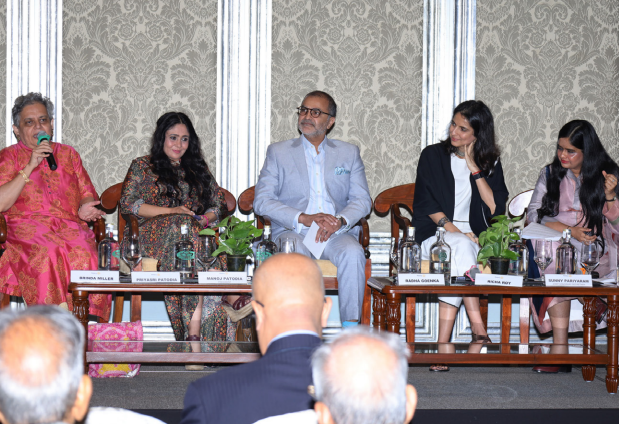
What about art? Article continues on Page 2 Ms. Radha Goenka, Director of the RPG Foundation and founder of the Heritage Project; Ms. Brinda Miller, artistry and honorary chairperson of the Kala Ghoda Association; Mr. Asad Lallji, SVP, Essar Group, and CEO of Avid Learning, and also the curator of the Royal Opera House, Mumbai; and Rtn. Priyasri Patodia, founder of Priyasri Art Gallery, Mumbai, and Q@Priyasri, The Artist Studio, Baroda
Moderated by Ms. Richa Roy, lawyer and partner, Cyril Amarchand Mangaldas, and cultural ambassador with Asia Society. Richa: Thank you so much to the Rotary Club for hosting us. It’s such an iconic club, and it’s all about community and charity. Just in the 10 minutes we’ve been here, to see the enthusiasm with which you celebrate each other’s birthdays and the work that you’re doing in communities across the city is really inspiring. And, of course, thought leadership through events like this. So, really grateful that you’re hosting us. We have a stellar panel, the title for the panel is “What about Art?”
Rabindranath Tagore, who wrote our National Anthem, said, in response to the question, “What is art?” that art is the response of man’s creative soul to the call of the real. If you ask an economist or someone in finance, they’ll say that creative industries including art and culture contribute to 3.6% of global GDP. That is significant. In India alone, it’s valued at USD 36 bn. And it’s going to propel India’s growth over the next few decades. So, staying with the real world, we live in a time of poly-crisis or what people even call perma-crisis; there are two wars going on. There’s a climate crisis, there’s technology that is threatening to upend the world.
So, what do we talk about art, given this sense of poly-crisis? Thomas Jefferson, the President of the United States, said that the reason you need art in wartime is because history cannot exist without the discipline of imagination. And I would add that even the future cannot exist without art because art is the essential equipment to the task of being human. And, we have a stellar panel to unpeel all of these layers.
We have an art creator, an art curator, a patron, and a philanthropist. So, this is going to be really exciting. We have Brinda Miller, who is one of India’s most celebrated artists. She’s received several awards; her works adorn not just walls of galleries, but also public spaces including the Mumbai airport and traffic chowkis and we have her to thank for the iconic and beloved Kala Ghoda Arts Festival. Thank you so much, Brinda, for being here. Radha Goenka is the chairperson of the RPG Foundation and, in that capacity, has led important projects in social justice with innovation and creativity. She also led heritage revival projects at Worli Koliwada and Banganga. She’s an insightful writer and I urge you to read her articles in The Indian Express; they’re very deep and thoughtful. Asad Lallji, first of all, I’d like to say it’s very rare that men are in the minority on a panel so thank you for being the token man here, Asad. Asad went from being a “Madman” to being a man of the arts. No, I’m joking. He has had a career in advertising on Madison Avenue, so therefore the reference to the show Madman. And he’s now the curator of the iconic Royal Opera House and the CEO of Avid Learning. He oversees some of the most original and exciting programming in the city. He’s also one of the forerunners of the use of technology in the arts. We are excited to speak to you about that.
Priyasri Patodia is the chair of the Urban Heritage Committee of the Rotary Club of Bombay and in this capacity has undertaken critically important projects on public art. She’s the founder of the Priyasri Art Gallery and has represented contemporary and modern masters. She runs a studio in Baroda which nurtures future masters of the arts. And she brings her sense of sensitivity and compassion into the business of the arts. She’s a dear friend, so I’m going to run out of adjectives about her. But it’s a brilliant panel and I really hope that by the end, we will take away some insightful nuggets.
Brinda, I have to start with you because how can I not? Your art is absolutely mesmerising and occupies not just white cube spaces like galleries but also police chowkis, bridges, airports, etc. You’ve brought art to the streets in a very real way not just through your own painting but also the Kala Ghoda Festival. So, how do you bring out these different dimensions of art and, how does art shape urban dimensions and communities?
Brinda: I have always been a fine artist, but that has been my profession. I went to JJ School of Arts and it was a given that I would pursue a career in it which I did. My parents were extremely encouraging, but the part of the public art programme that I do with the Kala Ghoda Arts Festival and kind-of encourage murals across the city and all of that, I think it is in my genes. My father loved Mumbai; he always told me how green Mumbai should be and he used to plant trees around the city. I think a lot of that has come to me. He also used to manage a lot of events around Mumbai because he was a sheriff of Mumbai at that time. So somewhere along the way, and I think I must have been much older then, I said now I must do something. That’s how I started volunteering for the Kala Ghoda Art festival and Asad always laughs because every time I say that I’m still a volunteer at the festival, as is he. When I started off as a volunteer, a lot of people came, a lot of people left and I just took it on and it just became a big passion for me.
I paint for about six months of the year, organise the Kala Ghoda Arts festival six months of the year which is also about restoring lovely shops and lovely restaurants in the area. A lot of awareness was created when the festival took off and its next edition is going to be its 25th. It’s been a long, long time and looking back, I think it really does require somebody creative to run this festival. So that’s how I kind-of joined the festival and I’m still there till as long as it takes. I urge all of you to do something like this because the city of Mumbai needs it.
Richa: I didn’t realise it had been 25 years for the festival; as we were discussing before we came on stage, it’s fascinating how your efforts have helped revive a neighbourhood. It’s probably the only street art city festival of its kind, but in terms of its programming, it’s probably at par with a music festival and a literature festival and an art festival. Brinda: It’s all of those festivals rolled into one; it’s not just a literature festival, it’s just not. Music is very important, visual arts are very important. All of that is very important because it kind of invites everyone. It’s not just the elite and it’s not just the middle-class person or it’s not just… I mean, everyone rubs shoulders with everyone and each and every person really enjoys it. There’s a lot of good energy and yes, it’s probably the only festival of its kind in India. And though I sound like I’m showing off, it’s just happened like that; it’s not that we planned it that way. We started very, very small, and every year, we thought next year, we won’t have the money. How will we do it? There’s no funding. But somehow, it has a life of its own, and it’s really done well.
Richa: Tell us a little bit about your public art projects, including your work as the curator of the Navi Mumbai Airport, which is going to have the benefit of your artistic sensibility. Brinda: So that has just happened, it’s my latest project. I’m doing the curation for the Navi Mumbai International Airport. I think one thing has led to another. It’s too early to say anything about it, but I think it’s going to be one of my biggest projects to date. Richa: You’re constantly giving the city such gifts, the Kala Ghoda Arts Festival, some of your public art, and then now this. Thank you ever so much for that.
Radha, I’m going to come to you next. As I said, Radha writes regularly for the Indian Express. Just a few weeks ago, you wrote a piece about Viksit Bharat, and you provoked us to reimagine what development means, to think beyond metrics like GDP and economic indices of development. Where do you think art and culture fit in to your vision of development and Viksit Bharat?
Radha: Thanks, Richa. In this article that came out in The Indian Express, I talk about how we are racing ahead towards development, skyscrapers coming up all over the city. And there is this picture of a developed world. We think of New York, London, these cities, and we think that’s developed. But really, we need to first think about what development means to us. It may not necessarily be skyscrapers and more buildings. Really, what is the purpose of development? It is a happy society. There are some countries like Bhutan which don’t measure their progress on GDP, but on GNH, which is Gross National Happiness. And if our end goal is to create a happy, thriving society, maybe that does not lie in big buildings.
I did go a little bit deep into urban planning as an example there and talked about how there’s a lot of wisdom within India when it is our vastu. Or it is how we had courtyards in olden homes that created microclimates which were cooling in summer and heating in winter. And so, there was science behind that. Now we’ve forgotten all of that. As time has gone by, we have looked at the west for development. But there were many models of success in development, in history, and maybe we need to first re-evaluate what development means and also look at it in the context of India.
Similarly, art has a purpose and it’s not just art for beauty. If we look at art with that lens, I think art historically also had a lot of purpose. In Akbar’s court, for example, Tansen was a musical scholar. He came from a Hindu background. In fact, a majority of his songs were on Hindu gods and goddesses. But Akbar invited him to his court and made him a prominent feature. So, religion didn’t matter, art was a unifying medium that transcended caste, religion, or even a very humble background. So, art has a unifying role that can be achieved. In our work with RPG Foundation, we seed new projects in spaces that we feel are in high need in society. We start off by creating projects ourselves, so, we implement; we become an implementing organisation.
As we see a project become successful, we make it an independent NGO. We have seeded projects in English education, and many others in the environment space. But today, I’m going talk about the heritage project. As regards restoration, people invest in taking buildings or structures back to their original form, which are infrastructure heavy and therefore cost heavy. We feel that those are not scalable because how many projects will you actually restore and you need a lot of capital. So, we focus on preservation, which means we try and build out the stories of a place. We think that if the locals and tourists actually understand what the stories of the place are, they are more likely to preserve it. We also try to build economic models where the locals benefit.
So, for example, in Worli Koliwada, the locals have become tour guides. We’ve trained them to take you around and tell you the history of the place. The Koli people have delicious food, so we have created a food trail. You can go on and eat in a Koliwada home. And, you get to taste their authentic Koli food and they make an earning. We have come up with models that are linked to tourism, where they benefit from tourism and so they’re likely to encourage it, and preserve the place. With Banganga and the Worli Koliwada, we have supported art with purpose. So, in Koliwada, for example, there are a lot of biases against transgender.
We have commissioned a project with the Aravani Art Project, which is a group of transgender women who are the artists. They spent many days painting these walls and they also involved the locals in the process. A lot of the locals changed their perspective on how they think about the transgendered. In Banganga, we commissioned Shilo Shiv Suleman, an artist who has a Hindu mother and a Muslim father. We wanted to push the boundary there with Banganga being a Hindu religious site. And here, you have a mixed identity woman painting the Ramayana. So, we think of art as something that can unify, that can get people to question their biases. So, we try to use art with a purpose.
Richa: That’s so beautiful. Hearing the Banganga story gave me goosebumps. The work you’re doing is helping rebuild our national identity and melding the economy with a kind of unity in diversity; the cultural aspect is really so valuable. So, thank you so much. Having that kind of thoughtful leadership in a philanthropic organisation makes such a difference. On that note, you also had a lovely line in your remarks about how you build out the stories which is so profound and such a valuable model. You’d also written an article a few weeks ago about the use of storytelling in leadership. Storytelling is also a form of art. So why don’t you tell us a bit about how you think art can make better leaders?
Radha: Yes, I wrote that the two things you need to become a leader – one is skill, of course, but the second is storytelling. And how storytelling is probably more important because there are so many who have skill but the ones who outshine – whether it is our current leader and you know how well he can package something and tell us about it – or globally, if you compare a Barack Obama to Biden today. Obama had the gift of being able to communicate whatever it was, and probably Obama government would have also supported Israel. They are the biggest funders to the US government, but he probably would have got more traction from the US population, because he would know how to sell whatever he was doing. So, yeah, storytelling is possibly even more important, and that is what we focus on with our heritage sites. We have put out some of our collateral for Banganga and Worli Koliwada if you want to take a look at it. We’ve come up with artistic maps that tell you the stories of these places. I grew up two minutes from Banganga but I have learned more through the process of building these stories out. There are so many beautiful stories in Banganga. If you all have not done a heritage walk, please do that. It’s amazing how little we know of our own city, or about Koliwada. The fact that there are Hindus, Muslims, and Christians in a two-square kilometre radius, happily living together through all the riots of Bombay… they identify as Kolis, not as Hindu, Muslim or Christian. It’s a very femaleforward society in Koliwada. All their gods and goddesses are female, including within the Islamic Dargah, of two female saints.
So, it is about bringing these stories out, and we really focus on that on our side. I was just telling Brinda before this that she was an inspiration to us. When I look at the Kala Ghoda festival, it’s the festival that came before the actual horse, you know, it was the revival activity, the storytelling. People started going to Kala Ghoda, and then the government was forced to build that black horse. So, the power of storytelling is amazing, and we’re really trying that with our side, talking about Koliwada, the fort, the stories and we believe that that will start a system where eventually restoration, be it through government or private funding, is the next step.
Richa: Thank you so much for bringing out those poignant stories. So, we’ve talked a little bit about sort of philosophy of the art, we’re now going to get to sort of brass tacks. Priyasri, tell us about art as an asset class, as an investment and so if anyone wants to build an art collection, how should they think about it, how should they build it and what are the risks that they should mitigate and what should their identity be; should they be a patron, should they be an investor?
Priyasri: Before I start, I want to announce that art is not good for investment. It is asset building and it survives because of patrons like her and Asad, who works with an organisation for promotion of the arts. Going back to my life, it was all about growing up in Baroda in a place which has the MS university, and my parents are patrons and that’s how I got addicted to viewing art. The most important thing for me was how do I get this outside?
I ran a studio facility in Baroda and being a Shekhawati Marwadi, I believe in earning money, and I realised that students working at my studio were not able to make sales. And that’s when I thought of this lucrative market called Mumbai and came here to sell art. But in my heart, I believe that art should actually be bought as an asset. In India, of course, we have a lot of art heritage legacy left by our ancestors. Moderns like M.F. Husain, Akbar Padamsee or pre-Moderns like Amrita Sher-Gil or Raja Ravi Varma or even the Bengal school, they are valuable assets that one can actually procure and it can go from generations to generations. When you buy a stock, obviously there are returns, but I don’t know how many companies actually survive for 100 years. But art holds its position. So, if you’re talking about asset management, it holds its position.
Let’s look at New York because I am very excited to see how many people in New York actually buy art vis-a-vis Indians. So, if a person in New York has a house costing, let’s say, one million, he will 100% have art worth at least two million in his apartment. So, they really put their money where it matters and it’s also because of their upbringing and education which they actually start understanding, valuing. They have the museumgoing culture which is actually lacking in India. I asked somebody to do a little research on S&P’s 500 index and they told me that the growth of New York and US – because that’s the largest market – vis-a-vis other stocks 70% growth was seen in the art market and 30% only in the other stocks. So, I’m not trying to sell art, I’m only trying to speak about what I have understood. Our neighbour, China, has 200% more people buying art than we do. I guess the buck starts with me and I’m glad for patrons like Radha, Brinda, Asad and institutions like the Rotary Club of Bombay that have also been supporting the CSMVS, the Asiatic Library and so many other heritage spaces. I personally believe that primary education should include art. It’s a very, very important thing because it not only sensitises them but it also allows them to really think freely. I got an opportunity to teach at four municipal schools thanks to Mr. Ramesh Narayan who’s in the audience right now and I took these art and creative thinking classes at four municipal schools and the first thing I actually do when I spend time with them is I ask them to write stories of what they would dream to become or what they would want the world to become. In the beginning they were really apprehensive and they would come up with paintings that had one sun, a stream and then a house. But I tell them that if the Wright brothers did not have this mad idea of looking at a bird fly and thinking of flying, today we wouldn’t be actually flying. To sum this up, I would say that don’t look at art as an investment. Look at it as an asset. Look at it as a legacy that you’re going to be leaving. And look at it as archives for the next generation.
Richa: Thank you. That’s beautifully put. I appreciated the distinction between an investment and an asset and a legacy. That’s the kind of personal context in a community context. Why don’t you tell us a little more? I know you briefly touched upon the work Rotary is doing with the CSMVS, with the Asiatic Library and with schools as well, like your work in Baroda nurturing sort of future masters. How do we replicate it across the country so that we have many, many future masters that we’re germinating and growing.
Priyasri: To ask questions is very important. It’s very important to push your boundaries, to question why this why that. That only happens when the arts are given the space that also Radha has touched upon. Coming back to your question about the Rotary Club, I have to say that I am so fortunate to be a part of this organisation who has given opportunities to people like myself and several others who are passionate about art patronage. So, we’ve got a couple of things going on. First up, there’s Bhavishya Yaan, where we’re all about teaching art and creative writing. I’m personally involved in the creative writing part.
Then, there’s the Asiatic Library project. The Rotary Club’s been putting in work to restore these old books, which are real treasures. We’ve got a campaign where you can adopt a book for digitisation, keeping its legacy alive forever. And then, there’s the maps. Generous donors have been helping us restore them, and we’ve even had a couple of exhibitions. The other thing the Rotary Club works with and with which I am involved is also with the Chhatrapati Shivaji Maharaj Vastu Sangrahalaya. A couple of years back, when I was chairing the Environment Committee, the CSMVS which has no dearth of well-wishers invited RCB to install environment-friendly lighting. And thanks to Brinda Miller, my friend who was the catalyst, we were able to install environmentfriendly lighting for the museum which is a grade one heritage space. Today, it shines like a jewel in the crown of the Mumbai skyscape thanks to the donor and the Rotary Club of Bombay.
The other thing the Rotary Club has been involved with is an adoption of various galleries at the CSMVS, one of them being the Indian textile and costume gallery. They have re-adopted it recently for the second time and, as you know, India was known for cotton. It was the cotton king. So, it is also our duty to make sure that we let the world know what we are because the textile and costume gallery actually exhibits the absolutely contemporised silhouettes which is so shocking. Like today when we look at the garments, they are no less than what you and I are wearing. So, thanks to the Rotary Club for getting involved in heritage spaces.
Lastly, talking about growing up in Baroda, the small town has actually given me the opportunity to get more involved with the arts because the culture, the education, the exposure… it’s all about the Gaikwad family who support music, the visual arts, and the performing arts. That’s why I keep harping on this, that I hope that our government also introduces arts, and not because we don’t have to justify that it’s good for our mental health or how it will affect us economically, but it is something which has deeply benefited me. Absolutely. Thank you so much. I especially love the story about the children who initially struggled to draw anything and then eventually their imagination…
Priyasri: Yes. when I told them about the Wright Brothers, they were like, why can’t the boat be in the sky? And I’m like, yes, of course you can do it. And then somebody was, why does the sky have to be blue? I’m like, no, it doesn’t have to be blue. So, you know, it pushes boundaries. And these museums, they are un-intimidating spaces, right? So, it’s very important for community building. And when you go to a museum, you realise where you really stand in history and what innovation are you doing, or how you are pushing your boundaries.
Richa: Absolutely. Art is important to the discipline of imagination. And I think that’s the kind of work that Rotary and your work has enabled. Asad, I’m going to come to you now. Thank you again for being the token man on the panel.
Asad: Always happy to be here. Richa: You’re the curator of the Royal Opera House. It’s an architectural marvel, but you also have some of the most exciting programming in the city. You come at art from so many different angles, Hindustani and Western classical music, jazz, stand-up comedy, dance, everything. So, why don’t you tell us a little bit about how a space like the Royal Opera House and the cultural and art programming there helps democratise access and helps build a cultural imagination and muscle.
Asad: Thank you for that question, and having me here. The first thing I’d like to confess is that I don’t come from an arts background. I used to work in New York in advertising. I was a “Madman,” and I moved back to India supposedly for a short bit, and I fell into the arts and culture. I was always a consumer, never a producer, so I was always on the other side of it. Now, when the Opera House opened, it’s a very beautiful, elitist structure. How do you bring built heritage to life? I was very clear that it can’t be one of these red carpet, big chandeliers, which they have. You have to bring people in, and one size doesn’t fit all.
For the opening night, we had already agreed to do the MAMI film festival. Now, I said, that’s a disaster waiting to happen. You take an old movie theatre and you do MAMI, and people are going to think it’s a movie theatre again. So, I fought, and the next day I did my own opening, which I said, for me that’s the official opening, where I had a small evening of opera. I mean, it’s an opera house, you have to have opera, although it’s not a very popular genre in India, and rightfully so; we have a very rich cultural legacy that covers so many genres. And what I did was I invited the stakeholders, all the producers, I think Brinda was there, I see some other people in the audience were also there. This was to make people believe that this is for them to produce, to create, to use, and Bombay was very excited to have this age-old opera house that had been closed for 25 years, and everyone came to stake their claim over it, and by programming differently, and we know that the arts suffers from funding, right? It’s a given, but making it accessible through innovative programming, through funding, various ways, a theatre group can’t afford what a corporate can afford, or a music show, and in India you’ll soon realise that ticket sales don’t cover your costs. You’d go to the West End, you’d go to Broadway and you’d pay those costs, maybe somehow in the Bandra complexes people do pay, but people won’t pay those kinds of prices in our side of town.
That said, I love doing things that defy categorisation, and we love giving the kids, and not so established people also a chance, so it’s for the established and unknown. But the Opera House is a private institute, a private venue, privately owned, privately funded. So, it gives me the flexibility to do what I want but it also challenges me to make it financially viable.
That’s a really tough job. Thank you for being at the helm of that. You made a really important point about making the space democratic which everyone can access and you’ve done that so successfully. I’d also love to hear a little bit about how your work at the Opera House as well as at Avid Learning can, more broadly through arts and culture, help with some of the intractable problems we’re dealing with today. I was talking about perma crises and poly crises, how we deal with issues like climate change, technology, through the arts and culture?
Asad: Just the first part of your question, to make it more inclusive and accessible, at every event we keep about 30 to 40 seats for kids from differently abled backgrounds and we bring them in and we feed them from Tiwari Brothers across the road. We work with certain NGOs on a regular basis. The idea of having these kids come in and watch and especially the international productions or even the Indian ones, we get these sweet little notes back from them which is quite enduring.
For example, we had Baluji Srivastav, a visually impaired musician who is an OBE. I invited all the visually impaired people – I like to use the word visually impaired, not blind. Visually impaired school kids came and I made sure they sat in the first five rows and all the well-heeled were sent walking up. Talking about climate change and sustainability, I launched an online series called Sustainably NOW during lockdown, which emerged out of a conversation with Mr. Sabyasachi Mukherjee. I had asked him, what are the areas in which we could collaborate. And he said, sustainability. I said, sure, I’ll come up with the series. And I did, but a lockdown happened. So, we did it online. In fact, we did wonderful talks on the Green Museum, looking at the CSMVS, and we’ve done about 40 to 50 programmes in that space. I am a firm believer in arts for social change, so you can use it as a catalyst, as a medium, not just for adults, but also for kids. Kids are sponges. I mean, they’re the ones who react more. In fact, you know, you spoke about the Koli community. We were lucky to be part of COP28 in Japan and in Dubai last year, and we took a whole Koli production to Dubai. The other artist you mentioned, Shilu, was also there, doing a climate change intervention. So we’ve done a lot of work in that space. I also conceptualised a children’s book on coral conservation, which is a whim that we had launched with the CSMVS. So, I really believe that the arts have that effect that can help move the needle forward.
Richa: Absolutely. That’s really so valuable because helps us think differently and laterally about intractable problems and expands our critical faculties. It’s through imaginative programmes like yours that we’re able to do that. On that note, I think we’ve gone well over time and we could have gone on for much longer given this absolutely stellar panel. But I think we’ve unpeeled many, many layers about art. So, my deepest and warmest thanks to this absolutely stellar panel for your remarks today, but also for all the work that you’re doing in art and culture, which is expanding our economy but more importantly is deepening our cultural identity and strengthening our muscles. So, thank you ever so much.
ROTARIANS ASK
There was a lot that was being said about NFT art and now the generative AI. So could you throw some more insights into that area please? Asad: I’m no expert but I’m just as intrigued as you. Two and a half years ago I was obsessed by NFTs and I did everything from looking at it as one of the disruptors and enablers in the arts. We did NFT making workshops for a lot of the artists. And it was ironic that we had all these senior artists come and attend our talks because they wanted to learn. NFT is not just in art, it’s in music, it’s in literature, it’s in sports memorabilia, it’s across the board. And obviously the crypto winter came, went, whatever. But now obviously the next thing, not the next thing, but the thing everyone talks about is AI. And I think that’s a significant game changer.
The last two years we’ve been working a lot in programming, trying to understand the impact. And we’ve looked at it across genres from literature to where we’ve done film, we’re going to be doing music soon. But also, I shouldn’t be sitting with lawyers on the thing, but also the legal aspects of NFTs. And we have a full day workshop planned in July on AI and law. And AI is going nowhere. So, I mean, we better make friends with it, learn how to use it, see how it’s going to benefit us. As these experts will say, when photography came out, the purists said, oh, this is not art. Then they took it on, when computers came on, everyone was in a hullabaloo about it. But these are things here to stay. I just met a lady the other day, she’s come up with this app to edit books. And it’s so freaking cool. I mean, it’s not going take away the human intelligence, but it’s really gonna take away the editorial, the mundane. So people are not going lose jobs. People have to upskill and find new ways of working. So that’s my take on art and technology.