
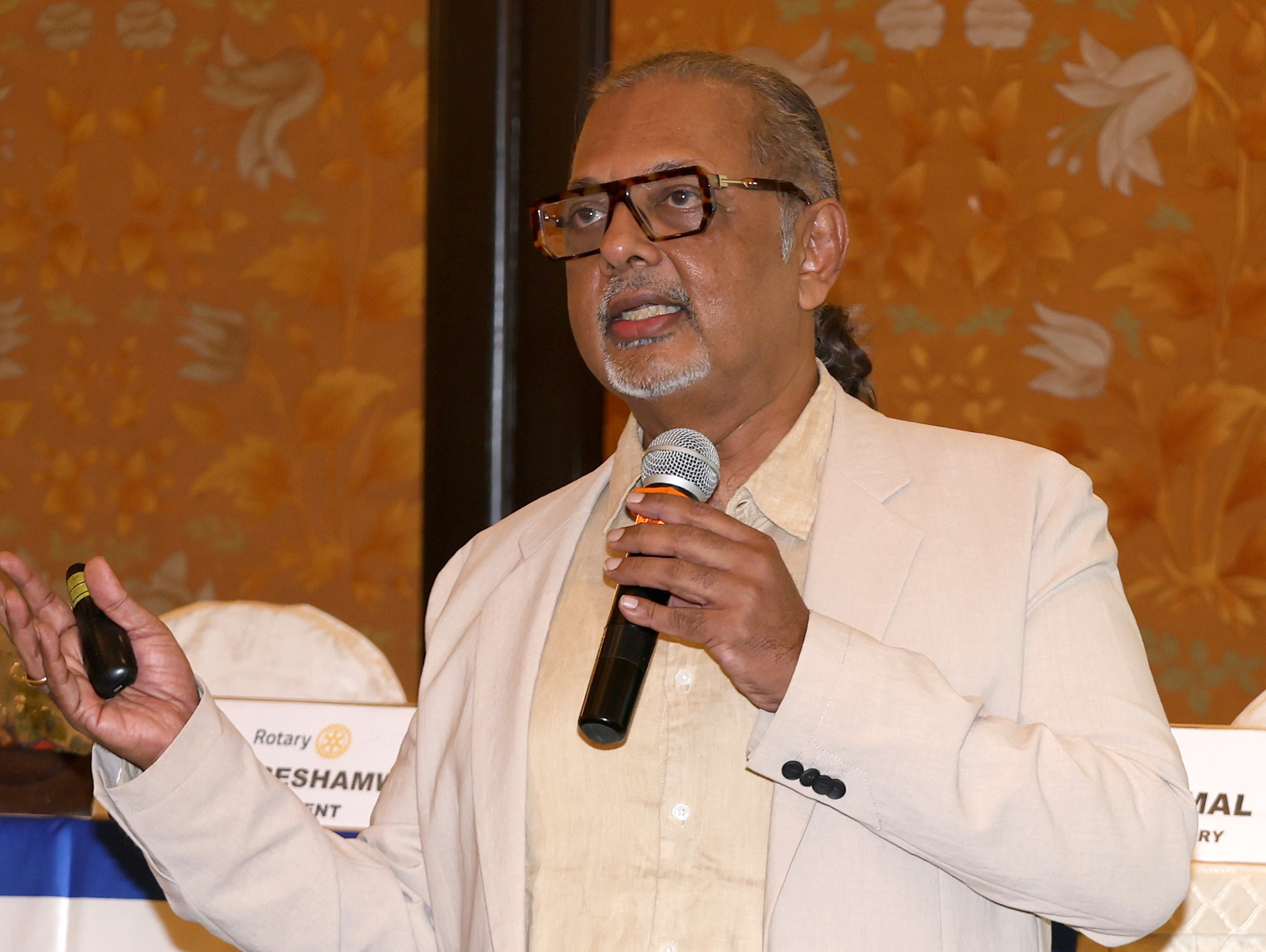
Mr. Abraham Thomas, CEO of Radio City, on ‘In the Age of Algorithms, Are We Still Listening?’
Good afternoon, everyone. I’m extremely honoured and privileged to be part of this august luncheon meeting. In our industry, which is media and entertainment, when Ramesh Narayan summons, you just land up. You don’t ask questions. So, I’m here to share a few insights that I have picked up over my many years across print, television, radio, digital, and the kind of media scenario that we currently all are living in.
So, in this age of algorithms, are we still listening? Typically, whether it’s in your residential building or your office building, you walk into an elevator, you see someone you know, you say, ‘How are you doing?’ You don’t wait for a response. Even if they do respond, it is invariably a lie. They say, ‘Oh, I’m doing great.’ So, people have actually stopped listening. And this is in an age when we are communicating the most, right? We are liking, we are forwarding, we are posting, we are consuming content by the hour. I think, on average, it would be about six hours a day that everyone is spending on social media and connecting. But is anyone really listening?
So, ‘How are you?’ has actually become a greeting today. Nobody expects an answer, nobody expects the truth anyway. And this is a time when we are probably in the most connected period in history because we are almost all the time online. We WhatsApp, we Instagram, we Zoom, we email, we comment. But I often wonder, is anyone actually listening?
When you make a post, you’re checking every ten minutes how many people have liked it, how many people have commented on it, because the keyword is now engagement. Reach is no longer enough.
I happen to run a business which is based on the old model, where one person speaks and other people listen. All of us probably remember an argument at home in the earlier days: ‘What do we watch?’ Those days, there was literally very little to watch, right? Today, we’ve solved that problem because now everyone’s got a screen of their own, right? You’re sitting in the same room, all four people consuming different content. But you will go through hours of Netflix and Amazon Prime and still not watch anything because you can’t really decide what to watch.
So, I always thought radio was in the business of music, right? And then you realise, maybe not. It’s in the business of companionship. Radio is one medium which continues to listen and act.
So, we went from too little content to too much content. This hyper-fragmentation and content for everyone has completely changed everything, including our social fabric, right? So, if you’re a Virat Kohli fan and you stop and watch videos promoting Virat Kohli, you’ll get sent hundreds of videos. And if you hate Virat Kohli, you’ll get sent hundreds of ‘hate Virat Kohli’ videos.
So, I think one of the causes for this has also been the function of marketing, from where I have come in. In marketing, we’ve always been taught that you identify the needs of the consumer and you overserve them. So, if you are right-wing, I’ll give you so much right-wing content that that’s your only worldview. And so it goes for the other two.
So, the over-fragmentation and this algorithm, which keeps feeding you more and more stuff that you consume, whether you wanted to consume it or not, you keep getting fed more. So, from that single home, single TV, and 20 years ago, when we used to say, ‘India is always a single-television home because we all meet at dinner and then everybody sits and watches TV.’ Now everybody has dinner in their own rooms with their own screens.
So, what has become scarce is not the content, which was the case earlier. What has become scarce is attention. Tech companies are doing everything they can to get your attention. They’re just about buying your attention, and people know more about an influencer that they’ve never met than what’s happening within their own family and friends.
Another advantage of radio, after companionship, is that radio makes a decision, right? Four friends get into a car, everybody has their own personal playlist. Spotify is the best for that. Spotify is the best jukebox in the world, because you decide, you create a playlist and they’ll keep playing that.
Now, four friends get into a car, then the radio decides what to play, and there’s shared discovery. So, I mean, I come from a school of thought where I want to be entertained. I don’t want to be the entertainer. While there are millions and millions of creators that come in, I want somebody to create great content that I like and serve it for me.
But algorithms have somehow ensured that it’s all about wherever you pause and spend more time, we’ll kind of serve you more of that. So, in a car, suddenly you discover music that you haven’t heard for a long time.
Research shows that people consume, for example, it’s raining outside. Right now, Spotify doesn’t really react to the fact that it’s raining outside. The algorithm will say, ‘72% of people who listen to music in the rain love Kishore Kumar’, or some such thing. But the point is, the radio jockey in the studio knows it’s raining, knows what you’re going through in your city, and therefore creates music for you.
So, artificial intelligence is the big thing, right? All of us have interacted with artificial intelligence even today. So now AI will know which song you like because you’ve listened to it or you listened to similar songs in the past. But it will not tell you what song you need. For that, you need a human to say that today, this is the song that goes with the mood. So, AI definitely needs more of human intelligence. AI knows I like a song, but radio knows it’s currently raining in Mumbai.
I always worry for all these start-ups and all these reports that keep coming out that they were asking Claude or ChatGPT or whatever to do research and create a concise report and all of that. If you realise, AI never disagrees with you. If you say, ‘Is there a business idea that I can create in something like this?’ they’ll give you reams and reams of research which says, ‘Yes, it’s a brilliant idea, go for it.’ And God help us if you actually depend on that data and put your money in it, right?
At best, repetitive, large, voluminous data can get curated and given to you on a platter. But that’s your starting point. You can’t just say, ‘Make me a project report for XYZ.’ And it takes less than a minute typically to create that, right? So, AI never disagrees with you, so you have to be very careful when you are using AI for any decision to make.
You can’t talk back to an algorithm, and this is one of the biggest challenges that we are getting. People have worried, will AI replace jobs? Repetitive, voluminous jobs? Of course, it can do it much faster, and that’s what we should be using it for.
Another interesting example is that the content didn’t change, the context changed. Most of us had no idea who this gentleman was, Ravi Kishan. He’s a big Bhojpuri superstar, moved into Hindi, moved into television, and now you’re realising, can you just flip it? “Money follows, my brother. Money follows.” He’s just been rediscovered. He’s a huge sensation amongst Gen Z on Instagram because of some old video of his which resurfaced.
So, the content never changed. The context needs to change. And this is a cue for all of us in conventional media. All the large music labels are recreating old songs. Universal recently did something called Revibe. They’ve taken their old classics and got them sung by current-day artists, and the Gen Zs are loving it because the melody and the harmony have stood the test of time, and here it is presented to them in their manner.
So, a lot of content is timeless. It probably just needs to get represented and recreated in today’s grammar.
So, now is the age of influencers, right? And there are influencers of all sorts, from small to large, from micro to nano, with different engagement rates. So, you can actually go by the kind of engagement that you actually want.
The radio jockeys were the original influencers. Still, it has the highest trust and credibility amongst all media, right? People believe what the radio jockey is going through because that person is live right now. So, when he or she is speaking to you on a Tuesday afternoon, it’s Tuesday afternoon and it’s not some old content.
Most of these radio jockeys are now, earlier the joke used to be, ‘You got a face for radio’, but today radio jockeys are the influencers as well, and all of them have large digital followings. Even the ex-radio jockeys still maintain their prefix, so it’s still RJ Naved, or it’s still RJ Ronak, or whatever, although they’ve left radio a few years ago, because it adds a certain credibility to their thing.
So, there are numerous examples of how a radio jockey has made an impact. I remember earlier there was one caller who would call every morning show and request the same song. So, after some time, we got to him and spoke to him, and he told us that he’s from a different country. This song reminds him of home. So, every morning when he’s commuting, he’ll call up and say, ‘Can you play this song for me?’ So, that’s how radio kind of works for him.
So, this is another thing that radio actually listens, and radio also shows up. There are numerous examples of CSR activities that radio stations have done. We did a plastic collection drive in Bangalore where the RJs actually encouraged people to donate plastic. We had it picked up, and the road outside the international airport had been created with the plastic collected from Bangalore City.
This is another one which we did during COVID, when there was a shortage of plasma. So, between donors and people who were requiring the plasma, radio acted as that conduit to kind of say that you can speak to this number and get help.
During the floods, we were up all night telling people who were stuck somewhere that, ‘You know what, so-and-so is stuck on this level,’ and communicating that accordingly. So, radio always shows up. The algorithm can only tell you what is trending.
In media, we are very good at writing obituaries. So, we said theatre is dead, right? And it’s killed by cinema. This was done in 1910, right? Cinema is dead, killed by television. Television is dead, killed by OTT. Newspapers are dead, killed by social media. Radio is dead, killed by the apps.
The fact is, all these media are alive. They’ve all evolved. Their business model has changed. Their content creation and their content philosophy have changed. That’s because content consumption habits have changed. But all of them coexist.
Radio, for example, has a point. People listen to live radio in the mornings, right? The consumption of radio is very high from 7 am till almost 6 or 7 in the evening. And people have formed a relationship with the radio jockey.
So, I remember in the first decade of radio, people would say, ‘Oh, great music, but some irritating talk happening. Why don’t you tell them to shut up?’
By the second decade, when it became a habit, people were saying, ‘It’s a companion. I’m travelling.’ It’s quite often where you’re sitting in the car for the song to get over or sitting in the car for that link to get over before you get off.
So, that’s how endearing radio jockeys can be.
Yes, radio is alive. That’s all I have.
ROTARIANS ASK
Q1. I used to listen to radio a lot. But what gets irritating is the amount of ads that come into the radio. It’s like more ads and less content. Isn’t that killing radio?
In fact, to meet our costs, we need advertising, right? And it’s a necessary evil. But I think this feedback comes more from people who don’t listen to radio. People who listen to radio respond to the ads because, at Radio City, we have about 15,000 advertisers in a year. And they keep coming back again and again and again. Seventy-five per cent of them are repeat advertisers. So, they’re obviously getting a response. People are listening to the ads and responding, which is why that industry is continuing to grow.
So, yes, there needs to be regulation for advertising, but I recently read somewhere that on television, they’ve also removed the cap on advertising to compete with digital. Which is a really suicidal move because digital inventories are unlimited because it’s serving different content to different individuals. But that’s the sign of our times in terms of just the economics of making the revenues meet.
Q2. Abraham, one thing that we always remember was commentary on the radio, cricket commentaries. There was no other medium that was available for many, many years other than the commentary because you’d get up at 5:00 in the morning to listen to Australia, you’d get up later to listen to some other part of the world. So, are you still getting that traction?
Unfortunately, by the policy of the government, we are prohibited from carrying news, current affairs and live commentary. So, we can’t go there. What we do is our radio jockeys watch it on TV and then give an update because we say, ‘Now it’s not live. It is somebody who’s watched it and now you’re giving an update.’ But otherwise, we’re not allowed to do live commentary. These are one of the many pending requests before the government.
Q3. Thank you for that talk. I like the points that you make on the nostalgic dimension of things and the human dimension of things. And you also talk about this, ‘Are we still listening?’ There’s a corollary to that also. Is content worth listening to still being generated? Because what’s happened with a lot of social media and this five-second Twitter consciousness is the contraction of attention spans in so many people. It is perpetuating the generation of content that is actually subpar to what was generated in the past. So, there are two sides to it. There’s a loss in terms of that as well. So, if you could talk a little bit to the degeneration of the content that we are consuming as well, that would be helpful.
Very valid observation. Yes, there is. Attention spans have shrunk. Radio adapts it to two-minute, three-minute songs and two-minute talks and talk in between that. But the point is that because of this over-fragmentation, I decide if you’re a Rohit Sharma fan based on what you’ve consumed, and I will share more of that with you, right, vis-à-vis what digital allows you to do. But on conventional broadcast media, I can’t do that. So, I’m deciding for you. That’s the difference.
Which is why, yes, a lot of the content and the way we create content on radio has changed. In the old days, we used to read the newspapers, figure out stuff, then go find out more and get a link done. But today, the influencers have already covered it in the morning. So, from yesterday’s news, we moved to what’s happening currently.
So, a lot of those things have definitely happened, but I think over-fragmentation of audiences is one of the reasons why everyone’s trying to super serve you with content which you like.
Q4. First of all, you’re bang on in terms of attention span. But I’m a regular radio listener whenever I’m in the car, and I completely agree with you. The magic of surprise, you don’t know what the next song is going to be. I think that’s a big plus for me.
But as a regular listener, one couple of feedbacks I would like to give is, why do people call it a radio channel or radio? It’s a radio station. They use the term ‘channel number one’, that’s more in a lighter way.
Secondly, in terms of segmentation, what we clearly, or at least I clearly see, because I listen to pretty much all radio stations, is that 102.8, the kind of songs, the kind of detail they give, is a lot more content-oriented as compared to all you guys. What’s your kind of, is it a conscious thing or what’s your feedback on that?
Yeah, so this is very true, but this is again driven by economics. If I were to differentiate too far away, then I become a niche, right? So, I can go language, I can do Marathi, I can do Punjabi and so on and so forth. Or if I differentiate into the genre of content itself and I say, ‘Okay, now I will do news’, which incidentally is not allowed for us.
But if you are playing in the mass market, then there is only Bollywood music, which is 60 to 70 per cent of the music consumption. And because we are prohibited from carrying news and current affairs, you are forced to restrict yourself within select genres of content.
Now, what happens is, the differentiator, therefore, so if you ask around, you think everyone plays the same kind of music, which is by and large true, right? But people differentiate on the basis of the emotional bonding, emotional branding that you can give.
So, ‘Rag Rag Mein Daude City’ is Radio City, ‘Mirchi Sunne Wale Always Khush’ is Mirchi. So, that’s how the differentiation is being built on an emotional level because at the rational level, if I go too different, I become a niche and then I’m not playing in the mass advertising market.
Q5. So, as you mentioned, you’re not allowed to carry current affairs and news. So, I mean, two-part question is that, news channels have breaking news, newspapers have scoops. If you come across something that nobody’s come across, you can’t broadcast it. It means you have to let it go.
Absolutely. Although the biggest show on radio is Mann Ki Baat’, so we actually use that to communicate. But other than that, we’re not allowed to. And in fact, the government has been reluctant in letting us carry news.
Now, they say you can take news from All India Radio. But we’re telling them we need news which is local. I need to know what’s happening in South Bombay or in the suburbs to that extent. You can’t go and say, ‘Today at 11 o’clock something happened at the national level.’ So, it’s for all practical purposes not allowed.
Q6. So, my second part of the question is that if there is a big explosion in the city or there’s a raging fire…
Now, this is the argument that we have made with the ministry and with TRAI, and said at least for disaster management you should allow radio receivers on mobile phones.
Now, another point is that when there’s a flash flood or there’s a bomb blast or whatever, the authorities first come to radio. And they announce the whole thing on radio. So, radio is the preferred medium to announce disasters.
We’ve said, as disaster management, at least mandate that every mobile phone has a radio receiver. They do, but it’s been blocked because all the networks and the hardware people are building their own content play. So, they don’t want free content from radio to play on it.
Q7A. Hello. One thing that really puts me off on radio is the quality of the sound. I don’t know whether it’s 96K or 128K, and I think most of the channels or stations don’t even have stereo. Is that a financial limitation, a channel limitation or a medium limitation? Why is it this way?
No, because depending on the city that you are in, like in Mumbai, you are allowed 10 kilowatts of transmission power. So, everybody does it at that. It’s possible that with the explosion of high-rises and flyovers and all that, when you’re going in certain areas, the signal drops. But otherwise, it’s pretty standard across all radio networks.
The explosion in construction has, to some extent, happened. Then there are solutions to that, which is to use a booster and all of that, again, which is restricted by the ministry.
Q7B. No, my question was on the quality of the sound. So, Spotify has 640 kbps lossless quality. When you hear Spotify against a radio channel, there’s a huge difference, even with a good signal. So, is that a medium limitation?
Yes, that is. But I’ll tell you, for example, we run 39 stations. We have 12 stations which run out of studios. All the other stations, the radio jockey is going live from home. He kind of records his link, sends it by VPN to the server, and it gets inserted into it.
Now, if you actually listen to it in a car audio, then you will find that 30, 35 minutes of the hour is music, which is digital quality. Another 10, 15 minutes is advertising, which is digital quality. It’s only these eight to ten minutes an hour which is talk. And it’s very difficult to tell one from the other.
Yes, if you’re listening to it on a Sennheiser and saying that I want studio-quality sound, you may not be able to get it on radio.
Q8. I just wanted to ask you about what kind of career opportunities you have for youngsters. Are they looking at radio channels as a career for themselves? And do you do a general recruitment drive?
In fact, the hottest career seems to be influencers. And a lot of our, like I said, there’s a merger of radio talent becoming influencers.
Most of our clients are not buying radio alone. They’re doing radio plus some on-ground plus some digital. So, therefore, that is the plane which radio stations are trying to play. Therefore, compete in a larger bucket of advertising than just pure radio.
Otherwise, brands are seeking solutions. So, we’re looking at content-solution people who can come up with a solution for a brand challenge.
Q9.A. Why has the government made this decision to ban current affairs on the radio? And is it constitutional? I mean, it seems like a monopolistic trade practice.
There is, I mean, it’s a licence agreement that we sign where religion, politics, news and current affairs, and live sports are not allowed.
Q9.B. That seems completely, that cripples radio, doesn’t it?
It does. We’ve been pleading with the ministry to let us use, allow us news and current affairs because that’ll open up a new bunch of listeners and a new bunch of advertisers as well.
But they’ve been, first they said no. Then, after five years, they said, ‘Okay, now you can take All India Radio news.’ And first they said you have to use the same feed. That didn’t work because, obviously, the energy and the sound is different.
Then now they’ve said you can take from there and recreate yourself. But still doesn’t work because we need stuff that is local.
Q10. Are you fighting it?
Yes, we go, and they keep quoting ‘Mann Ki Baat’ as their best example.